

The Yen Holds Its Breath: Markets Await Signals from Tokyo and Washington

Introduction: The Calm Before the Storm
Tuesday’s trading session in Asian currency markets was marked by a wait-and-see attitude. The Japanese yen held its ground, but traders remained on alert over the possibility of intervention by Tokyo. Policymakers’ comments regarding the allocation of state pension fund assets kept the market on edge, preventing the yen from either strengthening or weakening significantly.
The dollar also remained largely unchanged ahead of key US inflation data scheduled for release later on Tuesday. Investors are awaiting June Consumer Price Index figures and comments from Federal Reserve Governor Christopher Waller. These events are expected to determine the future path of US interest rates.
Meanwhile, tensions in the Middle East continue to escalate. President Trump stated that the United States would restore the naval blockade of Iran and ensure that the Strait of Hormuz remains open under the protection of the US armed forces. Oil prices surged, bringing inflation risks back into focus.
In this article, we will examine all the factors affecting the yen and other Asian currencies, assess the outlook for the dollar, and attempt to determine where the market may be heading in the coming days.
The Yen: Expectations of Intervention and the Repatriation of Pension Assets
The Finance Minister Clarifies Her Position
The yen remained in the spotlight after Finance Minister Satsuki Katayama elaborated on comments she had made the previous week. She said that the portfolio of the Government Pension Investment Fund could be reviewed if necessary, as Japan pursues policies aimed at increasing the attractiveness of yen-denominated assets.
These are not merely words. Japan’s Government Pension Investment Fund is the world’s largest pension fund, managing more than $1.5 trillion in assets. Any change in its investment strategy could have an enormous impact on currency markets.
Katayama also proposed allowing Japanese government bonds to be held through the country’s tax-advantaged NISA investment program. This signals a broader effort to redirect household savings back into domestic markets.
The Pain Threshold Is Approaching
Bank of America analysts noted that investor sentiment toward the yen remains at its most bearish level since 2022. CFTC data show that leveraged funds are holding their largest net short positions in the yen since 2007.
These figures are both impressive and alarming. Seventeen years is an entire era in financial markets. The fact that speculators continue to increase their bets against the yen, even after warnings from Japanese authorities, indicates a high level of confidence that the current trend will continue.
However, Bank of America analysts believe that Katayama’s latest comments suggest policymakers may be approaching a “pain threshold” for both the yen and Japanese government bonds. This increases the likelihood of further measures to support domestic markets.
What a GPIF Portfolio Review Could Mean
A review of the Government Pension Investment Fund’s portfolio could have far-reaching consequences. If the GPIF begins increasing its allocation to domestic assets, it would create additional demand for the yen and Japanese bonds.
Tony Sycamore of IG previously estimated that even a moderate rebalancing could generate approximately ¥12 trillion in yen purchases, while a more aggressive shift could result in purchases of up to ¥30 trillion. These are amounts capable of reversing the trend in the currency market.
For now, however, this remains only a potential possibility. No decision to review the portfolio has yet been made, and the process could take months. Nevertheless, markets have already begun pricing in this possibility, providing the yen with some support.
The Dollar Awaits Inflation Data
CPI and Waller’s Speech
The dollar remains resilient as investors await June consumer price data and comments from Federal Reserve Governor Christopher Waller. These events are expected to provide new guidance on the outlook for US interest rates.
Headline inflation is expected to decline on a monthly basis, while the core index is projected to remain at approximately 2.8–2.9% year over year. This leaves open the possibility of further monetary policy tightening.
Christopher Waller is known as a hawkish member of the Federal Reserve, and his statements could have a significant impact on the markets. If he confirms his willingness to support further interest-rate increases, the dollar could receive an additional boost.
The Dollar Index Holds Steady
The US Dollar Index is trading at approximately 101.2, demonstrating resilience despite the uncertainty. Markets are largely staying on the sidelines ahead of the release of US inflation data.
If the figures come in above expectations, the dollar could strengthen and put pressure on the yen and other Asian currencies. If the figures are lower than expected, the dollar may weaken temporarily, but it is unlikely to lose substantial ground given the existing geopolitical risks.
The Middle East Factor: Oil and Inflation
Trump Pledges to Keep the Strait Open
President Trump stated that the United States would restore the naval blockade of Iran and ensure that the Strait of Hormuz remains open under US protection. The announcement pushed oil prices higher and intensified concerns about a renewed increase in inflationary pressure.
The Strait of Hormuz is a vital route for the transportation of energy resources. Any disruption to shipping through the strait causes oil prices to surge, accelerating inflation around the world.
For the dollar, this represents an additional source of support. Rising energy prices increase inflation expectations, encouraging the Federal Reserve to maintain a restrictive monetary policy, which strengthens the US currency.
The Impact on Asian Currencies
For Asian countries that are major oil importers, rising energy prices create serious challenges. They weaken trade balances, increase inflationary pressure, and put downward pressure on national currencies.
The yen, as the currency of a country heavily dependent on energy imports, is particularly sensitive to this factor. However, the potential repatriation of pension assets could partially offset this pressure.
Regional Currencies: Diverging Movements
The South Korean Won Recovers
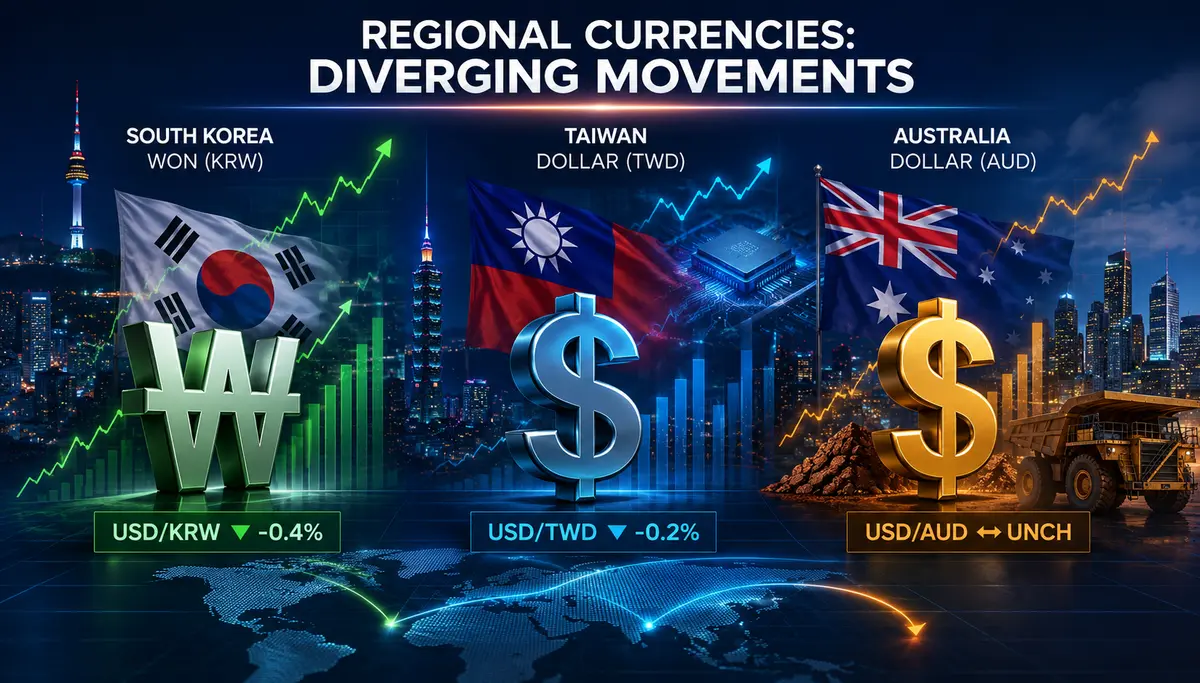
The USD/KRW pair declined by approximately 0.4% to around 1,492, continuing its recovery following Monday’s sharp sell-off in Korean assets. This is a positive signal suggesting that panic in the Korean market is gradually subsiding.
Nevertheless, risks remain. South Korea’s technology sector is highly dependent on global demand, and any negative signals from the United States or China could trigger another round of capital outflows.
The Taiwan Dollar Stabilizes
USD/TWD declined by 0.2% as Taiwan’s currency stabilized following the recent withdrawal of foreign capital from AI-related technology stocks. This suggests that markets are gradually adapting to the new environment.
Taiwan remains a key center of semiconductor production, and any changes in global demand for chips are reflected in its currency. As long as demand remains strong, the Taiwan dollar is likely to remain supported.
The Australian Dollar: Optimism in the Data
USD/AUD was little changed despite positive economic data. The Westpac Consumer Sentiment Index rose by 4.1% in July, while the latest NAB survey showed an improvement in business confidence. These are positive signals for the Australian economy.
However, consumer sentiment remained significantly below the neutral level of 100, emphasizing that households are still cautious despite signs of stabilization in business conditions.
For the Australian dollar, the key factor remains the price of iron ore, the country’s primary export commodity. As long as prices remain stable, the Australian currency is likely to remain resilient.
Market Psychology: Waiting as a Strategy
Why the Markets Have Paused
Markets have paused ahead of key events: the release of US inflation data and comments from Christopher Waller. Investors are reluctant to open large positions until they receive clear signals about the future path of interest rates.
This has created a low-volatility environment that could erupt at any moment. If the data contain any surprises, markets could move sharply in one direction, forcing traders to adjust their positions.
The Role of the Japanese Authorities
Japanese authorities, particularly Finance Minister Katayama, continue to exert psychological pressure on the market. Comments about a possible review of the GPIF portfolio and the possibility of investing in Japanese government bonds through NISA are creating expectations of support for the yen.
This may discourage traders from taking excessively aggressive positions against the yen, but it has not yet changed the fundamental trend. The NAND memory market remains volatile, while demand for memory used in AI applications continues to grow.
What Comes Next: Possible Scenarios
An Optimistic Scenario for the Yen
If US inflation data come in below expectations and Waller’s comments signal a willingness to ease monetary policy, the dollar could weaken, providing support for the yen.
An actual decision to review the GPIF portfolio could provide an additional catalyst. If the Japanese authorities announce concrete measures to increase the allocation to domestic assets, the yen could receive a powerful boost.
The Realistic Scenario
The more likely scenario is that the current situation will continue. US inflation may remain at a level that does not require immediate action from the Federal Reserve but also does not allow policymakers to discuss monetary easing. Japanese authorities may continue making statements in support of the yen without taking concrete action.
Under this scenario, the yen may remain within a range of 160–165 against the dollar, with possible short-term fluctuations in response to news.
The Pessimistic Scenario
The worst-case scenario for the yen would be higher-than-expected US inflation combined with hawkish comments from Waller. In this case, the dollar would strengthen, while the yen could break through the 163 level and continue to decline.
Intervention by the Japanese authorities would become more likely under these circumstances, but experience shows that its effect would probably be short-lived. Japan could spend billions of dollars supporting the yen, but without a change in fundamental factors, such measures might only delay, rather than prevent, further depreciation.
Conclusion: A Moment of Choice for the Yen and the Dollar
Tuesday became a day when the yen held its breath while awaiting key signals. US inflation data, comments from Christopher Waller, and further statements from the Japanese authorities will determine the market’s direction over the coming days.
The yen is maintaining its position thanks to speculation about the possible repatriation of pension assets, but fundamental pressure on the currency remains high. The interest-rate differential between Japan and the United States, high oil prices, and geopolitical uncertainty continue to weigh on the Japanese currency.
Regional currencies are moving in different directions, reflecting the specific factors affecting each country. The South Korean won and the Taiwan dollar are recovering from recent losses, while the Australian dollar is receiving support from positive consumer sentiment data.
Investors remain cautious, preferring to wait for clear signals before placing large bets. This creates the conditions for potentially sharp market movements once the accumulated tension is released.
In this environment, the key issue for the yen is whether the Japanese authorities can turn their words into concrete action. If the government and the Bank of Japan introduce genuine measures to support domestic assets, the yen could finally receive the long-awaited impetus for appreciation.
The dollar, meanwhile, continues to benefit from the energy shock and the Federal Reserve’s restrictive monetary policy. As long as these factors remain in place, demand for the US currency is likely to remain strong.
The coming days will be decisive for the currency markets. Investors are waiting for signals, and once they appear, the resulting movement could be sharp and powerful. Market participants must be prepared for any possible scenario.

Comments
No comments yet. Be the first to share your thoughts!
Authentication Required
You must be logged in to post a comment.