

End of an Era: Mastercard Returns Vocalink to British Banks
Introduction: A Strategic Asset Too Costly for American Ownership
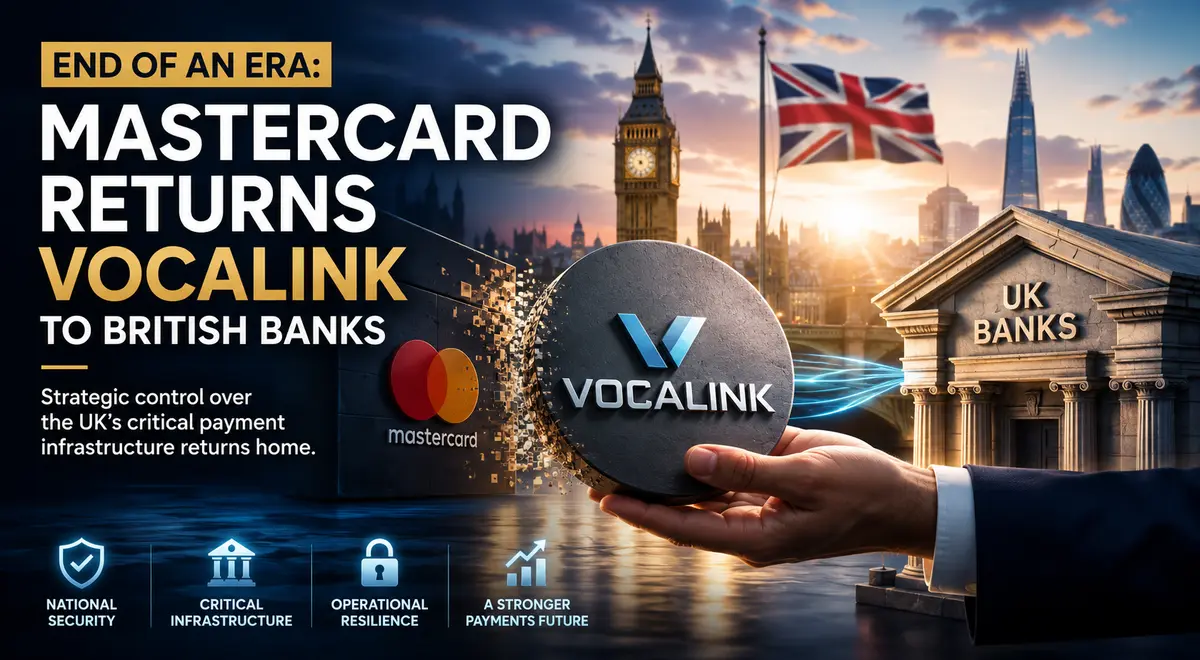
The story unfolding around payment operator Vocalink could easily serve as the plot of a political thriller. American giant Mastercard, which acquired the British company in 2016 for £701 million, is now considering selling a controlling stake back to British banks. The reason is growing concern over foreign ownership of a strategic national asset.
This is more than a simple business decision. It is an acknowledgment that some assets are too sensitive to remain in the hands of a foreign company, even when that company is as reputable as Mastercard. Vocalink is not merely a payment operator. It is the infrastructure supporting the entire UK retail payments system.
The Financial Times, citing people familiar with the matter, reports that negotiations are still at an early stage. No formal proposals have been submitted yet, but one potential buyer has already been identified. It is DeliveryCo, an organization established with the support of the banking industry to manage procurement for the UK’s new payments platform. If completed, the deal is expected to value a 51% stake at approximately £400 million.
Vocalink: More Than Just a Payment System
The Figures Speak for Themselves
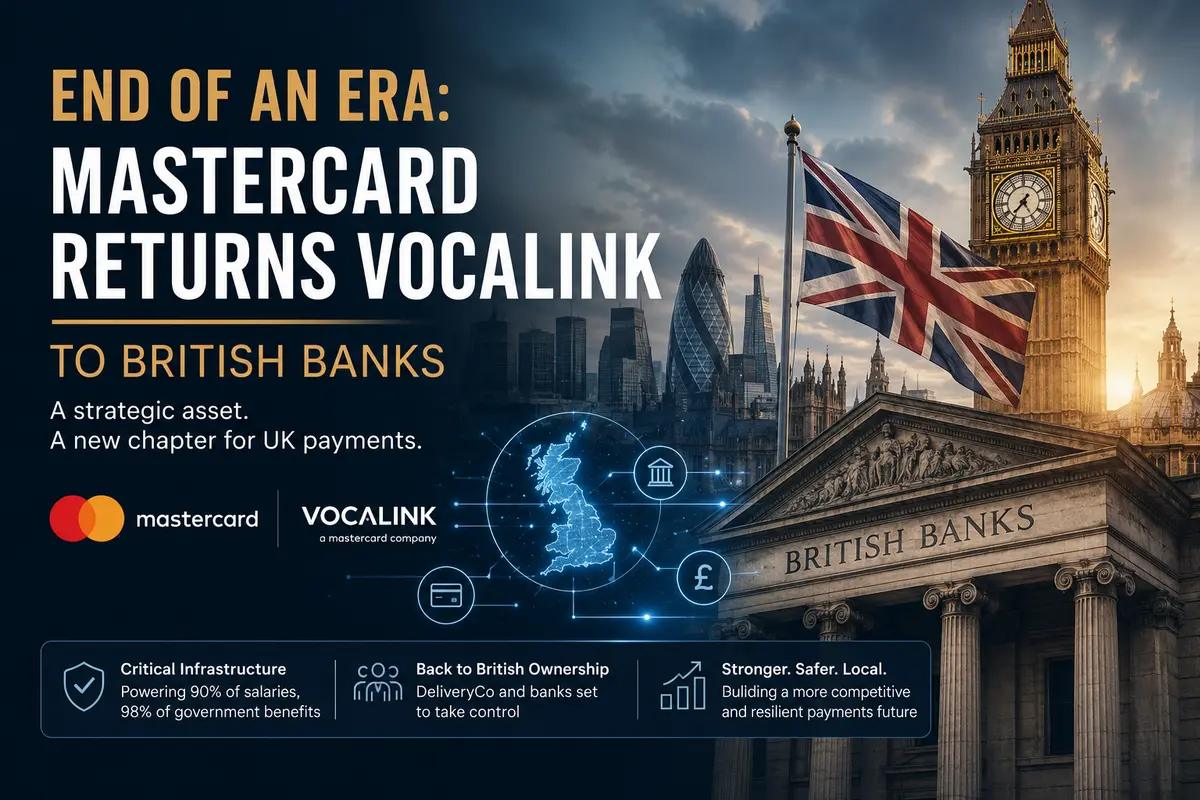
To understand why Vocalink is causing such concern among British authorities, it is enough to look at the figures. The company processes more than 90% of salaries, over 70% of utility bills, and 98% of government benefit payments in the United Kingdom. It is not merely a payment operator; it is the circulatory system of the entire British economy.
When infrastructure of such critical importance is controlled by an American company, it creates potential risks. This is not because Mastercard is unreliable or acts in bad faith. Rather, in a world of geopolitical confrontation and economic warfare, control over such assets becomes a matter of national security.
Imagine a situation in which the US government, through sanctions or other political measures, could influence the operations of a UK payment operator. It may sound like a film scenario, but in the modern world, it is a very real threat.
The £11.9 Million Fine: A Warning Signal
Last year, the Bank of England fined Vocalink £11.9 million for shortcomings in risk management and corporate governance. This became another warning sign that intensified the regulator’s concerns.
The regulator is increasingly requiring operators of critical infrastructure to ensure “operational resilience” — the ability to withstand disruptions, cyberattacks, and other emergencies. Requirements are becoming stricter, while responsibility is increasing.
When an operator is under foreign control, additional questions arise. How will cooperation with British authorities be organized during a crisis? Who will make decisions about priorities if a conflict of interest emerges? These questions have no simple answers.
From Acquisition to Sale: The Evolution of the Relationship
2016: The Deal of the Decade
In 2016, Mastercard acquired Vocalink from a consortium of 18 British banks for £701 million. At the time, it appeared to be a logical move: a global payments giant gained control over mature and reliable infrastructure, while the British banks earned a substantial return from selling the asset.
Additional performance-based payments made the deal even more attractive. Mastercard invested in Vocalink’s development, attempted to integrate it into its global network, and sought to expand its geographical reach.
However, time has shown that not every asset can be easily incorporated into a global corporate structure, particularly when it involves national payments infrastructure that is critically important to a country’s economy.
2026: Rethinking the Strategy
Ten years later, Mastercard is reconsidering its strategy regarding Vocalink. The sale of a 51% stake for £400 million is not merely a financial transaction. It is an acknowledgment that the era of American ownership of this asset is coming to an end.
Interestingly, the proposed sale price is significantly lower than the original purchase price. This reflects not so much a decline in the asset’s value as a change in how it is perceived. Vocalink has become more than a commercial asset. It is now politically sensitive infrastructure whose ownership may create more problems than benefits.
The Role of DeliveryCo: The Collective Intelligence of the Banking Industry
What Is DeliveryCo?
DeliveryCo is an organization established with the support of the banking industry to manage procurement for the United Kingdom’s next-generation retail payments platform. Put simply, it is the organization responsible for overseeing the creation and implementation of the country’s new payment system.
Many leading British banks and payment companies are involved in DeliveryCo. It is now being considered as a potential buyer of a 51% stake in Vocalink. This is a logical choice: who is better positioned to manage payments infrastructure than the institutions that use it every day?
Why DeliveryCo?
The choice of DeliveryCo as a potential buyer is not accidental. First, it would return control over critical infrastructure to British financial institutions. Second, it would simplify the integration of Vocalink into the new payments platform.
Banks that own Vocalink would gain more direct control over the infrastructure on which they depend. This could improve system reliability, strengthen risk management, and accelerate the introduction of innovations.
However, this approach also has a downside. Banks would bear more direct responsibility for financing modernization and implementing the stronger controls increasingly required by regulators. This could raise the cost of operating the infrastructure and, consequently, increase the cost of services for end users.
The Regulatory Context: The Battle for Competition
The Bank of England’s Concerns
The Bank of England has long expressed concern about insufficient competition in the retail payments sector. Mastercard and Visa control a large share of the market, and the regulator wants to create conditions that will allow new participants to emerge.
The sale of Vocalink to British banks could be a step in this direction. When the infrastructure is controlled by domestic institutions, the regulator may find it easier to influence the development of the payments market and encourage competition.
The Government’s Ambitions
According to the Financial Times, the UK government is also seeking to increase competition in retail payments. This is consistent with the broader objective of strengthening the competitiveness of the British financial industry following the country’s departure from the European Union.
Returning control over Vocalink to British banks is viewed as part of this process. It is intended to demonstrate that the United Kingdom is capable of managing its critical infrastructure without relying on foreign companies.
What This Means for End Users
Reliability Versus Innovation
For ordinary British consumers who use Vocalink’s payment systems to receive salaries, pay bills, and collect government benefits, the main question is not who owns the company, but how reliably it operates.
As Vocalink’s owners, banks would have a direct interest in maintaining system reliability because disruptions would damage both their reputation and their finances. This could improve the quality of services, but it might also increase their cost.
As Vocalink’s owners, banks would be required to continuously modernize the infrastructure, introduce new technologies, and strengthen security. This would create additional pressure on their budgets, which they would most likely pass on to customers.
Competition and Choice
Banks that own Vocalink could also gain a competitive advantage by using the infrastructure to develop new services. However, this could create risks for independent payment providers that are not members of the consortium.
The regulator will have to find a balance between efficient infrastructure management and preserving competition in the payments market. If Vocalink ends up in the hands of several major banks, it could create barriers to entry for new participants.
The Investment Perspective: What Mastercard Stands to Lose
Financial Consequences
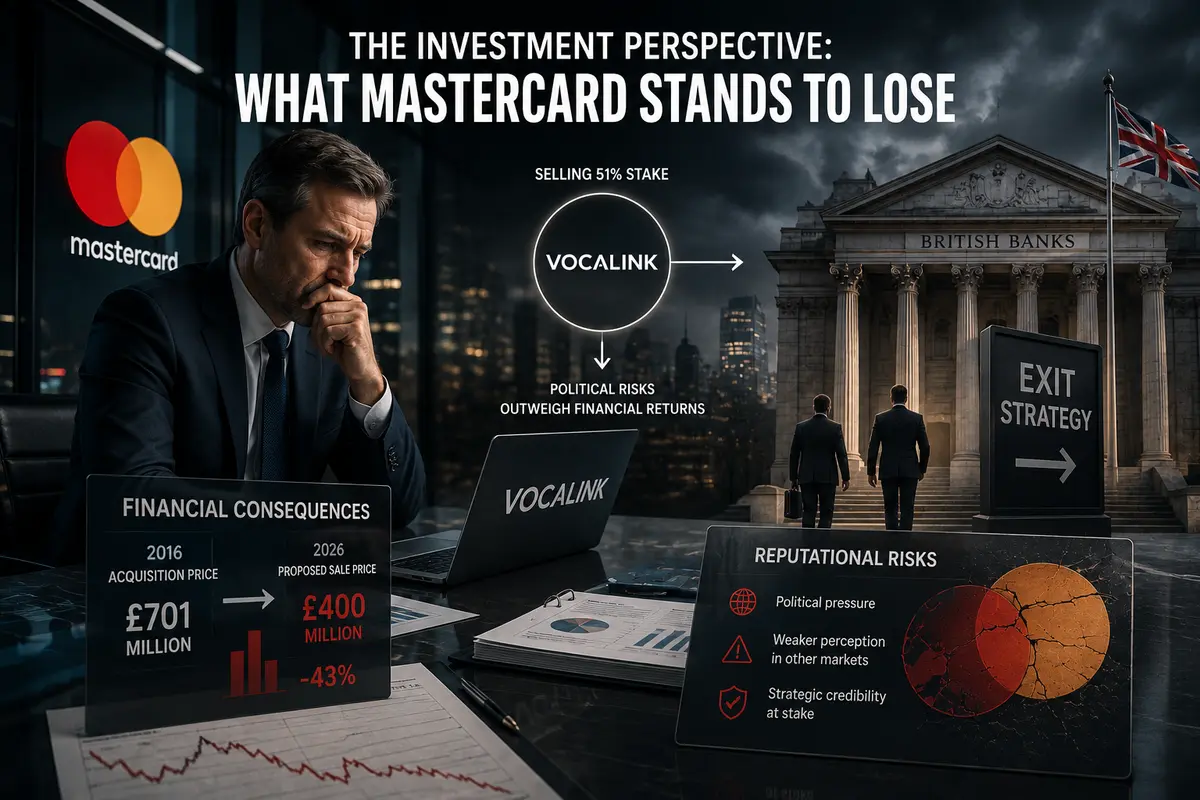
For Mastercard, selling a 51% stake in Vocalink for £400 million would represent a significant loss compared with the original acquisition price of £701 million. However, the company evidently believes that the political risks associated with owning the asset outweigh the financial losses.
The decision to sell may also form part of Mastercard’s broader strategy to withdraw from infrastructure assets and focus on more profitable business areas, such as transaction processing and value-added services.
Reputational Risks
In addition to the financial loss, the sale of Vocalink could have reputational consequences for Mastercard. A company forced to sell a strategic asset because of political pressure may appear weaker in other markets.
However, Mastercard is likely aware of this risk and may believe that voluntarily exiting the asset is preferable to waiting until regulatory or political measures make continued ownership impossible.
Prospects for the Deal: When and How It Could Happen
Time Frame
The Financial Times notes that any agreement is unlikely to be completed before next year. This suggests that negotiations will be lengthy and that the transfer of control will take place gradually.
Such a time frame is understandable. The sale of critical infrastructure requires thorough due diligence, regulatory approval, and careful planning of its integration into the new payments platform.
Potential Obstacles
The deal could face several obstacles, including antitrust reviews and objections from independent payment providers. If British banks gain control of Vocalink, the transaction could be perceived as the creation of a cartel.
The price of the deal may also become a point of dispute. Mastercard will probably seek to obtain the highest possible value for the asset, while the banks will attempt to minimize their costs.
Alternative Scenarios
If the Deal Does Not Happen
If negotiations reach an impasse, Mastercard could retain control of Vocalink but face greater regulatory oversight from the Bank of England. This could make the business less attractive to the American company.
Another possible scenario would be the sale of a stake smaller than 51%. This would allow Mastercard to retain some influence while reducing political pressure.
If the Deal Is Completed
If the deal with DeliveryCo proceeds, it could establish a precedent for other countries, which might also demand the return of control over critical infrastructure from foreign owners. This could reshape the global payments market.
After gaining control of Vocalink, British banks could begin actively modernizing the infrastructure and launching new services. This could position the United Kingdom as one of the leading countries in innovative payment solutions.
Conclusion: A New Era for British Payments
The proposed sale of Vocalink is more than a corporate transaction. It reflects deeper changes in the global economy, where sovereignty and control over critical infrastructure are becoming increasingly important.
Mastercard acquired Vocalink in 2016, when the geopolitical environment was more stable and globalization appeared irreversible. Ten years later, the world has changed. Although relations between the United States and the United Kingdom remain friendly, they have become more complex. Regulators have become more demanding, while national security concerns have grown more urgent.
The sale of a 51% stake to British banks through DeliveryCo could be the right solution for all parties. Mastercard would dispose of a politically sensitive asset. British banks would gain control over critical infrastructure. Regulators would gain greater influence over the payments market.
One question remains: how would this affect ordinary British consumers who use payment systems powered by Vocalink every day? If the deal is completed, they are unlikely to notice any difference in the short term. In the long term, however, they may benefit from more innovative and reliable payment services.
For now, all parties remain at an early stage of negotiations. No formal offers have been made, and any transaction is unlikely to take place before next year. Nevertheless, the very fact that such discussions are taking place suggests that the era of carefree globalization in payments infrastructure is drawing to a close. It is being replaced by an era in which national interests and sovereignty are considered no less important than economic efficiency.

Comments
No comments yet. Be the first to share your thoughts!
Authentication Required
You must be logged in to post a comment.