

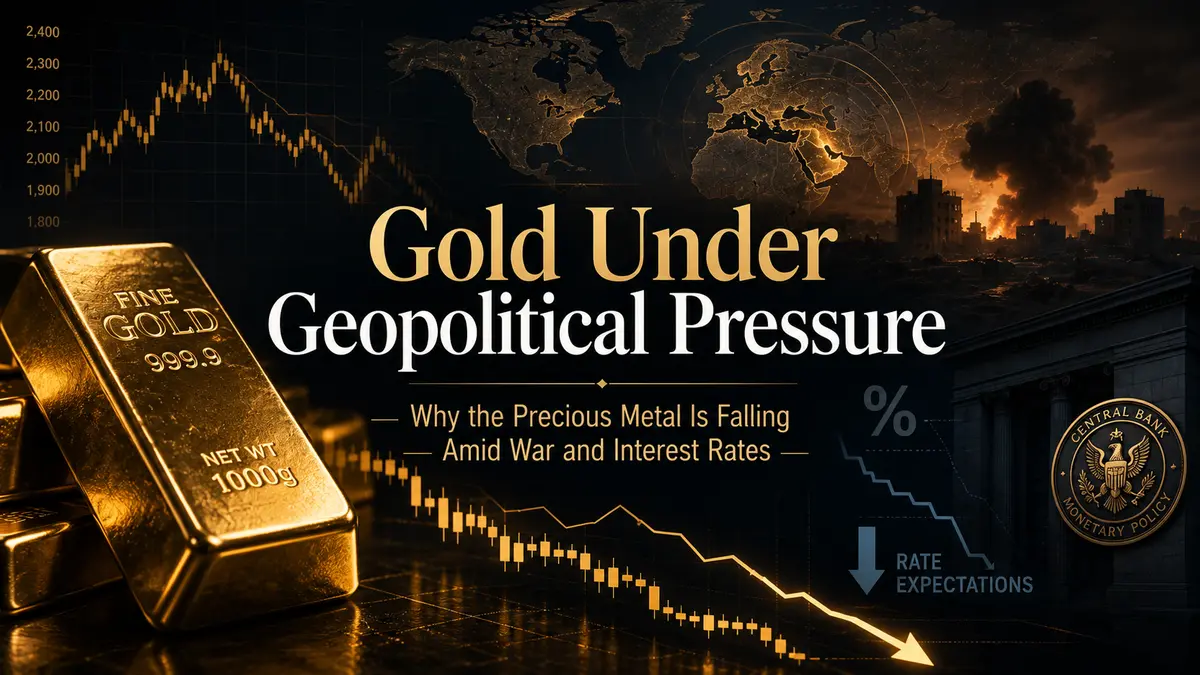
Gold Under Geopolitical Pressure: Why the Precious Metal Is Falling Amid War and Interest Rates
Introduction: The Safe-Haven Asset Paradox
In the world of finance, there are axioms that seem unshakable. One of them says that during periods of geopolitical instability, investors flee to gold. It is the ultimate refuge, a safe harbor where money waits out the storm. But the current week has shattered this neat narrative. Prices for the yellow metal barely changed on Friday, yet over the course of five trading sessions they are down by roughly one and a half percent. And this is despite the fact that the conflict between the United States and Iran has entered a new phase, while oil prices have surged to levels that only recently seemed almost unimaginable.
So what is happening? Why has gold, the traditional beneficiary of crises, suddenly come under pressure precisely when its protective qualities should have been fully on display? The answer, as is often the case, lies in a complex combination of factors, where geopolitics collides with monetary policy and short-term fears give way to long-term calculations. Let’s break it down.
The Iran Factor: War as an Inflation Catalyst
Escalation of the Conflict and the Market Reaction
This week began with what many analysts called a “worst-case scenario.” U.S. President Donald Trump announced the end of the ceasefire with Iran and ordered an intensification of strikes against the country. Tehran responded in kind, and the Middle East once again found itself on the brink of full-scale war.
For financial markets, this became a moment of truth. Oil prices reacted immediately with a sharp jump. And this is logical: the Middle East remains a key supplier of energy resources, and any military action in the region directly threatens the stability of supply.
But why did gold not follow oil higher? After all, classic logic suggests: war → uncertainty → rising demand for safe-haven assets → higher gold prices. In reality, however, things turned out to be more complicated.
Inflation Expectations as the Metal’s Main Enemy
The point is that the jump in oil prices triggered not so much fears about global peace as concerns of a completely different nature. Markets became afraid of inflation. Not abstract inflation, but very specific inflation driven by rising energy costs.
And this is where a mechanism that works against gold comes into play. When investors begin factoring accelerating inflation into their models, they also start thinking about how central banks will respond. And the Federal Reserve, as we know, fights inflation by raising interest rates.
Higher interest rates, in turn, are gold’s main enemy. Why? Because gold is an asset that does not generate income. It does not pay coupons like bonds, and it does not provide dividends like stocks. Its value is determined solely by market expectations and its role as a store of value.
When interest rates rise, the opportunity cost of holding gold increases. It becomes more attractive for investors to keep money in debt instruments that provide guaranteed income than in a metal that simply sits in storage and waits for its moment.
FedWatch Data: Markets Prepare for Tightening
And these expectations are not unfounded. According to CME FedWatch data, this week markets have been increasingly pricing in a Federal Reserve rate hike this year. The federal funds futures market now shows a non-zero probability that the regulator will move toward tightening policy.
This is a major shift compared with the situation a month ago, when most investors were confident that the rate peak had passed and that only easing lay ahead. The Iran factor has overturned these expectations, and gold has found itself between the hammer of geopolitics and the anvil of monetary policy.
The Diplomatic Background: Between War and Peace
Attempts to Preserve the Memorandum
There is one nuance in this grim picture that prevents markets from fully sliding into panic. According to Axios, regional mediators continue to make active attempts to preserve the recent memorandum of understanding between the United States and Iran.
This memorandum, achieved with great difficulty after long months of negotiations, is now hanging by a thread. But the very fact that mediators have not stopped their efforts gives markets hope for a diplomatic solution. A weak hope, perhaps, but still hope that full-scale war can be avoided.
It is precisely this hope that limits the rise in oil prices and, as a result, inflation expectations. If markets were certain that escalation was inevitable, gold could receive a short-term upward impulse. But while the prospects for peace remain extremely uncertain, investors are taking a wait-and-see position.
The Dual Impact on Gold
The situation with Iran has a dual impact on gold. On the one hand, the conflict itself increases demand for safe-haven assets. On the other hand, the resulting rise in oil prices and inflation expectations push the Fed toward tightening, which weighs on the metal.
As a result, these two opposing factors almost balance each other out. Gold is showing neither a sharp decline nor explosive growth, remaining within a narrow range. But by the end of the week, the balance tipped downward: the negative factor of interest rates outweighed the positive impact of geopolitics.
Dollar Stabilization: Temporary Relief for the Metal or a Trap?
A Rebound from Last Week’s Lows
Another factor that influenced gold’s performance this week was the stabilization of the dollar. Last week, the U.S. currency suffered noticeable losses amid disagreements within the Fed and weak labor market data. This gave gold an opportunity to rise slightly.
However, this week the dollar found a floor and began to consolidate. It cannot be said that it strengthened significantly; rather, it stabilized at the levels it had reached. But even that was enough to halt the rise in metal prices, which traditionally move inversely to the dollar.
Why the Dollar Is Not Falling Further
Interestingly, the dollar avoided further decline largely thanks to the same events involving Iran. Rising oil prices and the related inflation expectations make the U.S. currency more attractive. After all, if the Fed is forced to raise rates, the dollar will receive additional support.
This creates a paradoxical situation: the conflict in the Middle East, which should have weakened the dollar due to rising uncertainty, is actually supporting it through the inflation channel. And this support for the dollar, in turn, puts additional pressure on gold.
Other Precious Metals: Silver and Platinum in the Shadow of Events
Gold was not the only metal under pressure this week. Other precious metals also showed negative dynamics over the five trading days, although on Friday some of them tried to recover their losses.
Silver: An Industrial Metal in the Risk Zone
Spot silver posted a small gain on Friday — around half a percent — rising to $60.25 per ounce. However, this was not enough to offset the decline accumulated over the week. Silver’s losses amounted to more than 4 percent, significantly more than gold’s.
This dynamic is explained by silver’s dual nature. This metal is not only a store of value but also an important industrial component. It is used in electronics, solar panels, and medical equipment. In conditions of geopolitical instability, industrial demand declines, which puts additional pressure on the price.
In addition, silver is traditionally more volatile than gold. Investors view it as a riskier asset, and during periods of uncertainty they prefer to shift into more reliable gold, amplifying silver’s decline.
Platinum: A Metal with Its Own Story
Spot platinum gained 1.2 percent on Friday, rising to $1,636.14 per ounce. But here too, the weekly performance remains negative, although not as dramatic as silver’s — down 0.4 percent.
Platinum is in a unique situation. On the one hand, like other precious metals, it suffers from high interest rates. On the other hand, its price is affected by the situation in the automotive industry, where platinum is used in catalytic converters. The global shift toward electric vehicles is reducing long-term demand for this metal.
The rise in oil prices observed this week could theoretically have supported platinum, since high gasoline prices stimulate demand for more fuel-efficient cars, in which the use of platinum may be higher. However, this effect was apparently not strong enough to outweigh the general pressure on the market.
Economics Versus Geopolitics: What Will Prevail in the Coming Weeks?
Three Scenarios for Gold
Looking ahead, three main scenarios can be identified for gold in the coming weeks.
The first scenario is escalation of the conflict. If the United States and Iran move into open military action, oil prices could soar. In the short term, gold would likely receive support as a classic safe-haven asset. But if the rise in oil proves sustained and forces the Fed to act aggressively, that support could quickly turn into pressure.
The second scenario is a diplomatic solution. If mediators manage to preserve the memorandum of understanding, the geopolitical premium in oil prices will begin to evaporate. Inflation expectations will decline, and pressure on gold from interest rates will ease. This could give the metal room to rise, especially if the dollar begins weakening again.
The third scenario is prolonged uncertainty. This is a situation in which the conflict does not escalate into a full-scale war, but also is not resolved diplomatically. This option is probably the most difficult for gold. Constant uncertainty keeps investors on edge, but does not provide clear signals for action. In such an environment, gold is likely to remain in a sideways trend with high volatility.
What the Fundamental Factors Are Saying
In addition to geopolitics, there are other factors that will affect gold in the near term. China, the world’s largest consumer of gold, is showing signs of economic recovery, which could support demand for jewelry and investment coins.
Inflation in the United States, although it has slowed from its peak levels, remains above the Fed’s 2 percent target. If inflation begins to accelerate due to rising energy prices, this will increase pressure on the Fed, but at the same time it may push investors toward buying gold as an inflation hedge.
Interestingly, markets have already begun pricing in rate hikes, and if the Fed does take this step, part of the negative effect may already be reflected in prices. Gold could suffer a short-term blow, but then recover if investors decide that the tightening cycle will be brief.
Market Psychology: Fear, Greed, and Gold
How Emotions Drive the Price
The psychological factor should not be forgotten either. Gold is a metal whose price is largely determined by emotions. Fear lifts it; greed pushes it down. But this week we are seeing an interesting phenomenon: geopolitical fear, which should have pushed gold higher, is being offset by fear of rising interest rates.
Investors have found themselves caught between two fires. The Middle East conflict is frightening because of its unpredictability, but rising rates are frightening because of their inevitability. And in this confrontation, the more concrete threat — high interest rates — is currently winning.
This resembles situations from previous years when gold was insensitive to geopolitical shocks. Remember how in 2022, when the war in Ukraine began, gold first surged and then corrected? Back then, the rate factor also played a role, as the Fed was just beginning its aggressive policy tightening.
The Role of Speculators
Major speculators are also playing a significant role in the current dynamics. Hedge funds managing billions of dollars in assets are now actively revising their gold positions. Many are reducing long positions, fearing further price declines.
This creates a snowball effect: when major players start selling, prices fall, forcing others to sell as well and intensifying the pressure. Conversely, if a reversal signal appears, these same players could trigger a sharp rise by closing their short positions.
Conclusion: New Rules of the Game for Gold
The current situation in the gold market illustrates how the rules of the game have changed for precious metals. Simple correlations no longer exist: “war means gold rises” or “rates rise means gold falls.” Now all factors act simultaneously, intertwining and creating a complex picture.
Gold has fallen this week not because investors have become calm. On the contrary, anxiety has reached high levels. But this anxiety is specific: markets fear not so much war itself as its inflationary consequences and the central banks’ response to them.
And this raises the key question that will determine gold’s trajectory in the coming months: what will prevail — gold’s role as a safe-haven asset in an era of geopolitical shocks, or its vulnerability to monetary policy tightening?
The answer to this question depends on how long the conflict in the Middle East lasts, how strongly oil prices rise, and how the Fed responds. If rate tightening proves short-lived, gold may quickly recover its losses. But if inflation accelerates seriously and central banks are forced to act aggressively, the metal may continue its decline.
But one thing is certain: gold remains one of the most sensitive indicators of global risks. And the way it behaves today gives us important information about how markets assess the balance between geopolitics and economics. For now, this balance is not in favor of the yellow metal. But in a world where everything can change in a matter of days, today’s alignment may be revised as early as tomorrow.

Comments
No comments yet. Be the first to share your thoughts!
Authentication Required
You must be logged in to post a comment.