

The Concept and Types of Brokerage Companies

What is a Broker in Simple Terms?
An exchange broker is a legal entity acting as an intermediary between sellers and buyers on exchanges, including areas like insurance, real estate, and maritime freight. However, mentions of brokers are predominantly associated with the stock market, making it helpful to explore the history of this concept.
For those who rarely interact with the stock market, the term “makler” (jobber/dealer) might be more familiar. In the early days of the investment business, a makler performed functions similar to a manager or a senior servant, but their activity was strictly focused on the exchange. Wealthy investors preferred not to delve into the daily mechanics of the securities market, aiming instead for two main goals:
- Maximizing return on investment.
- Gaining access to exclusive exchange information.
With growing interest in making money on stock and commodity exchanges, there emerged a need to clearly define and separate responsibilities:
- Brokers communicate directly with clients.
- Exchanges execute trades exclusively through brokers.
To participate in trading, an individual must open an account with a brokerage company and conduct exchange operations only through it. In the modern world, with the rapid development of computer technologies and cryptocurrencies, the traditional role of brokers is evolving.
On new cryptocurrency exchanges that do not adhere to legacy rules, anyone can register directly and participate in trading, making such platforms especially popular.
Why Do You Need a Broker?
Anyone wishing to trade on an exchange needs a broker—their presence is an integral part of the process. This is because exchanges interact directly only with professional market participants. This system exists because exchanges would not be able to quickly or efficiently handle servicing millions of individual investors.
Brokers, being experienced market participants, act as intermediaries between the exchange and investors, taking on all the technical aspects of transactions. They manage trading terminals, prepare the necessary documentation, and provide technical support to their clients, ensuring the smooth functioning of the entire trading process.
Functions of a Broker
In the stock market segment, brokers act as intermediaries, connecting buyers and sellers of securities. Their key tasks include:
- Opening brokerage and depository accounts.
- Executing the purchase and sale of securities based on client requests.
- Preparing detailed reports on cash flows and account balance changes.
- Transferring funds from brokerage accounts to clients’ standard bank accounts.
- Calculating and withholding taxes on income earned from trading securities.
Additionally, brokerage companies can provide consulting services to clients and help develop investment strategies. Some brokers offer educational programs for beginners, allowing novice investors to not only protect their capital but also grow it.
Large teams of highly qualified specialists are actively involved in all aspects of operations within brokerage firms. These companies have numerous departments, each specializing in specific tasks. For example, the back office handles the preparation of necessary documents for client accounts, while the technical support department resolves emerging technical issues related to using the trading apps.
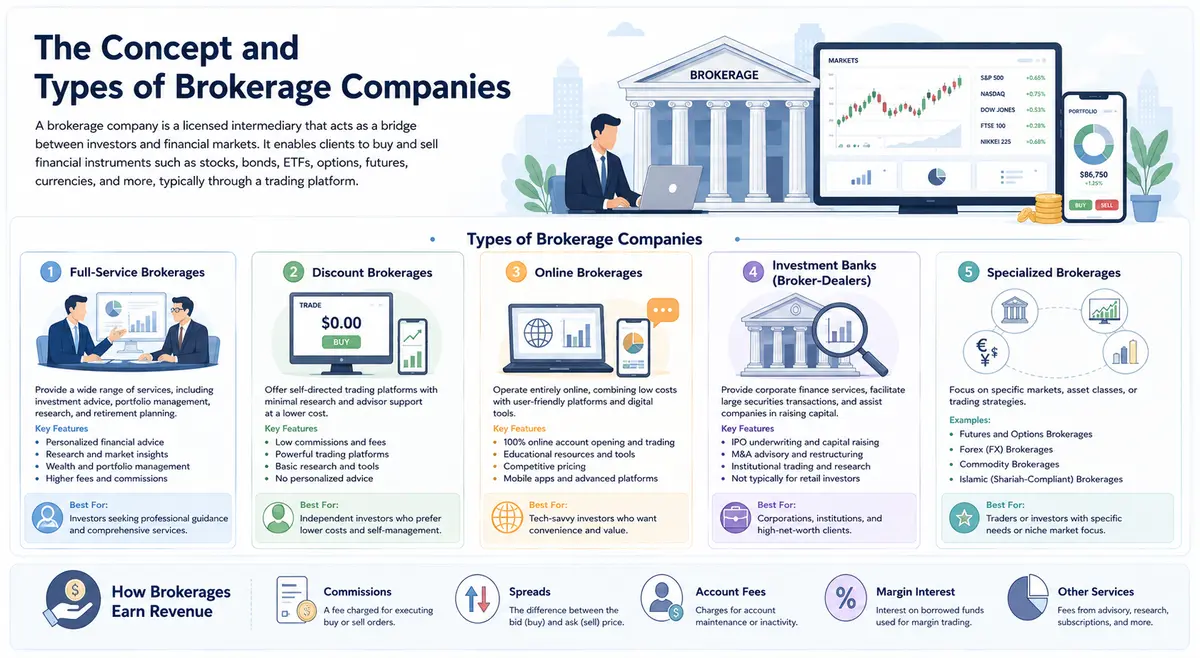
For providing their services, brokers charge commissions, with each broker setting their own rates. Most often, the commission size depends on the volume of trades executed by the client: the more trades, the lower the commission. There are also subscription-based tariff plans where investors pay a fixed amount per day or month and can make an unlimited number of trades. These plans are usually preferred by highly active traders.
Can You Do Without a Broker?
It is possible to do without a broker’s services in most non-financial areas where brokerage firms operate, but it is important to consider that conducting transactions independently has its nuances. For example, when buying or selling real estate, the parties can interact directly; however, the question of whether such a deal is executed safely and profitably remains open.
On the other hand, in certain areas, such as stock market investments, absence of a broker is impossible. The legal framework surrounding the acquisition of stocks, bonds, and other securities makes the presence of a broker mandatory. Even signing a trust management agreement does not eliminate the need for a broker, as your assets are still managed within a brokerage account. Therefore, depending on the specific situation and goals, bypassing a broker can be either entirely possible or legally impossible.
Main Types of Brokers
There are five main categories of brokers, each performing diverse intermediary functions. In a broad context, a broker is an entity that organizes and facilitates transactions between different parties. Depending on their industry, brokers can be categorized as follows:
- Exchange Brokers: These professionals execute trades with commodities, securities, and currencies on respective exchanges on behalf of their clients.
- Insurance Brokers: They act as intermediaries between insurance companies and clients, helping to find the best insurance policies and resolving potential disputes.
- Customs Brokers: These professionals handle the clearance of customs cargo on behalf of clients and interact with government agencies in this sector.
- Mortgage (Credit) Brokers: They help clients find favorable loan offers, collaborate with banks, and process necessary documents, typically for mortgages.
- Freight Brokers: This highly specialized role involves mediating between shipowners and charterers when concluding freight agreements.
What a Broker Does on the Stock Exchange
The role of a broker on the stock exchange is multifaceted and essential. When a client trades independently, the brokerage company takes on the task of efficiently supporting the client’s interests. This includes not just executing trading orders, but also properly preparing reports and calculating necessary tax obligations.
Furthermore, brokers provide investors with their own analytical materials and recommendations regarding stocks, bonds, Exchange Traded Funds (ETFs), and other investment instruments. However, investors should treat such analytics with caution, as the broker’s underlying goal might be to stimulate higher trading volume (which generates more commission), which doesn’t always align with the investor’s best interests.
To start trading on the exchange, you need a broker to help you:
- Gain access to the interface for executing exchange operations.
- Process trades and prepare the necessary documents.
- Manage your account, including providing the option to hire a trust manager.
- Provide analytical and informational support to help you make informed market decisions.

Differences Between a Broker and a Trader
Brokers and traders are often confused with one another since both participate in stock exchange trading, but they actually serve completely different roles.
A trader is an active market participant whose main goal is to generate profit by buying and selling financial assets. A trader’s income depends entirely on their ability to analyze the market, correctly select financial instruments, and capitalize on successful trades.
In contrast to traders, brokers earn primarily from commission fees for providing services and executing trades for their clients. Their income is directly tied to their client base size and trading volume. This is why brokerage companies strive to maintain a pristine reputation and expand their services to attract more clients and boost their revenue.
How to Choose a Reliable Broker
Finding and choosing a reliable broker is a vital step for successful trading.
However, keep in mind that promotional promises from brokers do not always reflect reality. For instance, promises of “guaranteed income” in financial markets should be seen strictly as a marketing trick, as trading results are inherently unpredictable. Truly reliable brokers avoid setting false expectations for their clients.
When choosing a broker, pay attention to the following criteria, especially if you are a beginner:
- Verify their license: Working with illegal, unregulated brokers is both risky and unlawful. Licensed brokers operate under strict industry standards.
- Study their reputation: Research ratings compiled by exchanges and read client reviews to gauge the broker’s standing in the market.
- Assess experience and scale: Newcomers might offer rock-bottom prices, but working with large, well-established brokers is generally much safer.
- Understand the terms of cooperation: Carefully check tariffs, commission fees, access to analytics, and the ability to trade on foreign exchanges.
- Evaluate the software: Test the convenience and stability of their trading platforms, including mobile apps, if you plan to trade on the go. A good broker provides seamless tools across multiple platforms (app, website, and desktop terminal).
How to Open a Brokerage Account
Opening a brokerage account is the first practical step for anyone intending to trade. This process can be done in several ways, depending on your preferences and the broker’s infrastructure.
At the Broker’s Office:
- Locate a branch in your city and contact representatives for details.
- Bring your passport and potentially your Tax Identification Number (TIN) and any other required documents.
- You will be asked to fill out a questionnaire and sign several agreements (brokerage, depository, and trading platform agreements).
- Be prepared to deposit initial funds to pay for services and fund your trading activities.
On the Broker’s Website:
- Go to your chosen broker’s website and fill out the online application.
- Upload scanned copies of required documents (passport, TIN, etc.).
- Wait for official confirmation that the account has been opened.
- Fund the account with your starting capital.
- You are now ready to trade.
How to Work with a Broker and Protect Yourself
Working with a broker is necessary, but investors must be prepared for certain drawbacks and risks. Before partnering with a brokerage, carefully study the following factors:
Cost of Services
In addition to standard monthly account fees, brokers may charge commissions for operations like withdrawing funds or using advanced trading software. Additional services, such as specialized depository maintenance, may also incur extra costs. Ensure you fully understand the fee structure.
Risk of Bankruptcy
While anxiety over a broker going bankrupt is often exaggerated, it is a reality. If a broker goes bankrupt, your assets are typically transferred to another brokerage, and your cash can be withdrawn. However, to minimize stress, always stick to highly reliable, well-capitalized brokers.
Unguaranteed Income
Understand that a broker is strictly an intermediary. They cannot guarantee you a profit. The stock market is subject to economic fluctuations, making trading results unpredictable. No one can accurately predict future stock prices, and financial losses are always a possibility.
How to Diversify Risks When Working with a Broker
Even if your relationship with a broker is smooth, the risk of losing investments due to intermediary bankruptcy exists.
- Monitor your account: Brokers have access to your funds and securities. Keep an eye on your balances.
- Read the fine print: Some brokers include clauses allowing them to use client funds and securities as collateral for their own credit operations. To avoid asset-access issues during a bankruptcy, look for contracts that restrict this practice, or ask to opt-out.
- Broker diversification: Don’t keep all your eggs in one basket. Distribute your investments across two or three different brokerage companies. This significantly reduces your reliance on a single intermediary.
Pros and Cons of Working with a Broker
Advantages
- Simplified paperwork: The broker handles all trade execution and document processing, freeing you from administrative routines.
- Convenient interfaces: You gain access to user-friendly platforms and apps designed specifically for seamless market trading.
- Information and analytics: Brokers provide market research and data feeds to help you make informed decisions.
- Trust management: If you prefer a hands-off approach, you can hire a professional manager through the broker to handle your portfolio.
Disadvantages
- High service costs: Monthly fees, trade commissions, withdrawal fees, and platform costs can eat into your profit margins.
- No income guarantees: The broker cannot guarantee returns. Your investments remain entirely exposed to market volatility and economic shutdowns.
- Potential conflict of interest: Broker analytics may sometimes be designed to encourage overtrading to generate more commission fees for the firm.
- Intermediary risk: In the rare event of broker insolvency, accessing or moving your assets can become a delayed and stressful process.

Comments
No comments yet. Be the first to share your thoughts!
Authentication Required
You must be logged in to post a comment.