

Foundations and Principles of the Securities Market
Core Definitions
The securities market is a segment of the financial market where capital is raised and redistributed through the issuance and trading of securities. It enables companies to secure additional resources for development by issuing and selling securities, while allowing investors to deploy their funds to generate income. This market is a vital economic pillar, driving capital reallocation and boosting overall investment activity.
Investments represent the allocation of capital with the primary goal of preserving and growing wealth. These can take the form of financial investments (securities) or real investments (tangible property or rights deployed into business operations or other ventures).
Types of Investments: Real vs. Financial
Real and financial investments are the two primary mechanisms of capital allocation, both playing a massive role in economics and business. While both aim to generate profit, they fundamentally differ in nature, underlying assets, and risk profiles.
Real Investments
Real investments involve committing capital to tangible and intangible assets used directly to produce goods or services. These include:
-
Tangible Assets:
-
Buildings and structures: Constructing new factories, offices, or warehouses.
-
Equipment and machinery: Purchasing production lines, vehicles, or specialized tools.
-
Land: Acquiring land for agriculture, construction, or resource extraction.
-
-
Intangible Assets:
-
Research and Development (R&D): Investing in new technologies, products, or processes.
-
Staff training and upskilling: Investing in human capital to boost productivity.
-
Marketing and branding: Building brand equity and launching promotional campaigns.
-
Key Characteristics of Real Investments:
-
High capital intensity: Demands significant upfront capital.
-
Extended payback periods: Returning the initial investment can take years.
-
Liquidity constraints: Selling real assets takes time and rarely guarantees the desired price on short notice.
-
Physical depreciation: Tangible assets wear out over time, requiring ongoing maintenance or replacement.
Financial Investments
Financial investments involve placing capital into financial instruments like stocks, bonds, deposits, and other securities. The main objective is to generate returns via interest, dividends, or capital appreciation. These are categorized into:
-
Stocks (Equities): Buying a slice of ownership in a company for dividends and capital growth.
-
Bonds: Lending money to a corporation or government in exchange for regular, fixed interest payments.
-
Deposits & Savings Accounts: Storing funds in a bank to earn a predetermined interest rate.
-
Investment Funds: Pooling money into collective investment vehicles (like mutual funds or ETFs) managed by professionals.
-
Derivatives: Financial contracts (options, futures) whose value is derived from an underlying asset.
Key Characteristics of Financial Investments:
-
High liquidity: Most financial instruments can be rapidly sold or converted to cash.
-
Flexibility: Investors can easily rebalance their portfolios by shifting capital between different assets.
-
Variable risk: Risk levels fluctuate wildly based on the instrument (e.g., equities carry higher risk, while government bonds are generally safer).
-
Diversification: Capital can be easily spread across diverse assets to mitigate overall risk.
Investment Horizons
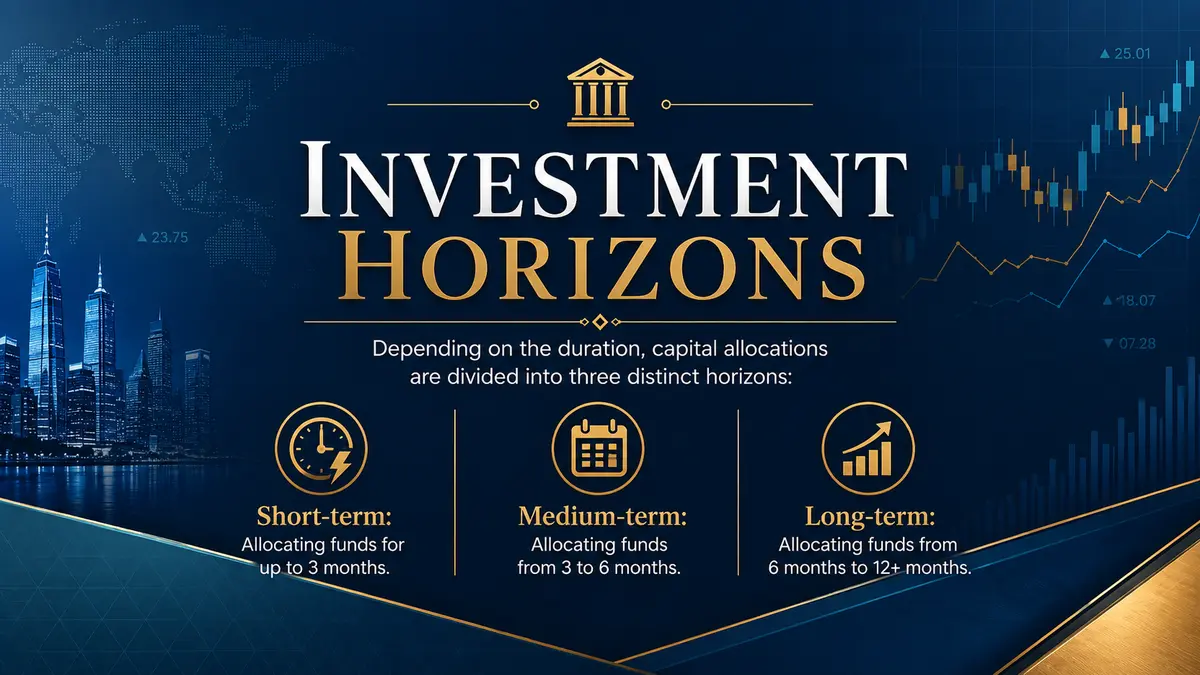
Depending on the duration, capital allocations are divided into three distinct horizons:
-
Short-term: Allocating funds for up to 3 months.
-
Medium-term: Allocating funds from 3 to 6 months.
-
Long-term: Allocating funds from 6 months to 12+ months.
How the Stock Exchange Works
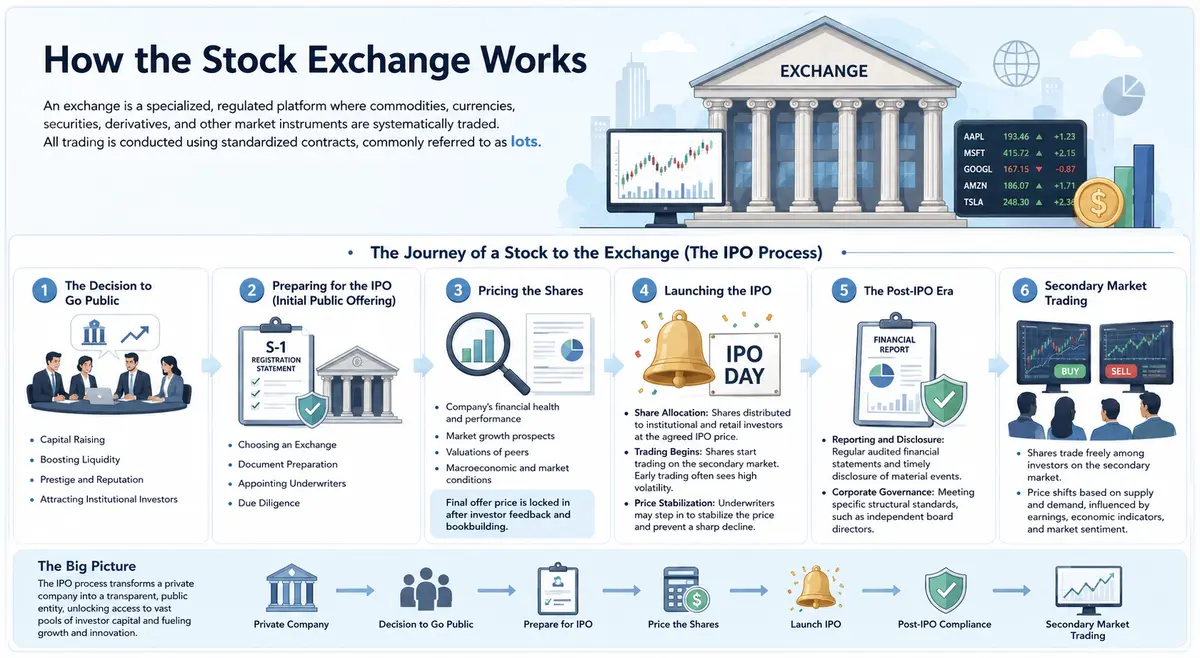
An exchange is a specialized, regulated platform where commodities, currencies, securities, derivatives, and other market instruments are systematically traded. All trading is conducted using standardized contracts, commonly referred to as lots.
The Journey of a Stock to the Exchange (The IPO Process)
Bringing shares to the public market is a complex, multi-stage operation governed by strict rules and regulatory oversight. This process transforms private businesses, allowing them to tap into massive pools of public investor capital.
1. The Decision to Go Public
Management decides to transition from a private company to a public corporation. This move is typically driven by:
-
Capital Raising: Funding business expansion, R&D, or paying down existing debt.
-
Boosting Liquidity: Publicly traded shares can be easily bought or sold, helping existing shareholders convert equity into cash.
-
Prestige and Reputation: Listing on a major exchange boosts visibility, credibility, and trust among clients and partners.
-
Attracting Institutional Investors: Public status opens doors to massive institutional funds.
2. Preparing for the IPO (Initial Public Offering)
To trade publicly, the company must undergo an Initial Public Offering (IPO), which requires:
-
Choosing an Exchange: Selecting a platform (e.g., NYSE, NASDAQ, LSE).
-
Document Preparation: Filing crucial paperwork with regulators (e.g., the Form S-1 filed with the SEC in the US), which transparently details finances, risks, and future outlooks.
-
Appointing Underwriters: Hiring investment banks to manage the listing, value the company, set the initial stock price, and market shares to big investors.
-
Due Diligence: Conducting a rigorous internal audit to ensure complete legal and financial transparency.
3. Pricing the Shares
The initial stock price is determined by an intense valuation process. Underwriters analyze:
-
The company’s financial health and historical performance.
-
Market growth prospects.
-
Valuations of publicly traded peers.
-
Broad macroeconomic and stock market conditions.
Following investor feedback and bookbuilding, the final offer price is locked in.
4. Launching the IPO
On the official IPO day, the stock goes live:
-
Share Allocation: Underwriters distribute shares to institutional and retail investors at the agreed IPO price.
-
Trading Begins: Shares start trading on the secondary market. Early trading hours often witness heavy volatility as the market seeks true price discovery.
-
Price Stabilization: Underwriters may step in to execute stabilizing trades to prevent a drastic downward spiral right out of the gate.
5. The Post-IPO Era
Once public, the company must adhere to continuous, stringent regulations:
-
Reporting and Disclosure: Regular publication of audited financial statements and timely disclosure of material events.
-
Corporate Governance: Meeting specific structural standards, such as appointing independent board directors.
6. Secondary Market Trading
Post-IPO, shares trade freely on the secondary market among everyday investors. The price shifts dynamically based on raw supply and demand, influenced by corporate earnings, economic indicators, and broader market sentiment.
Key Market Participants and Concepts
-
Broker: A legal entity acting as an intermediary between buyers and sellers across stock, commodity, and currency exchanges. In many jurisdictions, brokers also act as tax agents, automatically calculating and withholding taxes on investment profits directly from the client’s account.
-
Issuer: An organization (corporation, municipality, or government) that issues securities to fund and expand its operations.
-
Security: A financial instrument representing a legal claim to property or monetary rights (e.g., a share of net profits). It can also grant corporate governance rights, such as voting at shareholder meetings. Proving ownership allows you to exercise these rights (collect dividends, vote) or transfer them by selling the security.
-
Capital: Broadly, the accumulated sum of goods, property, and assets utilized to generate profit and build wealth.
-
Investor: An individual or legal entity allocating capital to secure future profits. Investors can deploy their own funds or use leveraged (borrowed) capital.
-
Shareholder: An individual or entity owning shares in a joint-stock company. Shareholders are entitled to a portion of profits via dividends and can participate in corporate meetings. Crucially, they are not liable for the company’s debts; their downside risk is strictly limited to the amount invested in their shares. They can sell their equity at any time without needing permission from other shareholders.
-
Depositary Receipt: A certificate representing ownership of shares in a foreign company that trades on a local exchange. Its primary advantage is allowing investors to trade international equities without needing to open a foreign brokerage account.
The Five Main Sections of the Exchange
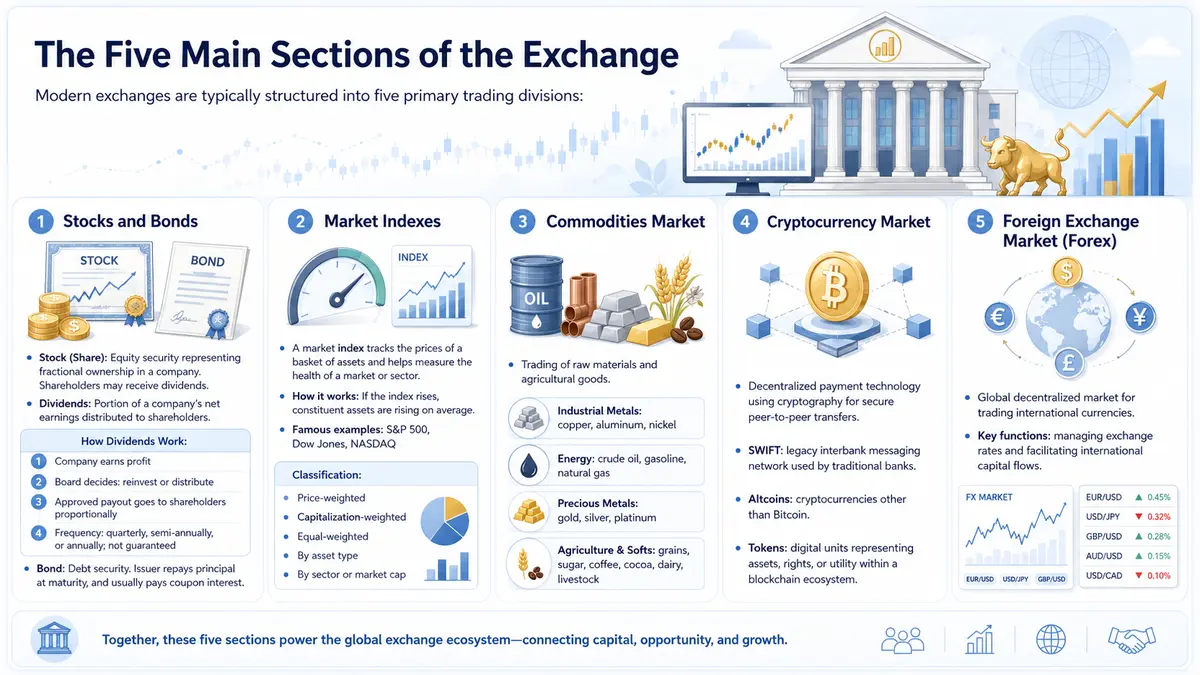
Modern exchanges are typically structured into five primary trading divisions:
1. Stocks and Bonds
-
Stock (Share): An equity security representing a fractional ownership stake in a company. It entitles the holder (shareholder) to a portion of corporate profits, distributed as dividends.
-
Dividends: A portion of a company’s net earnings distributed to its shareholders.
How Dividends Work:
Company Earnings: The business operates and generates a net profit.
The Distribution Decision: The Board of Directors evaluates whether to reinvest the profits back into the business (R&D, paying debt) or reward shareholders.
Payout: If approved, a portion of profits is paid out to shareholders proportionally to the number of shares they own.
Frequency: Payouts can be quarterly, semi-annually, or annually. However, companies are never obligated to pay dividends and may retain all cash for growth.
-
Bond: A debt security. The buyer lends money to the issuer (a corporation or government), which promises to return the principal (nominal value) on a specific maturity date. Bonds typically pay periodic or one-time interest, known as a coupon.
2. Market Indexes
A market index (or stock index) is a statistical metric calculated from the prices of a specific basket of underlying assets (stocks, bonds, etc.). Think of it as a thermometer tracking the “temperature” or health of an entire economy or a specific industry sector.
-
How it Works: Indexes pool multiple stocks together. If the index rises, it indicates that, on average, the constituent companies are seeing price increases.
-
Famous Examples:
-
S&P 500: Tracks 500 of the largest publicly traded corporations in the US.
-
Dow Jones: Monitors 30 massive, blue-chip industrial companies in the US.
-
NASDAQ: Heavily tech-focused index tracking major technology and growth firms.
-
Index Classification Methods:
-
By Calculation Methodology:
-
Price-weighted: Calculated purely based on the asset prices.
-
Capitalization-weighted: Factors in both the share price and the total number of outstanding shares (giving bigger companies more influence).
-
Equal-weighted: Assigns an identical weight to every single company in the index, regardless of size.
-
-
By Asset Type: Stocks indexes, bond indexes, or blended/composite indexes.
-
By Sector or Capitalization Specifics: Industry-specific indexes, large-cap/mid-cap/small-cap indexes, or broad market indexes.
3. Commodities Market
This sector facilitates the trading of raw materials and agricultural goods, categorized into major groups:
-
Industrial Metals: Copper, aluminum, titanium, lead, nickel, and rare-earth elements.
-
Energy: Crude oil (various benchmarks like Brent or WTI), refined petroleum products (heating oil, gasoline), and natural gas.
-
Precious Metals: Gold, silver, and platinum group metals.
-
Agriculture & Softs: Grains, beans, sugar, coffee, cocoa, vegetable oils, dairy, and livestock.
4. Cryptocurrency Market
Cryptocurrency is a paradigm-shifting decentralized payment technology. Cryptographic encryption enables secure, peer-to-peer global transfers without traditional intermediaries.
-
SWIFT: The Society for Worldwide Interbank Financial Telecommunication. It is a legacy international network that securely encrypts and routes payment messages between traditional banking institutions. Cryptocurrencies bypass this entirely, operating on automated, decentralized ledgers.
-
Altcoins: Broadly refers to any cryptocurrency that is not Bitcoin, each offering distinct features, protocols, or use cases.
-
Tokens: Digital units of account that act as proxies for real-world or financial assets (like equities, commodities, or gold) within a blockchain ecosystem. The token issuer essentially promises to deliver a specific utility, right, or asset in exchange for the token.
5. Foreign Exchange Market (Forex)
The FX market is a global, decentralized network for the trading of international currencies, managing exchange rates, and facilitating international capital flows.
Investment Goals and Financial Planning
Successful investing requires clear objectives. Common goals include:
-
Building an Emergency Fund (Financial Cushion): A liquid cash reserve to weather unexpected financial storms. Its size depends entirely on individual monthly living expenses and risk tolerance.
-
Enhancing Long-term Wealth: Designed for individuals seeking to elevate their standard of living and achieve true financial independence. Learning how to effectively manage and allocate income is a crucial life skill.
Setting Goals via the SMART Framework
To prevent aimless investing, goals should be structurally sound: Specific, Measurable, Achievable, Realistic, and Time-bound (SMART).
❌ Example of Poor Planning: > “I earn $5,000 a month. I want to make $1,000,000 in one year by investing $500 a month.” > While highly optimistic, the math makes this goal mathematically unachievable without taking catastrophic, lottery-like risks.
🍀 Example of Proper SMART Planning:
Specific: Generate $5,000 in monthly portfolio income over the next 10 years via the strategic buying and selling of equities, indexes, and other market tools.
Measurable: Have exactly $5,000 transferred to a personal bank card every single month.
Achievable: Calculate the necessary starting capital based on historical market average yields to ensure the numbers match up realistically.
Realistic: Assess personal skills. Ask: “Do I know enough to pick stocks safely? What educational gaps do I need to bridge first?”
Time-bound: Kick off the execution of this plan exactly two days from now.
Key Forex Market Participants
-
Commercial Banks: Execute the lion’s share of all currency transactions globally.
-
Currency Exchanges: Unlike traditional stock exchanges, the FX market operates virtually 24/7 across global time zones rather than inside a single physical building.
-
Central Banks: Manage national currency reserves, conduct monetary interventions to stabilize exchange rates, and regulate domestic interest rates.
-
Foreign Trade Firms: Importers (who demand foreign currency to buy goods) and exporters (who supply foreign currency earned abroad).
-
Investment Funds: Mutual funds, pension funds, and insurance companies that diversify risk by investing heavily in international assets.
-
Brokerages: Middlemen connecting retail and institutional buyers with sellers.
-
Private Individuals: Everyday citizens executing non-commercial trades for tourism, cross-border remittances, or personal speculation.
Types of Financial Flows
Managing capital efficiently means understanding where your investment funds originate. There are three core sources:
-
Self-funding (Equity Financing): Deploying personal capital, such as savings, regular salary allocations, business profits, or rental income.
-
Borrowed Funds (Debt Financing): Utilizing loans from banks or personal networks. When using leverage, it is critical to carefully map out interest rates, repayment timelines, and monthly obligations to avoid over-leveraging.
-
Leasing: Securing asset-backed financing, a method predominantly used by corporate entities rather than individual retail investors.
These funding methods can be deployed individually or blended together strategically. Ultimately, investment activities are accessible to anyone, regardless of current income level. The true catalyst for success is not the size of your initial capital, but consistency, discipline, and a well-educated approach to selecting financial instruments.

Comments
No comments yet. Be the first to share your thoughts!
Authentication Required
You must be logged in to post a comment.