

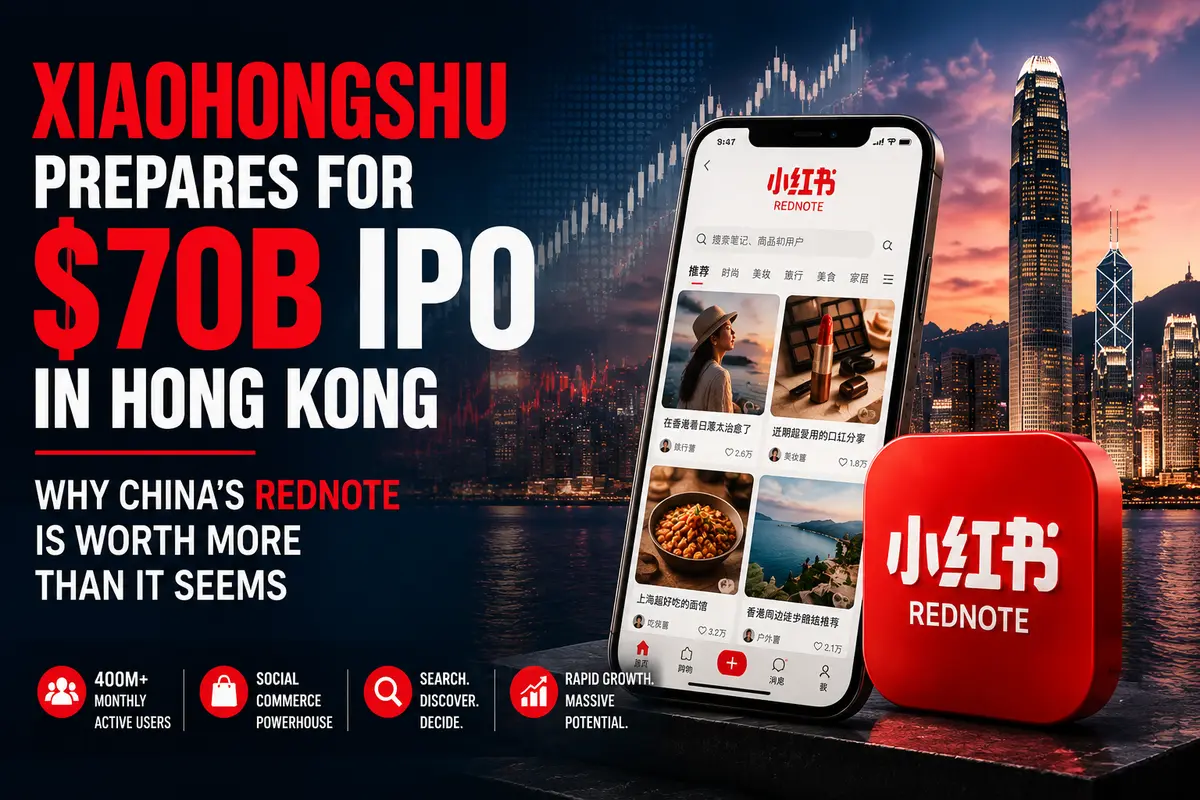
Xiaohongshu prepares for a $70B IPO in Hong Kong: why China’s RedNote is worth more than it seems
Introduction: a quiet revolution finally coming into the open
When last year American users flooded into Xiaohongshu, escaping uncertainty around TikTok, many in the West heard this name for the first time. In Chinese internet culture, however, RedNote (as the platform is known outside mainland China) has long been far from a discovery. For several years now, it has been a way of life for hundreds of millions of people—a place where questions are answered more effectively than in search engines, and where purchases happen more spontaneously than on any marketplace.
Now this story is entering a new stage. According to the Wall Street Journal, Xiaohongshu is preparing for an IPO in Hong Kong at a valuation of over $70 billion. This is not just a number in a headline. It signals that China’s social commerce sector has matured enough to go public, and that investors are willing to pay serious money for it.
Let’s break down what is behind this decision, why the valuation is controversial, and what this platform actually is—one that many in the West still casually call “the Chinese Pinterest,” repeatedly missing the point.
What Xiaohongshu is and why it is worth $70 billion
From hobby project to empire in twelve years
Founded in 2013, Xiaohongshu started as a modest shopping guide for Chinese women traveling abroad. Its founders, Miranda Qiu and Charlene Chen, could hardly have imagined that a dozen years later their creation would be valued at nearly $70 billion and considered one of the key assets of China’s internet economy.
Today it is not just an app—it is an ecosystem with more than 400 million monthly active users. For comparison, that is more than the population of the United States. And this is not an anonymous mass: each user comes with intent—seeking advice, inspiration, purchases, and often all of the above.
The key difference between Xiaohongshu and Western analogues is its dual nature. It is simultaneously a social network, a search engine, a marketplace, and a recommendation platform. Users are not here just for entertainment—they are here for solutions. “Which moisturizer is best for sensitive skin?”, “Where is the best dessert shop in Shanghai?”, “Should I buy this smartphone?”—these are questions Xiaohongshu answers in a more trustworthy and human way than traditional search engines or official brand websites.
This search-like function is what makes the platform unique. In China, Xiaohongshu is called the “Little Red Book” for a reason—it is a living encyclopedia of everyday life written by its users. And this encyclopedia is now worth as much as a mid-sized European bank.
Financials: why investors are willing to pay a premium
What makes institutional investors particularly excited is growth. According to WSJ sources, Xiaohongshu’s net profit exceeded $2 billion in 2025, and could surpass $3 billion in 2026.
To understand the scale, consider this: doubling profit in less than two years is a growth rate considered exceptional even for early-stage startups in Western tech, let alone a platform more than a decade old.
A $70 billion valuation is not simply a matter of applying a multiple to earnings. It is a bet that Xiaohongshu is only beginning to unlock its commercial potential. Compare this with other Chinese tech giants: Meituan once reached over $300 billion, Pinduoduo around $200 billion. Against that backdrop, $70 billion looks almost modest given Xiaohongshu’s growth rate and positioning.
Interestingly, its current secondary-market valuation is around $50 billion. The company is aiming for $70 billion at IPO—a 40% premium. That is a bold move, signaling confidence and a willingness to justify that premium to investors.
Why Hong Kong, and why now
Strategic choice in a new reality
The decision to list in Hong Kong is no accident. For Chinese companies handling data from hundreds of millions of users, listing in New York or London today carries significant political risk. Hong Kong remains a domestic-adjacent but internationally accessible market.
At the same time, the Hong Kong Stock Exchange has been actively trying to position itself as Asia’s leading hub for tech IPOs. Xiaohongshu, with its scale and recognition, is exactly the kind of flagship listing that can elevate the exchange’s status and attract global capital.
The involvement of China International Capital Corporation (CICC) as advisor is also meaningful. It signals high-level approval and reduces the likelihood of administrative obstacles that often delay Chinese IPOs.
Market timing: the 2026 window
Timing is another key factor. 2026 is shaping up to be a turning point for China’s tech sector. The major regulatory crackdowns have largely concluded, and the market is adjusting to new rules.
Investor interest in China is gradually returning, albeit cautiously. This creates a sweet spot: sentiment is still muted, but appetite is recovering. It is an ideal moment to bring a fast-growing, clearly understandable asset to market.
Xiaohongshu is also benefiting from global attention sparked by the mass migration of American users from TikTok last year. Many Western investors first discovered the platform then, and now see it not as an abstract “Chinese social app,” but as a real business with a clear model.

Business model: how Xiaohongshu makes billions
Commerce without aggression
Unlike many social platforms that resemble shopping malls filled with intrusive ads, Xiaohongshu maintains a careful balance. Advertising and paid content are integrated so naturally into the feed that users often cannot distinguish between recommendation and advertisement—and it works.
Main revenue streams:
Advertising model – Brands pay for influencer placements and targeted ads in the recommendation feed. But unlike platforms where ads interrupt the experience, here they are embedded in advice-style content, making them feel like useful information rather than intrusion.
Transaction commissions – The platform takes a cut from sales made through its built-in marketplace. This is not the largest revenue source but is growing rapidly.
Live-stream commerce – A massive industry in China. Unlike aggressive formats on Douyin or Taobao Live, Xiaohongshu’s streams are more curated and expert-like, closer to consultations than TV shopping.
Premium subscriptions – Still small but growing, especially in niche expert content and premium brand channels.
Importantly, Xiaohongshu does not aggressively maximize monetization at all costs. It avoids overloading the interface with ads and maintains strict quality standards for advertisers. This long-term strategy pays off in retention and loyalty.
User base as the key asset
With 400 million monthly active users, Xiaohongshu has a highly valuable audience profile.
First, it is young, urban, and affluent. Most users are women aged 18–35 living in major cities. This is prime purchasing power for industries ranging from luxury cosmetics to premium automobiles.
Second, users come with intent. They are not browsing passively for entertainment—they are actively searching for decisions. This is fundamentally different from TikTok or Instagram, where advertising often feels disruptive.
Third, trust is extremely high. Engagement is unusually deep for a social platform. Users write detailed reviews, post long-form experiences, and debate in comments—creating a trust-based ecosystem that cannot easily be replicated.
Risks and challenges
Regulatory pressure
No discussion of Chinese tech is complete without regulation. Xiaohongshu operates under strict data control rules. While it has high-level support, future regulatory changes remain a risk.
Data privacy laws in China have tightened, forcing platforms to balance targeted advertising with compliance.
International expansion also introduces GDPR and similar frameworks, requiring costly adjustments.
Domestic competition
The Chinese market is extremely competitive:
-
Douyin (TikTok China) dominates short video and live commerce
-
Taobao/Tmall dominate e-commerce logistics and scale
-
WeChat dominates user behavior and habit-based commerce
Xiaohongshu’s strength lies in premium, trust-based content. But it does not compete on breadth or logistics.
Global expansion risks
International expansion is both opportunity and threat.
Western users may not adapt well to Xiaohongshu’s long-form, image-heavy, review-based format. Algorithms built for Chinese behavior may not translate.
If the platform succeeds globally, it may face political scrutiny and regulatory pushback, limiting growth potential.
Investment case: is it worth the hype?
Compared to other Chinese tech companies, $70 billion places Xiaohongshu below giants like Tencent (~$400B) and Meituan (~$100B), but firmly in the top tier.
Bullish analysts highlight:
-
Untapped monetization potential (higher ARPU possible)
-
Strong network effects
-
Expansion into education, services, and possibly fintech
The key question: is $70 billion too high or too low?
Skeptics argue margins may plateau, regulation remains unpredictable, and past Chinese IPOs have disappointed post-listing.
Supporters counter that Xiaohongshu is structurally unique—no direct equivalent combines social, search, and commerce in such a trust-driven format.
Conclusion: what this IPO means
The Xiaohongshu IPO is more than just another Chinese tech listing. It is a litmus test for the entire sector.
If successful, it could unlock a new wave of Chinese tech IPOs and revive confidence in Hong Kong markets.
If it fails, it will signal that investors are still unwilling to pay premium valuations for Chinese growth stories.
For users, nothing changes immediately. But over time, public listing may push Xiaohongshu toward greater transparency—and potentially either more disciplined strategy or more aggressive monetization.
In any case, the “Little Red Book” of Chinese internet culture is opening its most important chapter yet—and its pages will be measured in billions of dollars and millions of new shareholders worldwide.
And the question remains: in five years, will this valuation look like a rare early opportunity—or a cautious step that should have been bolder? Only time will tell. But the fact that Xiaohongshu is now impossible to ignore is already undeniable.

Comments
No comments yet. Be the first to share your thoughts!
Authentication Required
You must be logged in to post a comment.