

Target Shareholders Said “No” to an Independent Chair — and That Says a Lot About the Company
A Vote That Could Have Changed Everything — But Changed Nothing
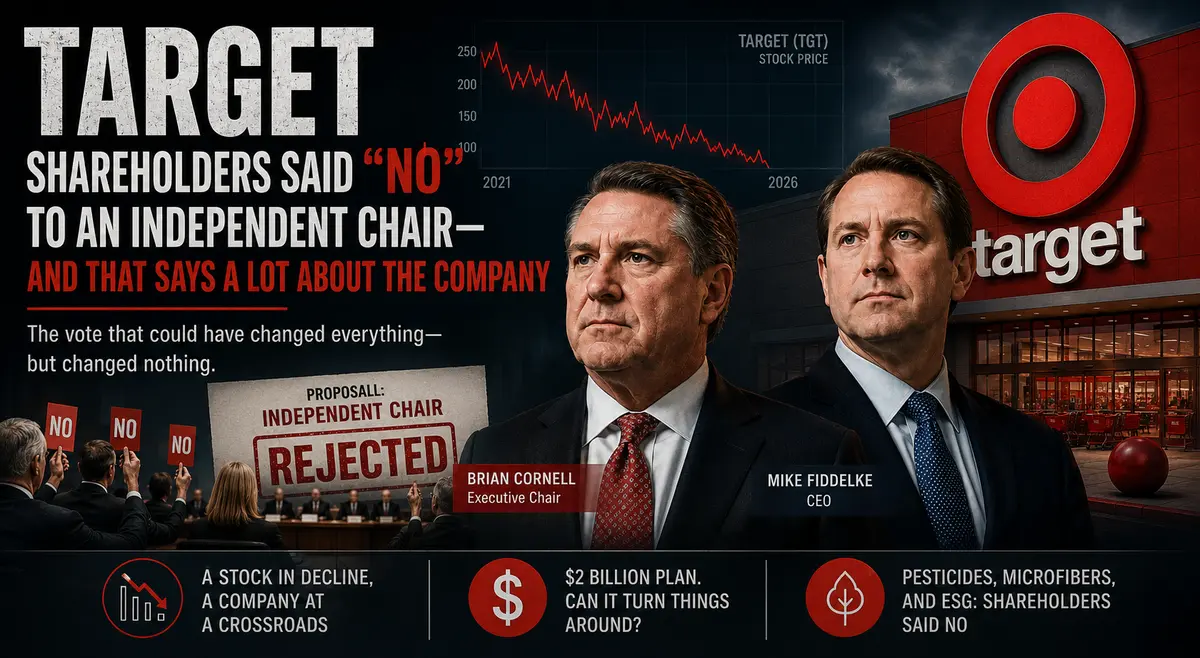
Wednesday, June 10, 2026. The annual shareholder meeting of Target Corporation. One of America’s largest retailers, a chain known to families from Maine to California. Three proposals were on the agenda. One of them was a bombshell: a proposal to separate the roles of board chair and executive leadership. In simple terms, it would have removed Brian Cornell from the position of executive chair, leaving him on the board but without operational authority.
Some investors, particularly institutional shareholders, had been pushing for this change for years. Their argument was straightforward: “Cornell served as CEO for 11 years. He led the company through a period of success, but that success eventually faded. The stock has fallen by roughly half since 2021. Walmart and Costco have pulled ahead. It’s time for new leadership, and for the old leader to step aside without continuing to influence day-to-day operations.”
But shareholders saw things differently. According to Reuters, the proposal for an independent chair was rejected. Two other shareholder proposals—one calling for greater disclosure about pesticide use in private-label products and another addressing microfiber emissions—were also voted down. All board nominees were elected.
Cornell stays.
He will continue overseeing his successor, Mike Fiddelke, who became CEO in February 2026. Fiddelke has already pledged to invest $2 billion this year to improve inventory management and sharpen Target’s pricing strategy.
Yet one question remains: why did shareholders who have watched the stock struggle over recent years decide not to change the company’s leadership structure? And what does that say about Target’s future?
Brian Cornell: Architect of the Rise and Witness to the Decline
For those who do not closely follow the American retail industry, Brian Cornell is a legendary figure. He joined Target in 2014 when the company was reeling from a failed expansion into Canada and a major data breach scandal. Before Target, he held leadership positions at PepsiCo, Walmart (where he led Sam’s Club), and Michaels Stores. In other words, he knew retail inside and out.
His early years at Target were remarkably successful. The company revitalized its private-label brands, emphasized design, and launched exclusive collaborations with brands such as Lilly Pulitzer and Missoni. The stock rose steadily, and investors embraced his strategy.
Then something changed.
The pandemic in 2020 created a temporary boom as consumers bought everything from toilet paper to bicycles. But when the world reopened, Target struggled to adapt to the new environment. Inflation squeezed household budgets. Walmart and Costco, with their strong value propositions, gained ground. Target, positioned as a stylish but affordable retailer, found itself caught in the middle—neither the cheapest nor the most premium option.
Merchandising mistakes piled up. Sometimes the company overstocked products consumers did not want; other times it failed to meet demand for popular items. Its handling of diversity, equity, and inclusion (DEI) initiatives drew criticism from multiple sides of the political spectrum, affecting customer loyalty.
In 2025, Cornell announced he would step down as CEO but remain executive chair. His successor, Mike Fiddelke, the former CFO, was widely viewed as a capable operator but not necessarily a visionary leader.
Many investors initially welcomed the transition as a chance for fresh leadership. However, it soon became clear that Cornell had not truly left. As executive chair, he retained significant influence over strategy, attended key meetings, and could shape major decisions. Officially, he was an adviser. In practice, many saw him as a shadow CEO.
Why the Independent Chair Proposal Emerged
A group of activist investors, including The Accountability Board, pushed for separating the roles of chair and CEO.
Their case rested on three main arguments.
First, corporate governance. Best practices increasingly favor an independent board chair. An independent chair can objectively evaluate management performance without conflicts of interest. When the chair is a former CEO who selected the current CEO, true independence can be difficult to achieve.
Second, performance. Target has lost roughly half its market value since 2021. The stock fell from highs near $250 per share to around $120–130. While Walmart and Costco expanded market share, Target largely stagnated.
Third, strategic missteps. Critics argued that Target made several questionable decisions under Cornell’s leadership. Its handling of DEI-related controversies alienated some customers without clearly winning over others. Investments in e-commerce lagged behind Amazon’s scale and capabilities. Meanwhile, a supply chain that was once considered a competitive advantage experienced repeated disruptions.
Supporters of the proposal believed that an independent chair could have asked tougher questions, demanded accountability sooner, and prevented Cornell from maintaining substantial influence after stepping down as CEO.
Shareholders, however, were not convinced.
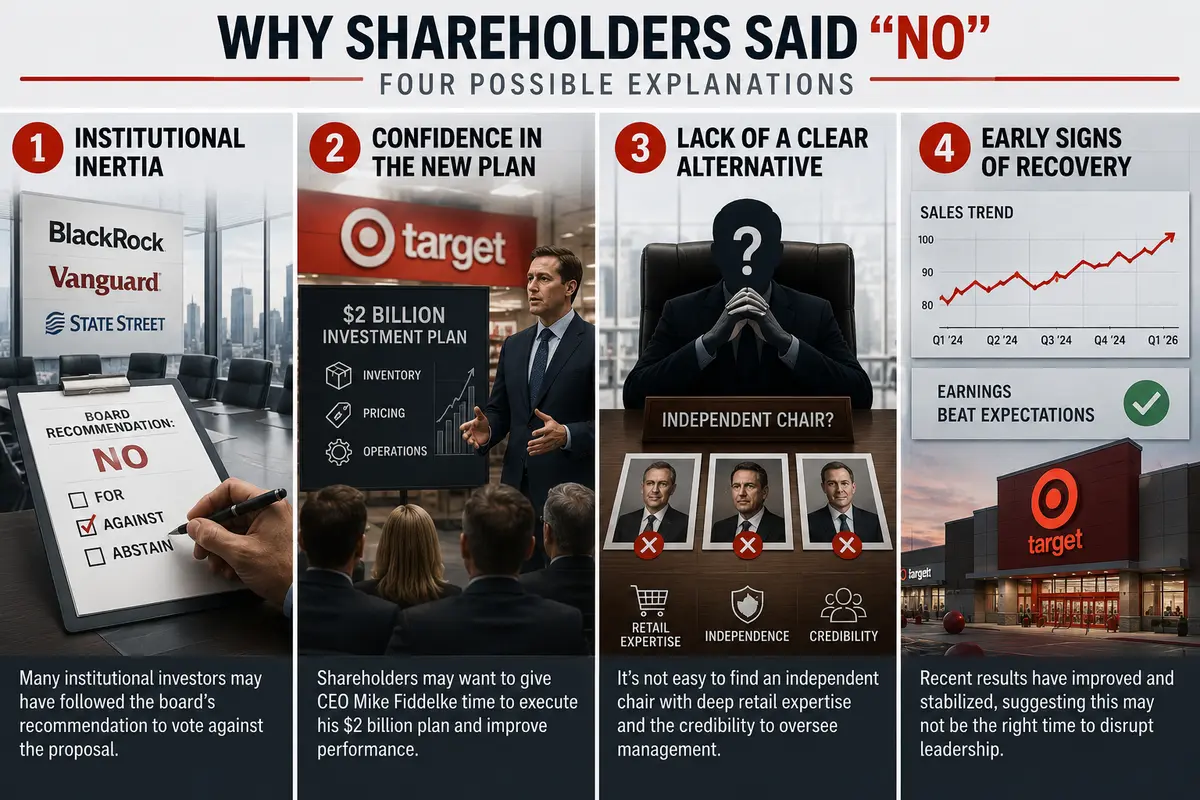
Why Shareholders Said “No”: Four Possible Explanations
Why would investors dissatisfied with the stock’s performance vote to preserve the status quo?
1. Institutional Inertia
Large asset managers such as BlackRock, Vanguard, and State Street often follow board recommendations unless there is a compelling reason not to. Since Target’s board recommended voting against the proposal, many institutional investors may have simply followed that guidance.
2. Confidence in the New Plan
Since becoming CEO, Mike Fiddelke has committed to investing $2 billion in inventory, pricing, and operational improvements. Shareholders may have decided to give him time to execute rather than create a governance battle that could distract management.
3. Lack of a Clear Alternative
Replacing Cornell raises an obvious question: with whom?
Finding an independent chair who possesses deep retail expertise and the credibility to oversee management is not easy. Target’s board already includes experienced directors, including Lead Independent Director Christina Hennington Leahy, who serves as an important governance counterbalance.
4. Early Signs of Recovery
Target’s most recent earnings reports have not been spectacular, but they have exceeded some expectations. Sales trends have stabilized. Investors may have concluded that now is not the right moment to disrupt leadership while the company is attempting a turnaround.
The Other Two Proposals: Pesticides and Microfibers
Shareholders also rejected two sustainability-related proposals.
The first called for greater disclosure regarding pesticide use in Target’s private-label food products. Activists wanted more transparency about the chemicals used throughout the supply chain and the quantities involved. The board argued that the proposal would be costly and unnecessary, and shareholders agreed.
The second proposal focused on microfiber pollution—tiny plastic particles released when synthetic clothing is washed. Activists requested reporting on measures Target is taking to reduce microfiber emissions associated with products sold in its stores. That proposal was also defeated.
These votes suggest that many Target shareholders are currently prioritizing financial performance over additional ESG reporting requirements. Alternatively, they may believe the company’s existing sustainability efforts are sufficient.
What This Means for Mike Fiddelke
Target’s new CEO faces a challenging situation.
On one hand, the board and shareholders have effectively expressed confidence in the current leadership structure. On the other hand, Cornell’s presence remains significant, and Fiddelke will operate under the shadow of his predecessor.
Fiddelke is known for his focus on data, efficiency, and execution. He aims to reduce costs, improve inventory turnover, and strengthen Target’s value proposition. The question is whether he will have enough autonomy to make bold decisions if Cornell continues to exert substantial influence.
Corporate governance experts often warn that companies with two centers of power—a sitting CEO and a powerful former CEO serving as executive chair—can experience slower decision-making, internal tension, and talent retention challenges. Top executives generally prefer clear lines of authority.
That said, successful transitions of this type do exist. Many companies have retained founders or former CEOs in board leadership roles without undermining new management. Ultimately, much depends on the personalities involved. Publicly, Cornell and Fiddelke present a united front. What happens behind closed doors is another matter.
Market Reaction: What the Numbers Say
At the time of writing, Target shares trade around $130. That is roughly half of their historical peak but about 20% above last year’s lows. Investors appear to have already priced in many of the company’s challenges and are looking toward a potential recovery.
The vote on the chairmanship produced little market reaction. Most investors expected the proposal to fail, given the board’s opposition and the tendency of large institutions to support management recommendations.
Analysts remain focused on Fiddelke’s execution of the company’s investment plan.
A $2 billion commitment is substantial. The key question is where that money will generate the greatest return:
-
Lower prices could improve competitiveness but pressure margins.
-
Marketing investments might strengthen the brand but take time to produce results.
-
Supply chain and technology upgrades could create long-term advantages but require patience.
Target is also trying to compete more effectively with Walmart and Amazon in e-commerce. Walmart has enormous logistics capabilities and online scale. Amazon possesses unmatched technology and customer loyalty through Prime. Target still benefits from strong design credentials and exclusive brands, but that alone may not be enough.
Fiddelke may eventually face a strategic choice: continue competing directly with Walmart on value, or reposition Target as a more differentiated, design-focused retailer with higher margins but lower volume.
So, What’s the Bottom Line?
Target is more than a retail chain. It is often viewed as a barometer of the American middle class. When Target thrives, it usually signals consumer confidence. When Target struggles, it suggests households are becoming more cautious with their spending.
Shareholders have chosen to preserve the current governance structure. Brian Cornell remains executive chair with operational influence. Mike Fiddelke continues as CEO. Both ESG-related shareholder proposals were rejected.
The real question is not who occupies the chair’s office. The real question is whether Target can reclaim its competitive position in an era when Walmart and Amazon continue to expand while consumers remain sensitive to inflation.
The $2 billion investment program represents an opportunity—but not an unlimited one. If Target fails to deliver sustainable sales and earnings growth over the next year or two, investors are likely to revisit the issue of board independence. And next time, the outcome could be very different.
For now, the status quo remains.
Cornell stays. Fiddelke leads. Shareholders wait and hope.
Target continues down its chosen path—carefully, cautiously, and without dramatic changes.
Whether that path ultimately succeeds remains to be seen.
One thing is certain: corporate America continues to experiment with different governance models, and Target has become one of the most fascinating case studies in recent years. It is a company worth watching—not only for investors, but for anyone interested in the future of retail and corporate governance.

Comments
No comments yet. Be the first to share your thoughts!
Authentication Required
You must be logged in to post a comment.