

USD/JPY Breaches 160, NZD Under RBNZ Hawkish Watch & Global Risk-Off Grips Asia

Week of 9–13 June 2026 · Asia-Pacific Session
★ EXTREME EVENT RISK WEEK · BoJ Intervention Live · US CPI Wednesday · RBNZ June 15–16 · EIA Thursday ★
USD/JPY 160.24 · NZD/USD 0.5796 · Copper $6.31/lb · Nat Gas $3.22 · Hang Seng 24,680 · SOL $60.24 · LTC $42.56
Past Week in Review — 2–6 June 2026
The week of 2–6 June 2026 delivered a series of threshold events across every instrument in CSFX’s Asia coverage. The dominant development was USD/JPY crossing 160.00 — the level the Bank of Japan has defended twice in the past 14 months — turning intervention from a tail risk into an active event probability. Goldman Sachs’ full liquidation of Solana ETF exposure triggered a 5.75% single-week selloff in SOL, resetting institutional sentiment for the Solana ecosystem. On the commodity side, natural gas’s 17.82% monthly surge — driven by Middle East LNG supply disruptions and above-average US temperatures — was only partially reversed by Friday’s 3.21% pullback on reduced LNG export volumes. The Hang Seng’s four-session losing streak, led by SMIC and Tencent declines, reflects the AI-sector correction on Wall Street feeding directly into Hong Kong’s technology-heavy index. Copper declined 4.25% on the week, pulled lower by China demand uncertainty, though the structural electrification thesis remains intact and the dip has brought the price to CSFX’s target entry zone. Litecoin was the hardest hit, falling 11.94% through the prior $47 support band and into the $40–$44 demand zone where the 2027 pre-halving accumulation thesis now activates.
Weekly closes: USD/JPY at 160.24, breaching the 160.00 BoJ intervention threshold. NZD/USD down 1.93% on the week to 0.5796, pulling back sharply from its 5-week high. Copper down 4.25% to $6.31/lb on softer China industrial data, now 6% below the $6.716 all-time high. Natural gas down 3.21% on Friday to $3.22/MMBtu but still up 17.82% for the month. Hang Seng down 2.25% across four sessions to 24,680, with SMIC falling 7.2% and Tencent declining 1.3%. Solana down 9.14% to $60.24 following Goldman Sachs’ ETF liquidation. Litecoin down 11.94% to $42.56, breaking below $47 support into the updated accumulation zone.
This Week at a Glance — 9–13 June 2026
The week of 9–13 June 2026 is defined by three sequentially linked event risks. First, USD/JPY is already above 160.00 — making BoJ intervention a live, non-hypothetical risk from Monday morning. Second, Wednesday’s US CPI for May sets the macroeconomic tone: a hot print deepens USD dominance, while a soft read opens the door for NZD recovery and broad risk-on. Third, Thursday’s EIA gas storage report is the confirmation mechanism for whether natural gas’s 17.82% monthly surge holds or reverses. Against this backdrop, the Hang Seng extends its four-session losing streak driven by tech weakness, Solana navigates post-Goldman institutional uncertainty, and Litecoin at $42.56 breaks below $47 into the updated $40–$44 demand zone.
The three event risks are sequentially linked in a specific way: Wednesday’s US CPI comes before the RBNZ on June 15–16, which means the CPI print sets the table for whether the RBNZ meeting delivers NZD bulls the catalyst they need. A hot CPI strengthens the dollar and pushes NZD/USD lower, meaning the RBNZ would need to be overtly hawkish to recover the pair. A soft CPI weakens the dollar and sets up any RBNZ hawkish signal as a powerful amplifier for NZD upside. Understanding this sequencing — CPI first, RBNZ second — is the core analytical framework for the week.
Weekly Overview — Asian Session Context
The Asian session enters the week of 9 June with USD/JPY having breached the critical 160.00 psychological level, a NZD/USD at 0.5796 at multi-month lows ahead of an RBNZ rate decision, and a Hang Seng that has shed over 1,900 points across four sessions as US-Iran ceasefire uncertainty and AI stock weakness weigh on risk appetite across the region.
USD/JPY at 160.24 has now crossed the level that triggered Bank of Japan intervention in both April and September of 2025. Prime Minister Kishida’s explicit labelling of 160 as a psychological bottleneck means the BoJ’s tolerance for sustained trading above this level is severely limited. For the week of 9–13 June, CSFX’s primary FX alert is asymmetric: long USD/JPY positions above 160 carry catastrophic intervention risk with a 300–500 pip adverse dislocation profile, while the short entry at 160.50 remains the preferred setup.
NZD/USD at 0.5796 has pulled back sharply from its 5-week high and is now trading at multi-month lows as the RBNZ’s June meeting on 15–16 June looms. The RBNZ under new Governor Anna Breman kept the Official Cash Rate at 2.25% in May but signalled readiness to hike if core inflation accelerates. Markets are currently pricing over 40% probability of a July hike. Annual CPI remained at 3.1% in Q1 2026 above the 1–3% target band, and the RBNZ’s own forecasts see inflation peaking at 4.3% in September 2026 driven by Middle East oil shocks. NZD/USD’s trajectory for the week depends on whether this week’s US CPI print reinforces or undermines broad USD strength.
In commodities, Copper at $6.31/lb has pulled back 4.25% on the week as China industrial demand concerns weigh, now 6% below its 52-week high of $6.716. Natural gas at $3.22/MMBtu pulled back sharply on Friday amid reduced LNG export flows from US facilities, but remains near 4-month highs on Middle East supply disruptions driving Asian premium demand. The Hang Seng at 24,680 has extended its losing streak to four sessions as semiconductor and technology stocks led declines, with SMIC falling 7.2% and Tencent declining 1.3% this week. In crypto, Solana’s sharp 9.14% move to $60.24 reflects Goldman Sachs liquidating its Solana ETF exposure, while Litecoin at $42.56 has broken below the prior $47 support band and is now testing the $40–$44 demand zone.
Three Forces Shaping the Asian Session
Theme 1 — BoJ Intervention Imminent Above 160 & RBNZ Hawkish Risk
USD/JPY has crossed the 160.00 threshold the Bank of Japan has defended twice in 2025, making intervention a live event risk for the coming week. Every 24 hours USD/JPY trades above 160 increases the probability of an unannounced BoJ selling intervention. Simultaneously, NZD/USD at 0.5796 now sits at RBNZ hawkish support territory — with OCR at 2.25% and inflation at 3.1%, the RBNZ is credibly positioned to signal further tightening, creating a structural floor near 0.5760 and triggering the CSFX long entry framework. These two central bank dynamics are the twin anchors of the week’s FX narrative.
Theme 2 — Commodities Diverging: Copper Near ATH, Gas Pulls Back
The commodity complex is telling two distinct stories. Copper at $6.31/lb has pulled back 4.25% on the week but the structural bull case remains intact — electrification demand for EVs, grid upgrades, and AI data centre cooling continues to outpace mine supply. Natural gas at $3.22/MMBtu holds steady on reduced LNG export flows from US terminals but remains structurally elevated as Middle East supply disruptions keep Asia-Pacific buyers competing aggressively for US LNG cargoes. The 4.25% copper pullback to $6.31 has created a buy-the-dip opportunity at CSFX’s target entry. These diverging trajectories demand instrument-specific positioning rather than a unified commodities view.
Theme 3 — Crypto Institutional Exodus: SOL in Drawdown, LTC at Support
Digital assets are under significant institutional selling pressure. Goldman Sachs’ liquidation of Solana ETF exposure has driven SOL to $60.24 — a 9.14% weekly decline — now within $2.24 of the $58 structural support zone where CSFX’s entry triggers. The 200-day moving average has turned downward since June 1. Litecoin at $42.56 has broken below the prior $47 support band with the 2027 halving cycle creating a medium-term buy-the-dip thesis, but the immediate macro environment favours risk management over accumulation. Meme-coin platform Pump.fun sold over 100,000 SOL this week adding direct sell pressure to the Goldman exit.
Trade Setups — Seven Instruments, 9–13 June 2026
All levels for reference only. Not financial advice. Visit capitalstreetfx.com for live signals.
USD/JPY — Short from 160.50 | BoJ Intervention Asymmetry
USD/JPY at 160.24 has now crossed the psychologically and politically critical 160.00 threshold that the Bank of Japan defended in April 2025 and September 2025. With the pair above 160.00, the BoJ’s intervention probability escalates sharply with every day of sustained breach. Prime Minister Kishida’s explicit labelling of 160 as a psychological bottleneck — combined with the BoJ’s demonstrated willingness to deploy foreign reserves without advance notice — creates a binary risk environment where every long position above 160 is exposed to a 300–500 pip adverse dislocation in minutes. This is not a trend-following trade; it is an asymmetric intervention premium capture. Size at 60% of full allocation with the defined stop strictly observed.
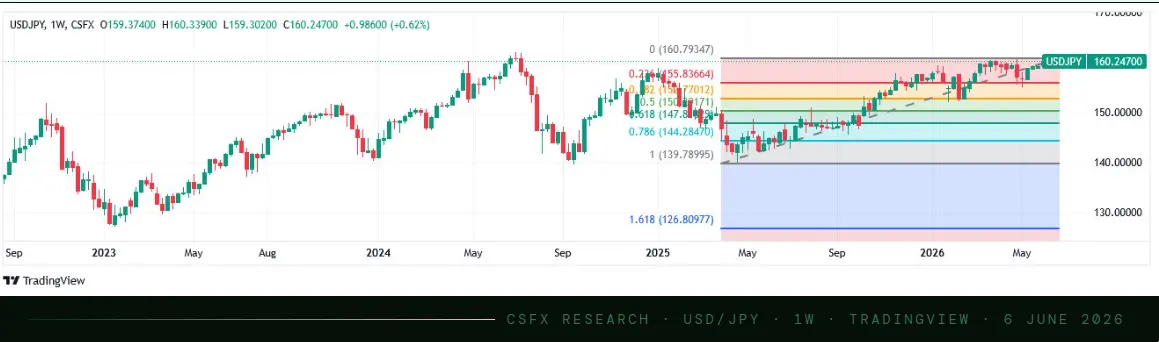
Direction: Short USD/JPY — Asymmetric Intervention Premium Capture
Entry: 160.50 — defined entry into the intervention zone premium
Stop Loss: 161.80 — acknowledges potential BoJ tolerance for brief overshoot
Take Profit: 157.20 — post-intervention equilibrium zone based on prior episode patterns
Size: 60% of full allocation — hard stop strictly observed
Key Risk: BoJ may delay intervention, allowing pair to run toward 161–162 before acting
NZD/USD — Conditional Long at 0.5796 | RBNZ Floor + CPI Binary
NZD/USD at 0.5796 has already dipped into the entry zone CSFX flagged last week, breaking below the 0.5820 structural floor on sustained USD strength. The RBNZ under Governor Breman has demonstrated willingness to hike if core inflation accelerates; annual CPI at 3.1% remains above the 1–3% target band for two consecutive quarters, and the bank’s own revised terminal rate of 3.28% implies approximately 100 basis points of tightening ahead. This hawkish backdrop provides a structural demand floor for NZD/USD near 0.5760–0.5800. The RBNZ’s June 15–16 meeting — just days after this week’s US CPI — creates a two-catalyst structure. CSFX’s framework: initiate at current market with a tight stop at 0.5720, acknowledging that a materially hotter-than-expected US CPI print could push toward 0.5740 before recovering. The RBNZ on June 15–16 is the primary take-profit catalyst — hawkish guidance targeting 2.50% OCR by September would drive NZD/USD toward 0.5950. Do not add size until the CPI binary is resolved.
Direction: Conditional Long NZD/USD — RBNZ Hawkish Floor + CPI Gating
Entry: 0.5796 — current market; at the flagged entry zone
Stop Loss: 0.5720 — below structural support; hot CPI could test this level
Take Profit: 0.5950 — RBNZ hawkish guidance catalyst target
Condition: Do not add size until Wednesday US CPI is resolved
Key Risk: Hot US CPI print pushes USD/NZD through 0.5760 before RBNZ can support
Copper HG — Buy the Dip at $6.31 | Electrification Bull Case Intact
Copper at $6.31/lb has pulled back 4.25% and is now sitting directly at CSFX’s preferred entry level — previously flagged as the structural retracement target. The dip has arrived faster than anticipated, driven by a softer China industrial demand narrative and broad commodity risk-off. Critically, the structural bull thesis remains entirely intact: mine supply deficits from Codelco and other major producers persist, and secular electrification demand — EVs, AI data centre cooling, grid modernisation, offshore wind — continues to absorb short-term demand uncertainty. The speculative long-overhang from the $6.59+ zone has now largely cleared, making this a cleaner entry. China’s Industrial Production and Retail Sales prints on Friday are the primary catalyst: a beat above consensus would be the risk-on trigger for copper to re-challenge $6.50+. A miss widens the path toward $6.10, where the defined stop provides risk management.
Direction: Long Copper — Buy the Dip; Structural Bull Case Intact
Entry: $6.31/lb — at the flagged structural retracement target
Stop Loss: $6.00 — below prior breakout consolidation zone
Take Profit: $6.70 — prior high zone / all-time high area
Size: 70% of full commodity allocation given current conditions
Key Risk: China Friday data miss (IP below 4.5%) widens path toward $6.10 stop
Natural Gas NG — Long Dips to $3.10 | EIA Thursday Confirmation Gate
Natural gas at $3.22/MMBtu has pulled back 3.21% from Friday’s session high, but CSFX’s structural bull thesis remains intact. The fundamental drivers — Middle East supply disruptions keeping LNG supply from the Persian Gulf curtailed, above-normal US temperatures through June 14 increasing power generation demand, and the EIA storage surplus continuing to narrow at now 5% above the 5-year average versus 6% last week — remain in force. The Friday decline is attributable to reduced LNG export flows to US terminals due to seasonal maintenance, not to any demand reversal. Natural gas at +17.82% for the month retains significant momentum even after this pullback. CSFX’s preferred entry is at $3.10, targeting the prior breakout zone from the March-April consolidation. Thursday’s EIA storage report is the key confirmation gate: a storage build below +60 bcf confirms the narrowing surplus trend and validates the bull thesis; a build above +90 bcf signals the surplus is widening and should trigger a reassessment before entry.
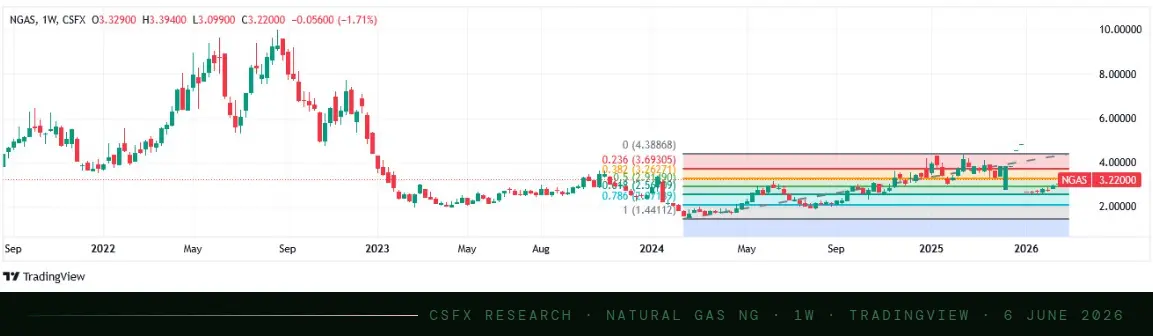
Direction: Long Natural Gas — Dips Supported; Friday Pullback is Healthy Retracement
Entry: $3.10/MMBtu — prior breakout zone from March-April consolidation
Stop Loss: $2.85 — below January 2026 spike high
Take Profit: $3.70 — next resistance zone
Key Gate: EIA Thursday: build above +90 bcf = reassess; below +60 bcf = bull case confirmed
Key Risk: Rapid Iran ceasefire would reduce Middle East LNG premium; stop essential
Hang Seng HSI — Conditional Short at 25,000 | Sell the Rally
The Hang Seng at 24,680 has now declined across four consecutive sessions, breaking below the prior 24,961 close and approaching three-month lows. Technology and semiconductor stocks continue to lead the selldown — SMIC’s 7.2% weekly decline reflects deepening US-China chip restriction concerns, while Tencent’s losses add pressure from the blue-chip technology segment. The US-Iran ceasefire’s fragility maintains a geopolitical risk premium that specifically weighs on Hong Kong equities given the region’s sensitivity to Middle East oil price shocks and global risk appetite deterioration. CSFX revises the short entry level down to 25,000, reflecting the accelerated selldown. The updated stop at 25,600 allows for a sentiment bounce if the US-Iran ceasefire stabilises or US CPI prints softly. The take-profit at 23,500 targets the next major demand zone. This remains a sell-the-rally framework in a structurally weakening market — do not chase the short from current levels of 24,680; wait for any intra-week bounce to 25,000 before initiating.
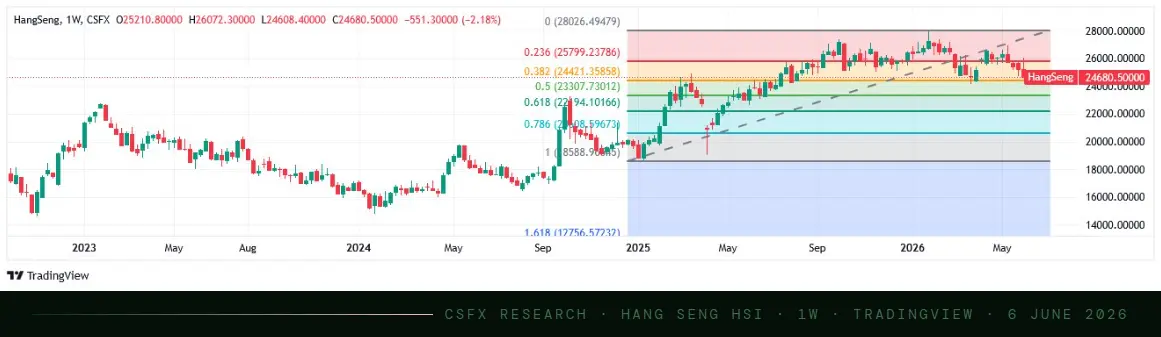
Direction: Conditional Short — Sell the Rally; Do Not Chase from 24,680
Entry: 25,000 — wait for intra-week bounce before initiating
Stop Loss: 25,600 — allows for ceasefire or CPI-driven sentiment bounce
Take Profit: 23,500 — next major demand zone / three-month low target
Key Risk: Soft US CPI or credible Iran ceasefire triggers sharp risk-on bounce above 25,600
Solana SOL/USD — Wait for $58 | Goldman Exit Drives to Entry Zone
Solana at $60.24 has dropped 9.14% on the week following Goldman Sachs’ full liquidation of its Solana ETF exposure — a signal the market has interpreted as a structural negative for institutional demand. Concurrently, meme-coin platform Pump.fun sold over 100,000 SOL adding direct sell pressure. The 200-day moving average has been falling since June 1, and the RSI is in bearish territory. At $60.24, SOL is now only $2.24 away from the $58 structural support zone — the level where CSFX expects compliant stablecoin demand and Solana ecosystem utility transactions to provide a natural demand floor. CSFX maintains the $58 entry discipline — do not initiate above this level despite the proximity. The $58 zone is where the 2025 institutional accumulation layer is concentrated, and entering at $60 provides insufficient buffer against a potential overshoot to $55. A breakdown through $58 on volume would re-target $52; hold the stop strictly.
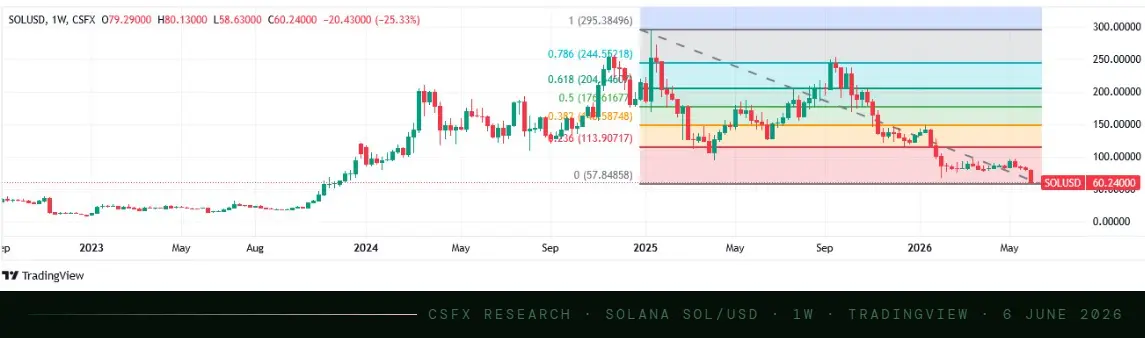
Direction: Wait — Buy at $58.00 Only; Do Not Chase at $60
Entry: $58.00 — structural support / 2025 institutional accumulation zone
Stop Loss: $52.00 — breakdown below $58 on volume re-targets this level
Take Profit: $76.00 — midpoint of prior consolidation range
Key Risk: Institutional follow-through selling breaks $58; Goldman exit signals further ETF pressure
Litecoin LTC/USD — Buy Zone $40–$44 | 2027 Pre-Halving Thesis Activated
Litecoin at $42.56 has broken decisively below the prior $47–$49 support band, declining 11.94% on the week in BTC-correlated risk-off selling. The breakdown through $47 is technically significant — it removes the prior accumulation floor and opens a path toward the $40–$43 demand zone now serving as the updated entry range. Despite the sharpness of the selldown, the fundamental pre-halving thesis remains fully intact: block rewards will halve from 6.25 LTC to 3.125 LTC in 2027, and historical pre-halving accumulation runs typically begin 12–18 months before the event. At $42.56, LTC is 28% below its 2026 high, creating a structurally attractive entry for patient accumulators. CSFX updates the entry zone to $40–$44, reflecting the new market level. At $42.56, the pair sits mid-zone — initiate 50% of the intended position now, reserving the remainder for any further dip toward $40. Keep position size to 30% of full crypto allocation given the macro risk-off environment.
Direction: Buy Zone $40–$44 — 50% position now, 50% reserved for dip toward $40
Entry Zone: $40.00–$44.00 — current price $42.56 is mid-zone
Stop Loss: $36.00 — below January 2026 lows; deeper BTC correlation break
Take Profit: $58.00 — prior support-turned-resistance from broken $47–$49 zone
Size: 30% of full crypto allocation — macro risk-off warrants reduced exposure
Key Risk: BTC breaks below $55K, triggering deeper altcoin correlation selloff
Key Catalysts — Events That Could Move Asia Markets This Week
BoJ Intervention Watch — USD/JPY Above 160 (Highest Priority)
With USD/JPY having breached 160.00 — the level defended in both April 2025 and September 2025 — the Bank of Japan’s intervention threshold is now live. The BoJ does not announce interventions in advance; they are executed without warning during low-liquidity sessions. Every day of sustained trading above 160 increases cumulative intervention probability. CSFX rates this as the single highest market-moving risk for the Asian session this week. An intervention episode would trigger 300–500 pips of yen strength in minutes, create risk-off across Asia-Pacific equities, and potentially provide the USD pullback that NZD bulls need to initiate their positions.
US CPI May 2026 — Wednesday Binary (Macro Dominant)
The US Consumer Price Index for May is the week’s most important macro data release. Consensus is for a modest 2.7% year-on-year print. A hotter-than-expected reading would reinforce USD strength — pushing USD/JPY further above 160 and pushing NZD/USD below 0.5760 — while also weighing on equities and crypto. A soft CPI print would provide relief across risk assets; with NZD/USD already at 0.5796, a soft print could spark an immediate bounce toward 0.5850. Core CPI consensus is 3.1% — above 3.3% is hawkish USD across all pairs; below 2.9% raises Fed cut probability.
RBNZ June 15–16 Policy Decision (NZD Catalyst)
The Reserve Bank of New Zealand meets on June 15–16 under new Governor Anna Breman. The OCR is at 2.25% following May’s 25bp hike, with markets pricing over 40% probability of a further July hike. The RBNZ’s own revised OCR path implies approximately 100bp of total tightening ahead. The June statement’s forward guidance language will be the critical driver of NZD/USD direction — hawkish language targeting 2.50% by September would support NZD above 0.5900. This meeting comes after Wednesday’s US CPI, meaning the CPI binary sets the macro backdrop for how much any RBNZ hawkish signal can move the pair.
EIA Natural Gas Storage — Thursday Confirmation Gate
Thursday’s EIA weekly natural gas storage report is the primary catalyst for managing the natural gas long position. The storage surplus has narrowed from 6% to 5% above the 5-year average over the past week. For the $3.70 take-profit target to remain valid with natural gas at $3.22, CSFX needs to see continued surplus narrowing to below 140 bcf above the 5-year average. A storage build below +60 bcf confirms the narrowing surplus trend and validates the bull thesis. A build above +90 bcf signals the surplus is widening and should trigger a reassessment before entry.
China Friday Data — Industrial Production and Retail Sales
Friday’s China Industrial Production and Retail Sales prints for May are the primary catalyst for both Copper and the Hang Seng. IP consensus is 5.6% year-on-year; below 4.5% would be bearish for copper and negative for Hang Seng tech and materials. Retail Sales consensus is 5.5% year-on-year; above 6% positive for Hang Seng consumer names; below 4% a macro weakness flag. A beat across both prints would be the risk-on trigger for copper to re-challenge $6.50+ and could provide the Hang Seng its first positive catalyst of the week.
US-Iran Ceasefire & Crypto Institutional Flows — Ongoing Wildcards
The fragile US-Iran ceasefire — with fresh strikes reported Thursday — is the primary tail risk for Asia-Pacific equities and energy markets. A credible peace deal would trigger risk-on across Hong Kong, reduce the Middle East LNG supply premium, and push the Hang Seng toward 26,000. Renewed escalation would deepen the current equity selldown and push natural gas higher. For Solana at $60.24, monitoring whether the $58 structural support holds or whether institutional follow-through selling breaks below it is the key data point. For Litecoin at $42.56, on-chain hash rate data and pre-halving cycle signals from major LTC wallets will refine timing within the updated $40–$44 accumulation zone.
Economic Calendar — Asia-Pacific, 9–13 June 2026
All times Singapore Time (SGT). Impact ratings: HIGH / MED / LOW. CSFX watch notes indicate the threshold levels that matter for each instrument.
Monday 9 June — China CPI May YoY at 09:30 SGT (HIGH, consensus 0.2%). Below zero is a deflation signal — bearish Copper and Hang Seng; above 0.5% is an upside surprise bullish for HK equities. Japan Q1 GDP Final Revision at 10:30 SGT (MED, consensus -0.7% QoQ). A weaker revision increases BoJ dovish pressure and may extend USD/JPY above 160 temporarily.
Tuesday 10 June — Australia NAB Business Confidence May at 08:00 SGT (MED, consensus +3). Below zero is AUD negative; above +5 signals RBA hold vindicated. BoJ FX Market Surveillance continuous all day (HIGH). USD/JPY above 160 means intervention risk is highest on any day — any MOF/BoJ statement triggers an immediate volatility event.
Wednesday 11 June — US CPI May YoY at 20:30 SGT (HIGH, consensus 2.7%). Above 3.0% means USD surge, NZD/USD tests 0.5800, risk-off in crypto. Below 2.5% means risk-on, NZD long entry triggers. US Core CPI May YoY at 20:30 SGT (HIGH, consensus 3.1%). Above 3.3% is hawkish USD across all pairs; below 2.9% raises Fed cut probability.
Thursday 12 June — EIA Natural Gas Storage Change at 01:00 SGT (HIGH, consensus +75 bcf). Build above +90 bcf is bearish for nat gas as surplus widens; below +60 bcf means storage tightening, bull case intact. Japan PPI May YoY at 07:50 SGT (MED, consensus 3.2%). Above 4% signals imported inflation adding BoJ rate hike pressure and supporting yen intervention urgency above 160.
Friday 13 June — China Industrial Production May YoY at 08:30 SGT (HIGH, consensus 5.6%). Below 4.5% is bearish for Copper; below 5% is negative for Hang Seng tech and materials; above 6% is a risk-on catalyst for both. China Retail Sales May YoY at 08:30 SGT (HIGH, consensus 5.5%). Above 6% is positive for Hang Seng consumer names; below 4% is a macro weakness flag. US Michigan Consumer Sentiment June Preliminary at 20:30 SGT (MED, consensus 67.5). Below 65 is risk-off into the weekend; above 70 is mildly USD supportive.
Asia-Pacific Enters a Week Defined by Three Binaries
The week of 9–13 June 2026 presents Asian session traders with an unusually concentrated event structure: USD/JPY has already crossed the 160.00 BoJ intervention threshold, meaning the Bank of Japan’s response is a live and near-term risk rather than a hypothetical. The US CPI release on Wednesday creates a second binary — hot CPI pushes USD strength further against NZD, copper, and crypto; soft CPI opens the door to NZD/USD recovery and risk asset stabilisation. Understanding the sequencing matters: Wednesday’s CPI sets the table for whether the RBNZ meeting on June 15–16 delivers NZD bulls the catalyst they need.
In commodities, natural gas’s sustained elevation near $3.22 and copper’s pullback to the $6.31 entry zone represent the two most tactically relevant commodity setups in CSFX’s Asia coverage. Friday’s nat gas pullback is a healthy retracement, not a trend reversal — the EIA Thursday print is the confirmation mechanism. Copper at $6.31/lb is now at the entry level that provides structural support and allows a defined risk framework.
In equities and crypto, CSFX’s core positioning is Hang Seng conditional short on any rally to 25,000 with geopolitical risk-off persisting; Solana still waiting at $58, currently at $60.24 and almost there; and Litecoin updated accumulation zone at $40–$44 at current levels of $42.56 on the 2027 halving cycle thesis. The single most important wildcard for the week remains the BoJ — an intervention episode would trigger yen strength across all Asia-Pacific pairs, create risk-off in equities, and potentially provide the USD pullback that NZD bulls need to initiate positions. CSFX will issue intra-week alerts if the BoJ intervenes, the US CPI materially surprises, or any crypto regulatory development changes the Solana or Litecoin setups.
Read Full Report: https://www.capitalstreetfx.com/market-analysis/daily-market-analysis/

Comments
No comments yet. Be the first to share your thoughts!
Comments only for logged-in users.