

Nvidia and Hyundai Discuss an AI Center in South Korea
When Two Giants Sit Down at the Same Table
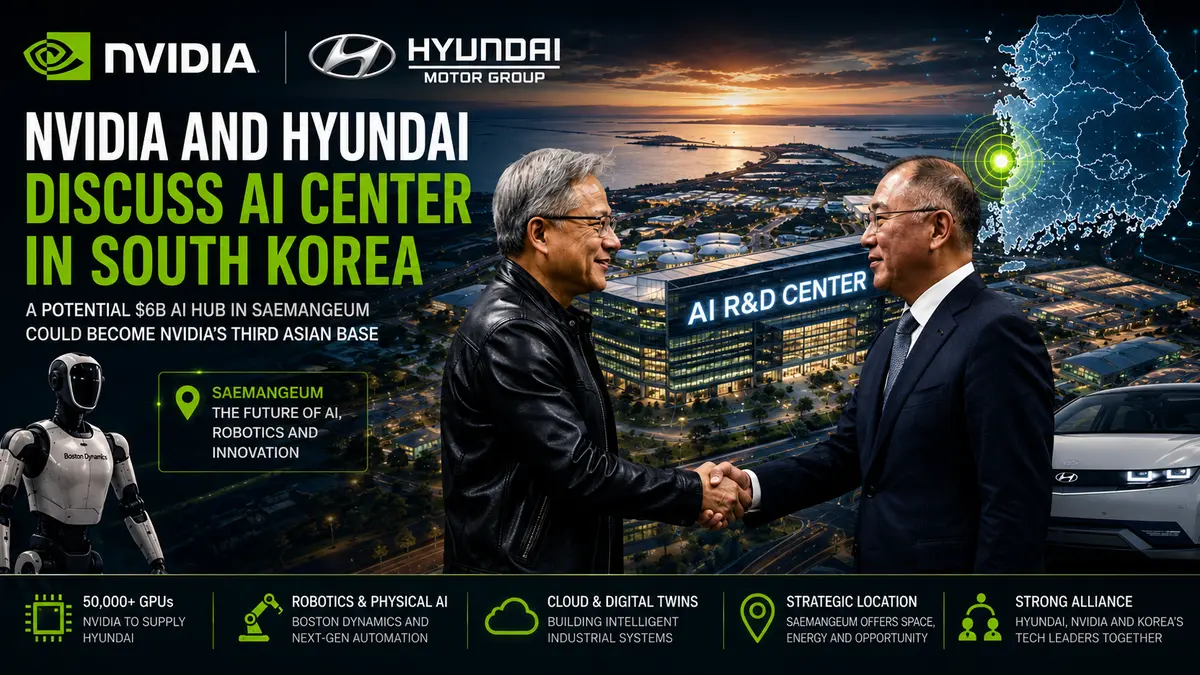
In the world of high technology, some developments make markets pause and watch closely. The ongoing talks between Nvidia and Hyundai Motor Group are one of those moments. Not because the two companies have never worked together before—they have, and quite extensively. Rather, it is because the scale of what is now being discussed goes far beyond a standard business partnership.
At the center of the discussions is the creation of an artificial intelligence technology hub in South Korea. Not merely an office or a university-affiliated research lab, but a full-scale R&D center that could become Nvidia’s third major base in Asia, alongside its existing hubs in Singapore and Taiwan.
Reports that negotiations have entered their final stage emerged Thursday in The Korea Economic Daily, citing government and industry officials. There has been no official confirmation yet. A Hyundai Motor Group spokesperson stated that no final decisions have been made regarding the project, its timeline, or its location. However, the fact that details surfaced just before Nvidia CEO Jensen Huang’s visit to Seoul is telling.
The timing is significant. In October 2025, Hyundai, Nvidia, and South Korea’s Ministry of Science and ICT signed a memorandum of understanding. Nvidia committed to supplying GPUs to Hyundai and jointly developing AI facilities in the country. Six months later, the partnership appears to be moving from broad commitments to concrete implementation.
Now attention has shifted to the final details: site selection, project structure, and strategic alignment. Huang is expected to arrive in Seoul on Friday and meet Hyundai Motor Group Executive Chair Euisun Chung. According to reports, an informal dinner is planned in Seoul’s Seongsu-dong district, with executives from SK Group, LG Group, and Naver also expected to attend.
The rumored menu? Korean pork belly barbecue accompanied by soju and beer. Not a formal state dinner, but a relaxed conversation. Those familiar with Huang’s style say this is exactly how he prefers to do business.
Saemangeum: From Reclaimed Land to Future Technology Hub
According to industry sources, the leading candidate for the new center is the Saemangeum coastal development zone on South Korea’s southwest coast.
Saemangeum is more than a construction site. It is one of the most ambitious development projects in South Korean history—a vast area reclaimed from the sea that the government has spent decades transforming into a hub for future industries.
Hyundai Motor Group has already committed approximately 9 trillion won—nearly $6 billion—to building an innovation cluster focused on AI, robotics, and hydrogen energy in the region.
Why Saemangeum?
1. Space
In a densely populated country where land is scarce, finding room for a large-scale AI campus is challenging. Saemangeum offers extensive opportunities for future expansion.
2. Energy
Training large AI models requires enormous amounts of electricity. Saemangeum’s renewable energy ambitions could provide relatively clean and cost-effective power for data centers and AI infrastructure.
3. Government Support
South Korea views AI development as a national strategic priority. Bringing Nvidia—the global leader in AI chips—to Saemangeum would not simply add another facility. It would create an anchor tenant capable of attracting startups, suppliers, and technology partners, helping build an entire innovation ecosystem.
For Nvidia, South Korea is much more than another market. It provides direct access to key partners such as Samsung and SK Hynix, both essential suppliers in the global semiconductor ecosystem. It also offers proximity to advanced manufacturing capabilities and a technologically sophisticated market that readily adopts innovation.
From Memorandum to Reality
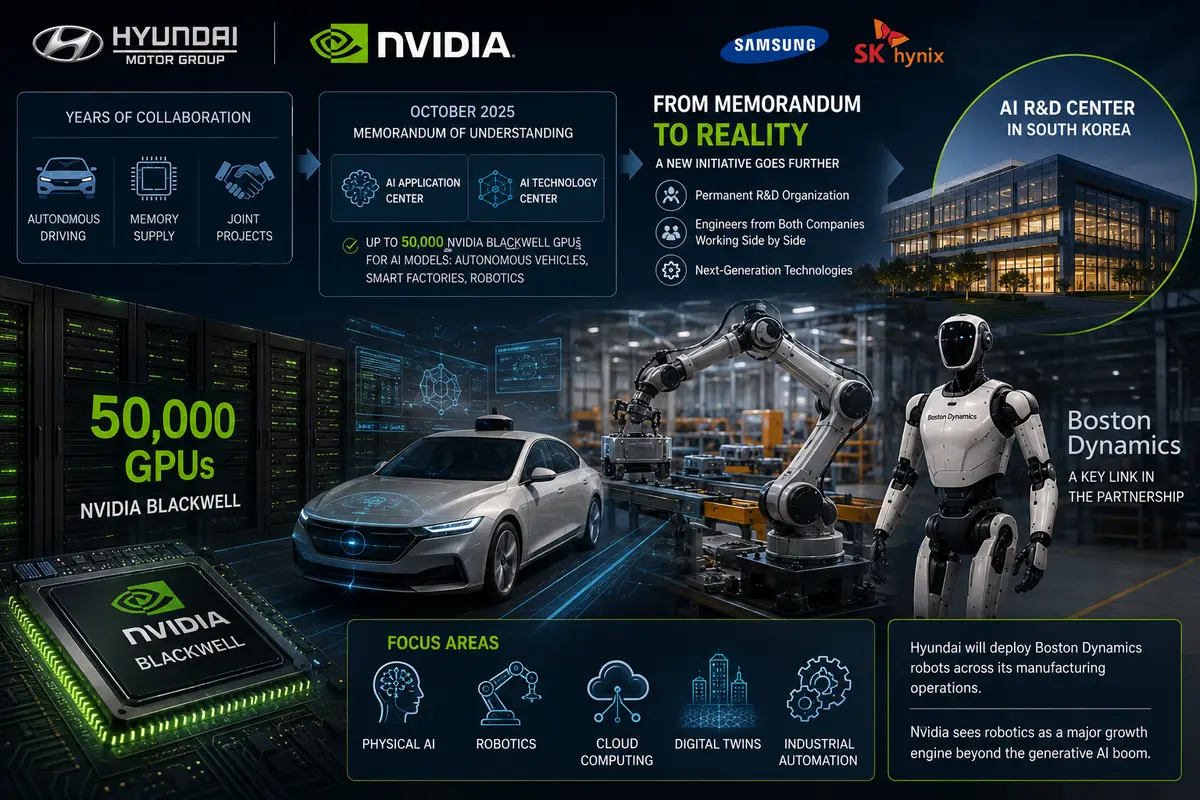
The roots of this partnership stretch back far beyond the October 2025 memorandum.
Hyundai already uses Nvidia technology in autonomous driving systems. Nvidia, meanwhile, relies on memory supplied by Samsung and SK Hynix. The companies have worked together for years.
What is being discussed today, however, is fundamentally different in scale.
The October memorandum envisioned both an AI Application Center and an AI Technology Center in South Korea. Hyundai was expected to gain access to as many as 50,000 Nvidia Blackwell GPUs to train AI models for autonomous vehicles, smart factories, and robotics applications.
Fifty thousand GPUs is not a symbolic deployment—it represents industrial-scale AI infrastructure.
The new initiative goes further. It is not simply about hardware procurement. It is about establishing a permanent R&D organization where engineers from both companies can work side by side on next-generation technologies.
Areas expected to receive significant attention include:
-
Physical AI
-
Robotics
-
Cloud computing
-
Digital twins
-
Industrial automation
A key link between Nvidia’s ambitions and Hyundai’s capabilities is Boston Dynamics. The robotics company behind the famous Atlas robot is owned by Hyundai Motor Group and is central to Hyundai’s automation strategy.
Hyundai plans to deploy Boston Dynamics robots throughout its manufacturing operations, while Nvidia sees robotics as one of the most important growth opportunities beyond the current generative AI boom.
Jensen Huang and Technology Diplomacy, Korean Style
Jensen Huang’s visit to Seoul carries significance beyond the negotiations themselves.
He is expected to arrive on June 4 and spend four days immersed in South Korea’s technology ecosystem.
Friday, June 5
The headline event is an evening dinner in Seongsu-dong, a district that has evolved into one of Seoul’s most dynamic centers for startup culture and innovation.
Attendees are expected to include:
-
Euisun Chung (Hyundai Motor Group)
-
Chey Tae-won (SK Group)
-
Koo Kwang-mo (LG Group)
-
Lee Hae-jin (Naver)
This would not be Huang’s first informal gathering with Korean business leaders. In October of last year, he reportedly met with executives including Samsung Electronics Chairman Lee Jae-yong and Euisun Chung at a fried chicken restaurant in Seoul. Those discussions focused on semiconductors, HBM memory, and chip collaboration. This time, the agenda is broader and potentially more transformative.
Saturday, June 7
Huang is expected to throw the ceremonial first pitch at a Korean Baseball Organization game featuring the Doosan Bears.
In South Korea, baseball is more than a sport—it is a cultural institution. Participating in the first-pitch ceremony is widely seen as a gesture of respect toward the local community.
Later that day, Huang is expected to meet NCsoft CEO Kim Taek-jin to discuss collaboration in gaming and AI.
Sunday, June 8
The focus shifts to startups and academia.
A closed-door meeting is reportedly scheduled at Seoul’s Shilla Hotel with representatives from AI and robotics startups, including Upstage, Nota, Bespin AI, and others.
The message is clear: Nvidia’s interest in South Korea extends beyond major conglomerates. The company recognizes that tomorrow’s industry leaders may emerge from today’s startups.
Huang is also expected to visit Seoul National University’s AI and Robotics Institute and tour Naver’s futuristic 1784 headquarters in Pangyo, where the company is experimenting with robotics, cloud infrastructure, and digital twin technologies.
He is scheduled to depart Korea on the evening of June 8.
In four days, Huang’s itinerary spans corporations, startups, universities, sports, and media appearances—an intensive engagement with virtually every layer of South Korea’s innovation ecosystem.
Why This Matters for Nvidia and Hyundai
For Nvidia, South Korea is not merely a customer base. It is a critical component of the company’s global supply chain.
While Taiwan’s TSMC manufactures Nvidia’s chips, much of the advanced memory that powers those chips comes from South Korea’s Samsung and SK Hynix.
Collaboration with Hyundai also allows Nvidia to move beyond selling chips and toward building complete AI-driven systems. Autonomous vehicles, robotics, and industrial automation all require deep integration of hardware and software.
Nvidia aims to be the architect of that integration.
For Hyundai, the partnership may represent one of its most important strategic advantages in the race toward the future of mobility and robotics.
Electric vehicles alone are no longer enough.
The next frontier includes:
-
Autonomous driving
-
Connected services
-
Delivery robots
-
Industrial robots
-
AI-powered manufacturing
All of these depend on advanced AI—and Nvidia currently leads the industry in AI computing platforms.
The proposed center in Saemangeum is therefore more than a building. It is a bridge between South Korea’s manufacturing expertise and America’s leadership in AI technology.
Its ultimate goal is to create a closed-loop ecosystem in which Nvidia’s AI systems learn from Hyundai’s industrial and mobility data, and those insights return as smarter vehicles, more efficient factories, and more capable robots.
Nvidia’s Broader Asian Strategy
If the Korean center moves forward, it would fit neatly into Nvidia’s larger strategy across Asia.
Each major location serves a distinct role:
-
Taiwan: Advanced semiconductor manufacturing through TSMC
-
Singapore: Regional cloud infrastructure and supply-chain management
-
South Korea: Physical AI, robotics, and industrial applications
Together, these three hubs could form a powerful technology triangle covering the entire innovation pipeline—from chip production to cloud infrastructure to real-world deployment.
This alignment is no coincidence.
Asia remains the center of gravity for much of the global technology industry. Nvidia cannot afford to be absent from the region’s most important innovation centers.
South Korea may not be the largest country in Asia, nor the cheapest in terms of labor costs, but it remains one of the world’s most technologically advanced and innovation-driven economies.
Market Reaction and What Comes Next
Reports of the negotiations immediately attracted investor attention.
Hyundai Motor shares experienced heightened volatility as investors awaited further details, while official confirmation of the project could also provide support for Nvidia’s stock.
Yet the market reaction may ultimately be less important than the strategic implications.
If the Saemangeum center becomes reality, it will signal that the global competition for leadership in physical AI and robotics has entered a new phase.
A phase in which the winner gains not merely market share, but influence over the future structure of entire industries.
When Jensen Huang sits down with South Korea’s business leaders, global technological rivalries will not disappear overnight. But a new alliance may begin to take shape—one capable of influencing how vehicles, factories, and robots are designed and operated throughout the next decade.
And that, perhaps, is worth setting aside formal protocol for a few hours and discussing over pork belly barbecue and soju—the Korean way: practical, personal, and focused on business.

Comments
No comments yet. Be the first to share your thoughts!
Authentication Required
You must be logged in to post a comment.