

Technological Anchor: Why the British Pound Is Finding New Support
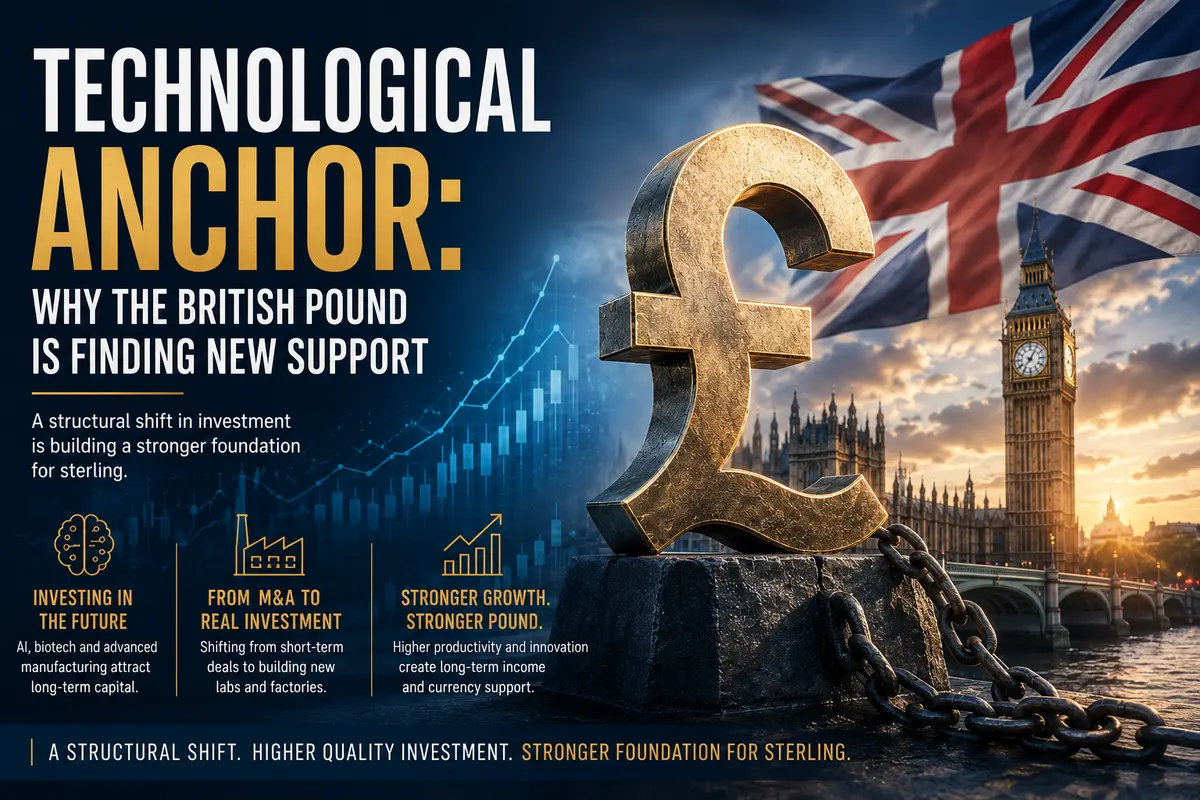
In recent years, the British pound has often looked like a currency adrift. Brexit, political turmoil, scandals involving prime ministers, inflation shocks, and the Iran crisis have all weighed on sterling from different directions. Yet beneath the surface of this turbulence, largely unnoticed by newspaper headlines, a structural shift has been taking place. According to Bank of America strategist Kamal Sharma, this shift could become a long-term pillar of support for the pound. The shift has a name: a transformation in the quality of foreign direct investment (FDI).
From Mergers and Acquisitions to Laboratories and Factories
For decades, sterling was highly sensitive to global mergers and acquisitions (M&A) cycles. When international corporations acquired British companies, billions of dollars flowed into the country, strengthening the pound. When M&A activity slowed, the currency weakened. This created a chronic dependence on short-term, volatile capital flows. A deal closed, money arrived. No deals, no money. The pound effectively danced to the tune of Wall Street investment bankers.
Now, according to EY data cited by Bank of America, the nature of investment flows is changing. The UK is gradually moving away from its dependence on mergers and acquisitions. Instead, it is attracting investment into new production facilities and research and development (R&D). Capital is no longer being used primarily to purchase existing assets but to create new ones. This represents a fundamentally different quality of investment.
Sharma points to specific sectors: artificial intelligence, biotechnology, and advanced manufacturing. These are knowledge-intensive industries that create high-paying jobs, generate intellectual property, and improve economic productivity. When Google or Microsoft opens a research center in Cambridge, when a pharmaceutical giant builds a laboratory in Oxford, or when a semiconductor manufacturer establishes a plant in Scotland, it is not merely a one-off capital inflow. It is the creation of long-term assets capable of generating returns for decades.
Why This Matters for Sterling
Currency markets often focus on short-term factors: what a central bank governor said, the latest inflation data, or how many oil tankers passed through the Strait of Hormuz. But the long-term fate of a currency is determined by fundamental capital flows. And this is where a significant shift is taking place.
Investment in R&D and manufacturing creates what economists call “non-price competitiveness.” A country begins exporting not just products, but high-value-added products. Medicines developed in British laboratories. Software written by British engineers. Chips designed by British architects and engineers. These activities generate income that flows back into the country, supporting the balance of payments and, by extension, the currency.
Sharma emphasizes that “this may not immediately translate into an improvement in the balance of payments.” Structural transformations do not happen overnight. A laboratory built today may only become profitable several years from now. But markets are forward-looking. If investors see the quality of incoming capital improving, they may be willing to assign a higher valuation to the currency today.
Political Uncertainty Has Not Broken Sterling
One of Sharma’s most intriguing observations concerns the pound’s resilience. He notes that the currency has remained relatively stable despite ongoing political uncertainty. And there has been no shortage of uncertainty: speculation about Keir Starmer’s leadership, the possibility of a change in prime minister, budget disputes, and ambiguity surrounding fiscal policy.
In the past, such a combination of factors might have been enough to send sterling sharply lower. Yet the currency has held up. Why? Sharma suggests that the answer lies precisely in the changing quality of investment flows. When a country attracts long-term strategic investment rather than speculative “hot money” that can leave at a moment’s notice, its currency becomes less sensitive to political noise. An investor who has committed a billion pounds to building a research center is unlikely to withdraw that investment simply because a prime minister changes. Their time horizon is measured in decades, not election cycles.

Europe Falls Behind: Old Industries Versus New Ones
Bank of America draws an important comparison with continental Europe. According to the bank, the UK exhibits a “structurally higher-quality profile of foreign direct investment inflows than Europe, where legacy industries still dominate.” It is a bold statement, but one grounded in economic reality.
Continental Europe, for all its strengths, remains in many respects an economy shaped by twentieth-century industries. Automotive manufacturing, chemicals, and heavy engineering continue to form the backbone of its investment appeal. These sectors remain important, but they are mature industries with limited productivity-growth potential. The UK, by contrast, appears to be repositioning itself toward the industries of the future.
This does not mean Britain has abandoned financial services—its traditional strength. Capital inflows into the financial sector remain substantial. However, they are now being complemented by emerging knowledge-intensive industries. This diversification of investment income sources is another factor that may reduce currency volatility.
The Medium-Term Outlook: Productivity and Income Growth
Sharma summarizes his analysis in terms that matter to long-term investors:
“The shift toward R&D, manufacturing, and knowledge-intensive sectors should support the currency over the medium term through stronger income generation, higher productivity growth, and reduced dependence on volatile M&A flows.”
Productivity growth is the holy grail of economic policy. A country that produces more output per worker can pay higher wages without fueling inflation. It can export more without sacrificing living standards. It can support its currency without relying excessively on higher interest rates. If Britain is genuinely moving in this direction, sterling is gaining a fundamental source of support that it has lacked for decades.
Reducing dependence on volatile M&A flows is another key factor. Mergers and acquisitions are cyclical. They surge during good times and dry up during downturns. Investment in R&D and manufacturing tends to be more stable. A laboratory is unlikely to close simply because global risk appetite declines. A factory will not relocate because a tax rate changes by half a percentage point. This creates a more predictable stream of income for the economy and a more stable foundation for the currency.
What This Means for Investors
For those following sterling, Bank of America’s analysis offers a new framework for evaluating the currency. Short-term factors—the Iran crisis, oil prices, and divergences in monetary policy between the Bank of England and the Federal Reserve—have not disappeared. They will continue to influence exchange rates on a daily basis. But beneath these fluctuations, a deeper, more tectonic shift is taking shape.
The pound is becoming less dependent on the whims of the global M&A market and increasingly supported by real, long-term investment in the technologies of the future.
This does not mean sterling faces a trouble-free future. Political risks remain. Inflation is still above target. Geopolitical tensions in the Middle East continue to pressure global currencies, including the pound. But if Sharma’s thesis proves correct, sterling is quietly developing a stronger and more durable foundation beneath the surface. And when the current storms eventually pass, that foundation may well determine the currency’s long-term direction.

Comments
No comments yet. Be the first to share your thoughts!
Authentication Required
You must be logged in to post a comment.