

What is a Financial Exchange? The Engine of Global Capital
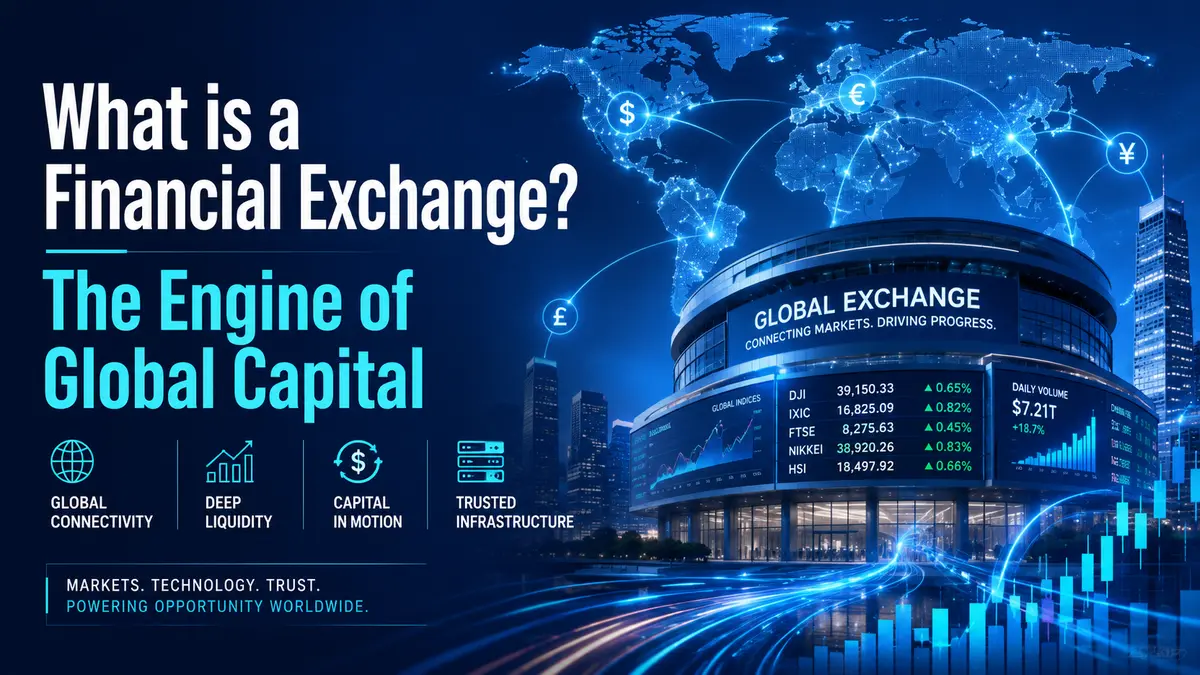
At its core, an exchange is a highly organized, centralized marketplace where participants gather to trade various financial instruments, including equities (stocks), bonds, commodities, fiat currencies, and a wide array of derivative assets. Far from being just a physical building or a digital website, an exchange is a foundational element of the global financial infrastructure. It acts as the beating heart of capitalist economies, channeling funds from investors who have capital to corporations and governments that need it to grow, innovate, and build infrastructure.
In the modern financial landscape, particularly in the United States and Europe, exchanges represent the pinnacle of regulatory compliance, technological sophistication, and financial security.
The Fundamental Pillars of an Exchange
To truly understand what an exchange does, we must look at the primary functions it serves in the broader macroeconomic ecosystem:
-
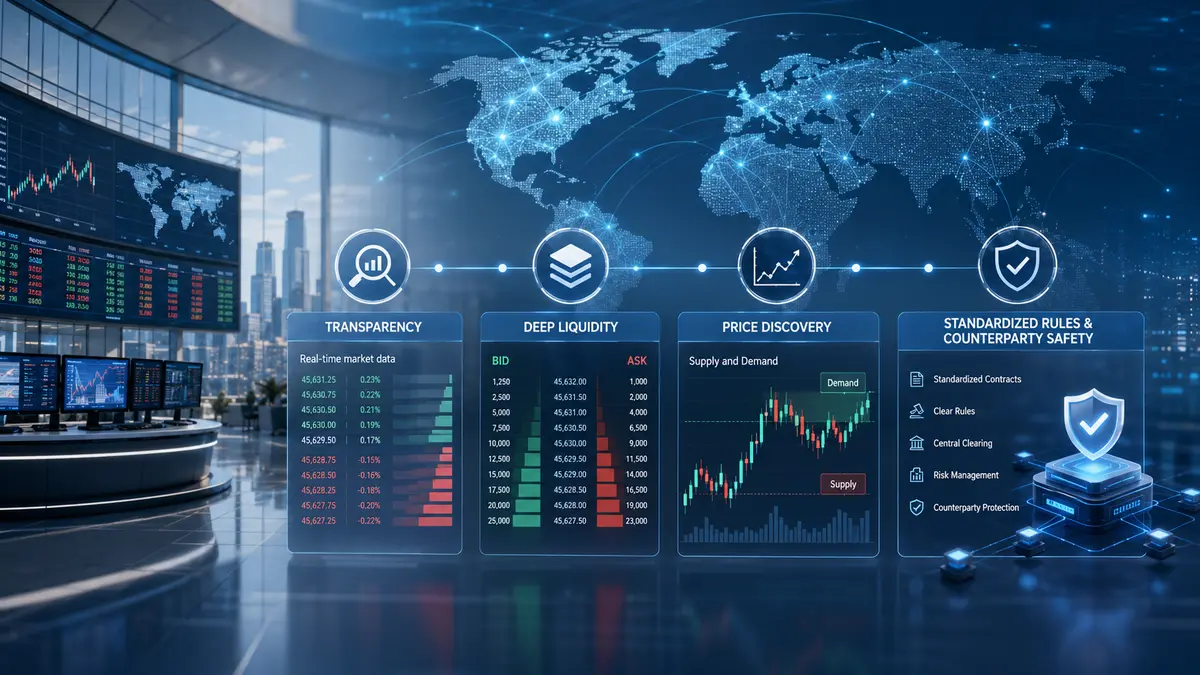
Uncompromising Transparency: One of the most critical features of a regulated exchange is its commitment to transparency. Every bid, offer, and executed trade is meticulously recorded and made available for public and regulatory observation through order books and the consolidated tape. This ensures the integrity and openness of the trading process. Whether you are a retail investor in Berlin or a massive institutional hedge fund in New York, you have access to the same real-time pricing data.
-
Deep Liquidity: An exchange facilitates liquidity by centralizing buyers and sellers in one venue. High liquidity means that investors can easily and swiftly buy or sell assets without causing a massive fluctuation in the asset’s price. Market makers — specialized financial firms like Citadel Securities in the US or Optiver in Europe — often operate on these exchanges to continuously provide buy and sell quotes, ensuring that the market never freezes.
-
Accurate Price Discovery: Exchanges serve as the ultimate mechanism for determining the fair market value of financial instruments. Prices are not set arbitrarily; they are forged in the fires of supply and demand. As millions of market participants interact, absorbing news about US inflation data, European Central Bank interest rate decisions, or corporate earnings reports, the exchange continually calculates and updates the true price of an asset in real-time.
-
Standardized Rules and Counterparty Safety: Trading on an exchange is governed by strict, standardized procedures. When you buy a stock on the London Stock Exchange (LSE) or the New York Stock Exchange (NYSE), a clearinghouse guarantees the trade. This eliminates counterparty risk—the danger that the person on the other side of your trade might default on their obligation.
Diverse Types of Exchanges in the Modern Financial Ecosystem
The global financial market is vast and highly specialized. Consequently, different types of exchanges have evolved to handle specific asset classes, each offering unique conditions and structures tailored to their respective industries.
1. Stock Exchanges (Equities and Derivatives)
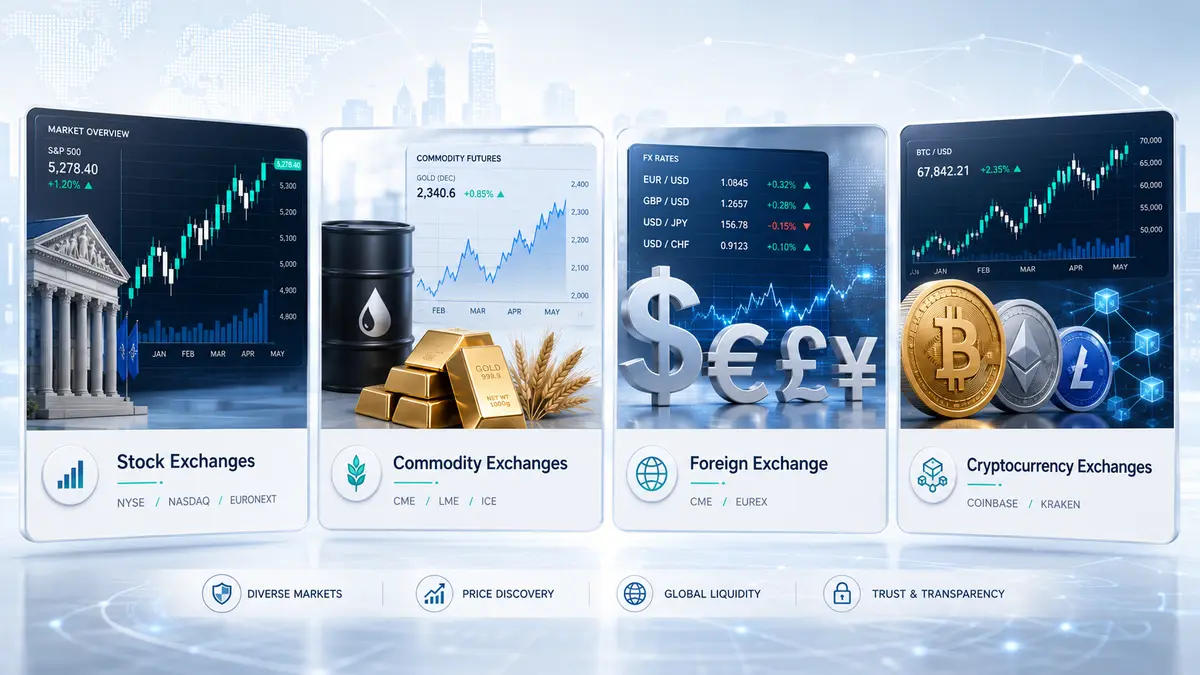
This is the most widely recognized type of exchange. Stock exchanges specialize in the trading of publicly listed company shares, as well as derivatives like options and futures. Companies list their shares here via an Initial Public Offering (IPO) to raise capital.
-
US and European Examples: The New York Stock Exchange (NYSE) and NASDAQ are the undeniable titans of the global equity market, hosting tech giants like Apple and Microsoft. In Europe, Euronext (which spans Paris, Amsterdam, and Brussels) and the Frankfurt Stock Exchange (Deutsche Börse) provide critical platforms for industrial and financial powerhouses across the Eurozone.
2. Commodity Exchanges
Long before tech stocks existed, merchants needed a way to standardize the trading of physical goods. Commodity exchanges handle the trading of raw materials such as crude oil, natural gas, gold, silver, and agricultural products like wheat and coffee. Today, most of this trading is done via futures contracts, allowing farmers to lock in prices for their crops and airlines to hedge against rising jet fuel costs.
-
US and European Examples: The Chicago Mercantile Exchange (CME) is a global leader in agricultural and energy futures. In Europe, the London Metal Exchange (LME) is the world’s premier center for the trading of industrial metals like copper and aluminum, while the Intercontinental Exchange (ICE) handles benchmark Brent Crude oil trading in London.
3. Foreign Exchange (Currency) Markets
While the broader Forex (foreign exchange) market operates primarily over-the-counter (OTC) directly between global banks, centralized exchanges play a vital role in currency derivatives. Investors and multinational corporations use these exchanges to exchange one currency for another at current or future rates, facilitating international trade and protecting against currency volatility (such as fluctuations in the EUR/USD pair).
-
US and European Examples: Currency futures and options are heavily traded on the CME in the US, as well as on Eurex, one of the leading derivatives exchanges in Europe, based in Germany.
4. Cryptocurrency Exchanges
Representing the newest frontier in finance, cryptocurrency exchanges facilitate the trading of digital assets and tokens like Bitcoin and Ethereum. Traders fund their accounts with fiat currency and place buy or sell orders to profit from the highly volatile price movements of these digital tokens.
-
US and European Examples: Platforms like Coinbase and Kraken dominate the US and European markets. Unlike traditional exchanges, crypto exchanges often act as the broker, exchange, and custodian all at once, leading to ongoing debates about regulatory frameworks, such as the Markets in Crypto-Assets (MiCA) regulation recently implemented in the European Union.
The Critical Role of Regulation and Oversight
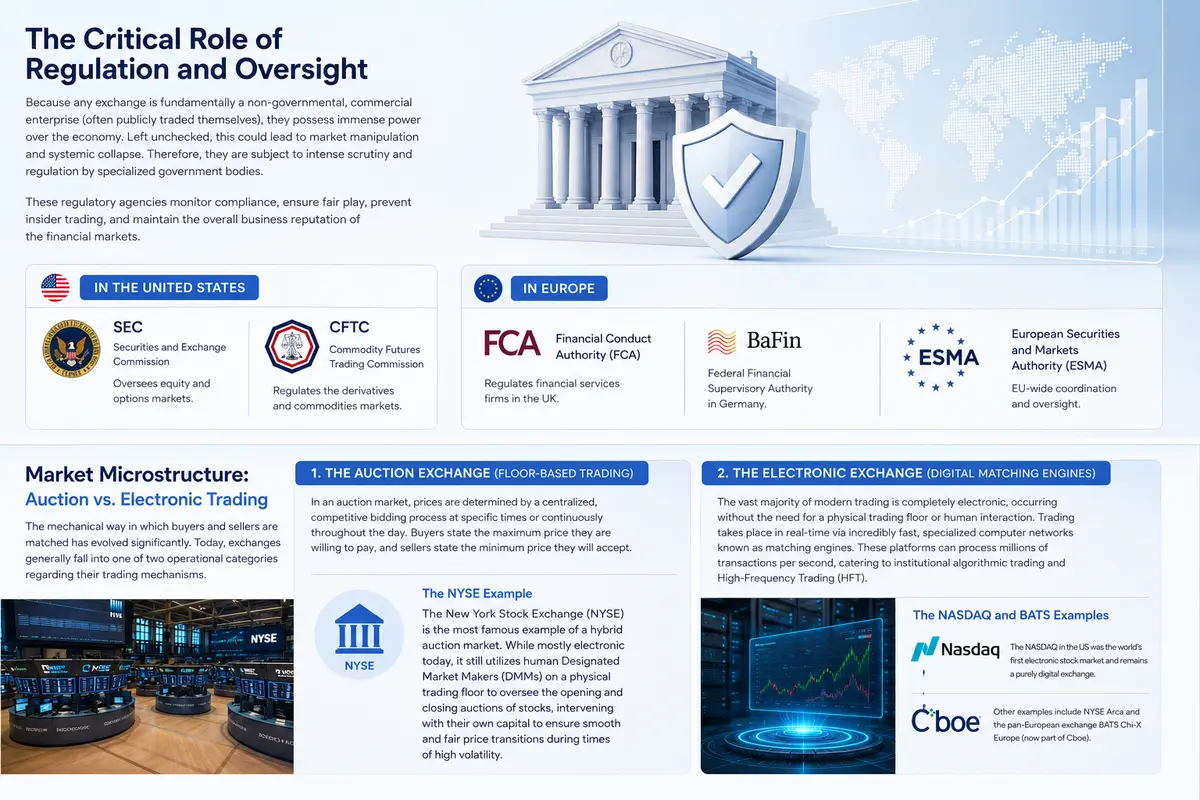
Because any exchange is fundamentally a non-governmental, commercial enterprise (often publicly traded themselves), they possess immense power over the economy. Left unchecked, this could lead to market manipulation and systemic collapse. Therefore, they are subject to intense scrutiny and regulation by specialized government bodies.
These regulatory agencies monitor compliance, ensure fair play, prevent insider trading, and maintain the overall business reputation of the financial markets.
-
In the United States: The Securities and Exchange Commission (SEC) oversees equity and options markets, while the Commodity Futures Trading Commission (CFTC) regulates the derivatives and commodities markets.
-
In Europe: Regulatory oversight is provided by national authorities like the Financial Conduct Authority (FCA) in the UK and BaFin in Germany, with broader EU-wide coordination handled by the European Securities and Markets Authority (ESMA).
Market Microstructure: Auction vs. Electronic Trading
The mechanical way in which buyers and sellers are matched has evolved significantly. Today, exchanges generally fall into one of two operational categories regarding their trading mechanisms:
1. The Auction Exchange (Floor-Based Trading)
Historically, trading floors were chaotic rooms filled with shouting brokers. In an auction market, prices are determined by a centralized, competitive bidding process at specific times or continuously throughout the day. Buyers state the maximum price they are willing to pay, and sellers state the minimum price they will accept.
-
The NYSE Example: The New York Stock Exchange (NYSE) is the most famous example of a hybrid auction market. While mostly electronic today, it still utilizes human Designated Market Makers (DMMs) on a physical trading floor to oversee the opening and closing auctions of stocks, intervening with their own capital to ensure smooth and fair price transitions during times of high volatility.
2. The Electronic Exchange (Digital Matching Engines)
The vast majority of modern trading is completely electronic, occurring without the need for a physical trading floor or human interaction. Trading takes place in real-time via incredibly fast, specialized computer networks known as matching engines. These platforms can process millions of transactions per second, catering to institutional algorithmic trading and High-Frequency Trading (HFT).
-
The NASDAQ and BATS Examples: The NASDAQ in the US was the world’s first electronic stock market and remains a purely digital exchange. Other examples include NYSE Arca and the pan-European exchange BATS Chi-X Europe (now part of Cboe).
The primary differences between auction and electronic exchanges lie in their price formation methods, the sheer speed of execution (microseconds in electronic markets), and how accessible they are to various types of participants.
Ultimately, every type of exchange has its distinct advantages and limitations, and the choice of where a stock is listed or where an investor trades heavily depends on their specific financial objectives, required trading speeds, and overarching investment strategies.

Comments
No comments yet. Be the first to share your thoughts!
Authentication Required
You must be logged in to post a comment.