

USD/PLN – Central European Growth Engine, NBP Rate Cycles, and EU Capital Flows
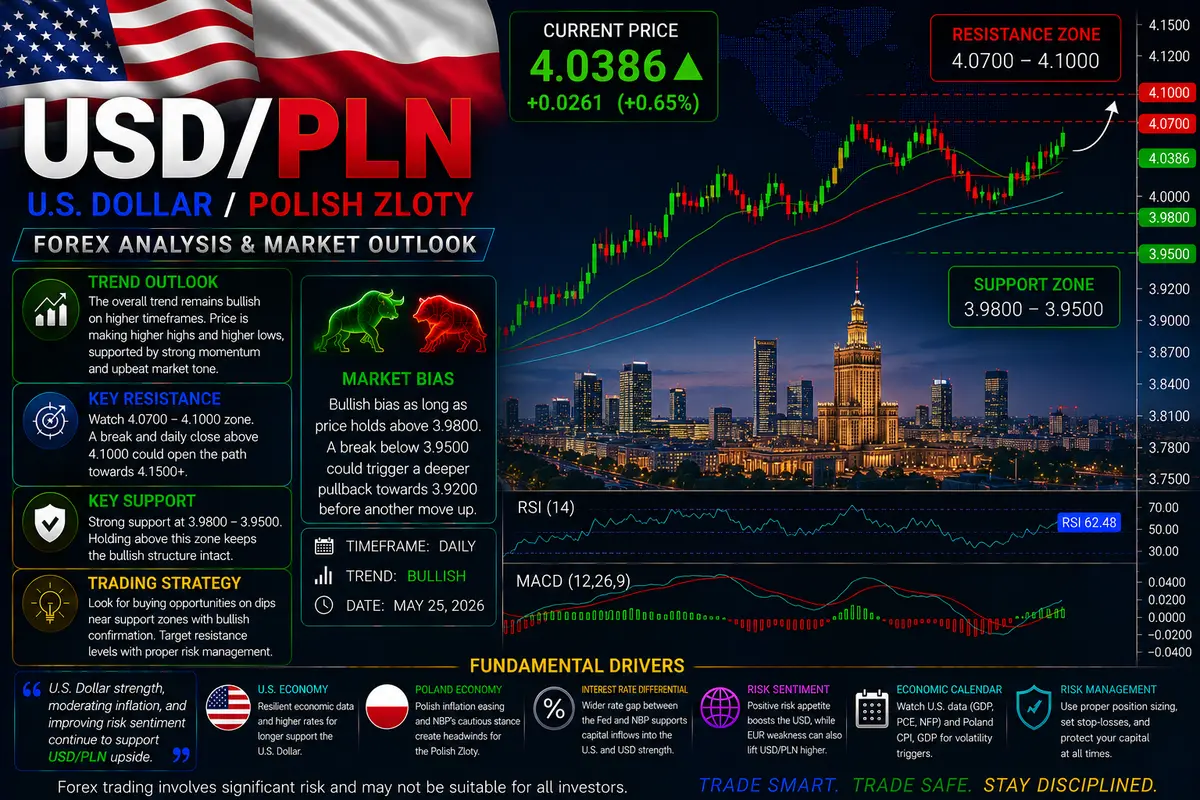
If you speak to institutional dealers handling Central and Eastern European (CEE) exposure, USD/PLN is universally recognized as the workhorse of the region. The Polish Zloty sits in a rare sweet spot for an exotic cross: it offers enough volatility to produce clean, directional multi-week trends while maintaining deep liquidity that prevents the chaotic order book gaps seen in thinner emerging market pairs.
Poland stands out as the economic powerhouse of Central Europe. Unlike smaller regional economies that depend on a single export sector, Poland features a well-diversified industrial base, a massive consumer market, and deep manufacturing ties with Western Europe. Because of these fundamentals, macro funds use USD/PLN as their primary liquid vehicle whenever they want to take a stance on European economic growth, central bank policy shifts, or regional risk sentiment.
1. The Core Engine: German Manufacturing Integration and Supply Chain Mechanics
To understand where USD/PLN wants to trade over a medium-term horizon, you have to look past simple domestic economic statistics and analyze what is happening inside the industrial heartland of Western Europe—specifically Germany.
Poland’s industrial sector operates as a direct engine room for German manufacturing. Polish factories supply critical components, automotive parts, machinery, and electrical equipment to German assembly lines. When German factory orders rise and purchasing managers’ indexes (PMIs) expand, Polish exporters experience an immediate surge in order flow.
When these Polish industrial firms earn foreign currency abroad, they convert those revenues back into Zloty on local dealing desks to pay domestic workers, settle tax bills, and buy local materials. This ongoing commercial conversion creates an underlying structural demand for the Zloty, putting steady downward pressure on USD/PLN during periods of European industrial growth.
Conversely, if the German industrial engine stalls out—due to rising energy input costs, weak global consumer demand, or supply chain bottlenecks—Poland’s export engine slows in tandem. Commercial conversions dry up, foreign investors trim their exposure to CEE growth assets, and USD/PLN quickly catches a strong bid.
2. EU Structural Funds and Institutional Capital Transfers
Beyond physical manufacturing exports, the Polish Zloty benefits from a unique structural capital flow that few other exotic currencies possess: massive injections of European Union development capital.
As one of the largest recipients of EU cohesion and structural funds, Poland routinely receives multi-billion-euro allocations designated for large-scale infrastructure, green energy transition, and modern defense projects. These funds do not simply sit in Brussels bank accounts. When European capital gets disbursed for domestic projects inside Poland, those funds must eventually be converted into Zloty to pay local contractors, engineers, and material suppliers.
These large institutional FX conversions are frequently managed directly through the Polish Finance Ministry or state-backed banking desks. When the government converts large tranches of hard currency into PLN on the open market, it creates a powerful temporary supply of foreign currency. Swing traders who monitor scheduled EU fund releases and government conversion announcements can anticipate these artificial liquidity injections, which frequently cap major upside rallies in USD/PLN.
3. The Narodowy Bank Polski (NBP) and WIBOR Rate Differentials
While cross-border trade and EU capital flows provide the fundamental background, monetary policy set by the Narodowy Bank Polski (NBP) drives the immediate interest rate differential.
The NBP’s Monetary Policy Council has built a reputation for acting decisively—and sometimes unpredictably—when adjusting benchmark interest rates. Unlike major G10 central banks that carefully telecommunication policy shifts months in advance, the NBP has historically delivered aggressive rate hikes or surprise cuts depending on domestic inflation prints, wage growth data, and fiscal spending plans.
When the NBP maintains a high benchmark rate relative to the US Federal Reserve, it creates a favorable yield gap. Institutional macro accounts take advantage of this through carry trade strategies, shorting USD/PLN to collect higher daily yield on Polish money market rates (WIBOR) while paying lower borrowing costs on US Dollars.
As long as global market volatility stays low, this carry yield acts like gravity on USD/PLN, grinding the exchange rate steadily lower. However, if the NBP suddenly delivers an unexpected dovish rate cut or signals that it is prioritizing economic growth over inflation control, carry traders rush to cover their short positions, triggering swift upside squeezes.
4. The Euro Correlation and Geopolitical Risk Premiums
When trading USD/PLN, you cannot analyze the chart in isolation from the broader European currency bloc.
Because Poland’s economy is fundamentally linked to the Eurozone, USD/PLN shares an extremely high inverse correlation with EUR/USD. On almost any given trading day, if EUR/USD is falling due to broad US Dollar strength, USD/PLN will be climbing. Institutional traders routinely keep a EUR/USD chart open on their secondary monitor as a lead indicator for directional momentum in the Zloty.
However, USD/PLN carries an additional variable that standard Euro trades do not: a regional geopolitical risk premium.
Because of Poland’s strategic position on the eastern border of the European Union, any escalation in regional security tensions, pipeline disruptions, or border disputes causes immediate nervousness among international asset managers. When geopolitical headlines break, offshore funds don’t wait to see how local Polish fundamentals respond—they automatically reduce exposure to Eastern Europe across the board.
Because USD/PLN offers the deepest liquidity in CEE, global funds use it as their primary emergency hedge. This creates sharp, asymmetric upside spikes on the chart where price can rocket higher by hundreds of pips in a single session before eventually settling back down to reflect real economic metrics.
Desk Execution and Strategy Guidelines
- Trade the European Window: The prime execution window for USD/PLN runs between 07:00 and 15:00 UTC. This is when Warsaw commercial desks and London institutional liquidity providers are both active, providing the tightest spreads and deepest order books.
- Monitor the EUR/USD Anchor: Always check EUR/USD market structure before taking a trade on USD/PLN. Taking a long USD/PLN position when EUR/USD is slamming into strong higher-timeframe support means you are fighting two major trends at once.
- Size Position for Pip Volatility: While USD/PLN is liquid, its daily range routinely spans 200 to 400 pips during active sessions. Calculate your position size strictly based on your total percentage account risk rather than standard major-pair pip distance allowances.

Comments
No comments yet. Be the first to share your thoughts!
Authentication Required
You must be logged in to post a comment.