

USD/IDR – Bank Indonesia’s Triple Intervention, Commodity Export Revenue, and High-Yield Bond Flows
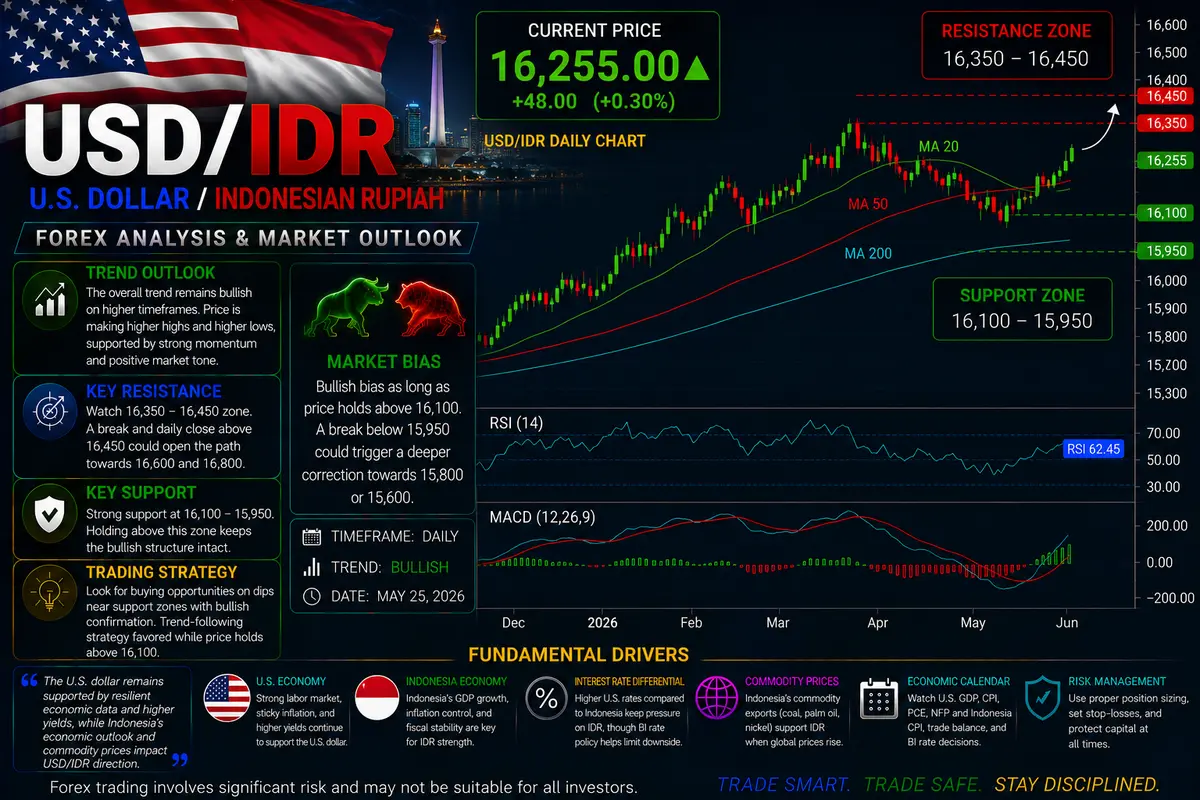
When trading emerging Asian FX on institutional desks, USD/IDR (US Dollar vs. Indonesian Rupiah) stands apart as a heavily managed, high-yield currency cross. Indonesia represents Southeast Asia’s largest economy, possessing vast reserves of critical industrial commodities alongside a high-yielding sovereign debt market that routinely draws foreign portfolio capital.
However, trading USD/IDR requires navigating a market where price action is strictly regulated by the central bank. Bank Indonesia (BI) enforces a hands-on stabilization framework designed to prevent currency volatility from disrupting domestic financial stability or sparking imported inflation.
1. Bank Indonesia’s Stabilization Mandate: The Triple Intervention Framework
Unlike G10 central banks that allow their exchange rates to float freely, Bank Indonesia actively manages the Rupiah through what dealing desks refer to as Triple Intervention.
When market turbulence or broad US Dollar strength pushes USDIDR ... toward key psychological barriers, Bank Indonesia intervenes simultaneously across three distinct financial channels:
                  Bank Indonesia Triple Intervention Mechanics

  +-------------------+   +------------------+   +--------------------+
  |1. Domestic Spot FX  |   |2. DNDF Market  |   |3. Secondary Bonds
  |                     |   |                |   |
  |Direct sales of USD  |   |Settlement of Domestic| |Purchases of SBN
  |reserves on spot desks| |Non-Deliverable Forwards| |sovereign bonds
  | to absorb IDR selling.|   | to manage forward|| anchor yields and
  |                  |  | expectations.  |   | prevent capital flight.
  +-------------------+   +---------------+   +-----------------------+
By utilizing Domestic Non-Deliverable Forwards (DNDFs), BI allows domestic commercial banks to hedge forward Dollar exposure locally without draining physical foreign exchange reserves. When USD/IDR rallies too rapidly, aggressive spot intervention by BI regularly caps price action, turning sharp technical breakouts into range-bound consolidation phases.
2. Commodity Export Realities: Nickel, Coal, and DHE Regulations
Indonesia’s current account and foreign currency reserves are linked directly to its status as a major global commodity exporter—specifically in refined nickel, thermal coal, palm oil (CPO), and copper.
During global commodity expansions, Indonesian resource exporters accumulate billions in hard currency. To ensure these foreign earnings support domestic financial liquidity, the Indonesian government enforces strict export proceeds rules known as DHE (Devisa Hasil Ekspor):
-
Mandatory Retention: Exporters in natural resource sectors are required to retain at least 30% of their foreign exchange earnings in domestic financial accounts for a minimum of three months.
-
Impact on USD/IDR: When global commodity demand surges, mandatory DHE conversions generate a steady, predictable supply of US Dollars on domestic spot desks. This structural inflow acts as a persistent cushion for the Rupiah, driving USD/IDR lower over medium-term horizons.
Conversely, if global industrial demand slows—particularly in China, Indonesia’s largest trading partner—commodity export revenues fall. DHE conversions contract, reducing the supply of Dollars in Jakarta dealing rooms and allowing USD/IDR to build upward momentum.
3. High-Yield Debt Flows and BI Rate Differentials
Because Indonesia maintains an orthodox monetary policy, Bank Indonesia keeps its benchmark policy rate (BI-Rate) elevated relative to developed markets. This creates a favorable interest rate spread that attracts global yield-seeking portfolio managers into Indonesian government bonds, known as SBN (Surat Berharga Negara).
When global market volatility (VIX) is low and the Federal Reserve adopts a neutral or dovish stance, offshore funds execute carry trades:
-
Portfolio Inflow: International funds borrow US Dollars at lower interest rates, swap them for Rupiah, and purchase high-yielding, long-duration SBN bonds.
-
Downward Pressure: These initial capital inflows require massive spot conversions of USD into IDR, driving USD/IDR down toward lower technical support zones.
-
Unwind Risk: If a sudden risk-off event or a surge in US Treasury yields hits global markets, foreign investors liquidate their bond holdings and attempt to convert Rupiah back into Dollars all at once. This capital flight triggers fast, vertical rallies in USD/IDR, forcing Bank Indonesia to step in with spot reserve interventions.
Desk Execution and Strategy Guidelines
To trade USD/IDR effectively while navigating central bank policy and local liquidity hours, keep three key rules in mind:
-
Respect the Onshore Trading Window (02:00 – 09:00 UTC): Primary market depth occurs during Jakarta banking hours. Spreads widen significantly outside the Asian trading session, and offshore Non-Deliverable Forward (NDF) markets in Singapore and New York can trade at a premium or discount relative to onshore spot prices.
-
Monitor Bank Indonesia Policy Days: Bank Indonesia’s Board of Governors meets monthly to announce the BI-Rate and outline its exchange rate assessment. Pay close attention to BI’s forward guidance regarding foreign reserve levels and DNDF auction volumes; a hawkish commitment to defend the Rupiah usually triggers an immediate sell-off in USD/IDR.
-
Adjust Sizing for High Nominal Exchange Levels: USD/IDR trades at high nominal exchange numbers (routinely above 15,000 to 17,000+ Rupiah per Dollar). Always calculate your position size using net account risk percentage rather than standard pip-distance metrics to ensure proper portfolio risk management.

Comments
No comments yet. Be the first to share your thoughts!
Authentication Required
You must be logged in to post a comment.