

Understanding buying and selling order in foɍex
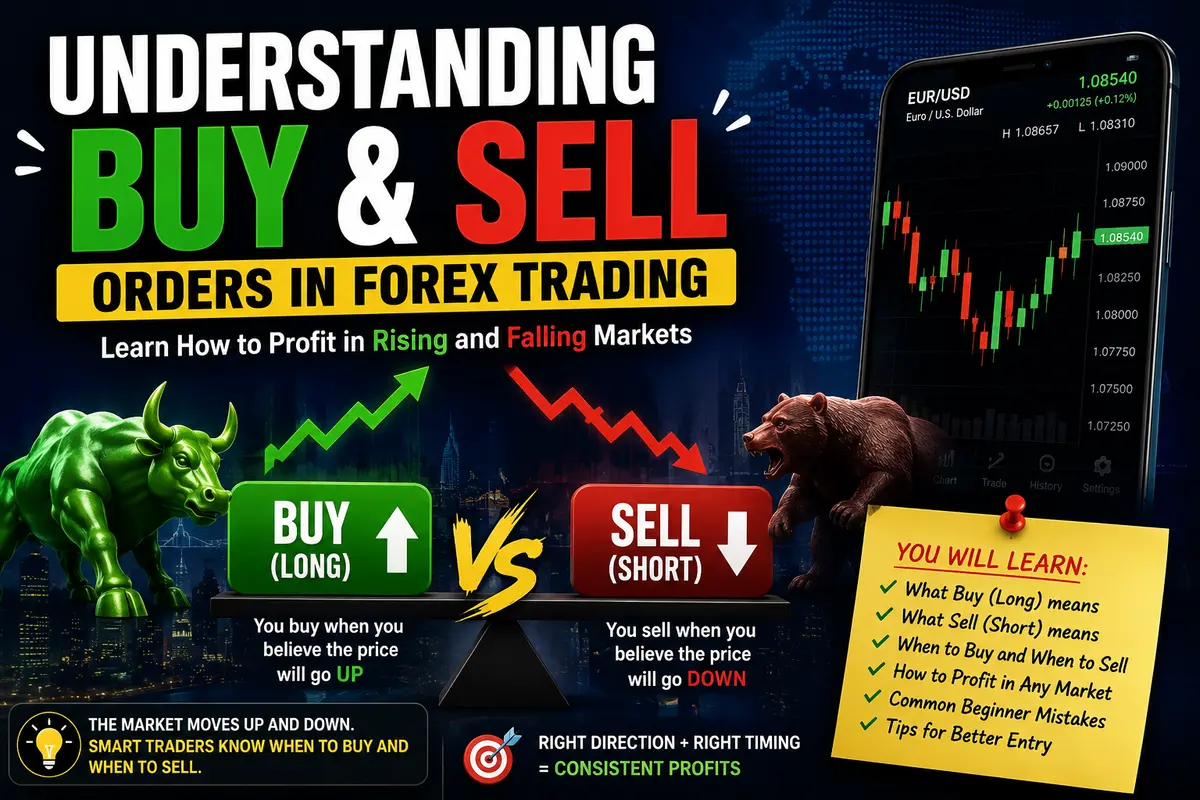
Understanding Buy and Sell Orders in Forex Trading
If you ask me, this buy and sell matter confused me more than candlesticks when I first started learning forex.
One day, my friend asked me, “If the market is falling, what will you do?” I answered immediately, “I’ll wait until it starts going up before I buy.” He just laughed and said, “That’s why you’re still thinking like someone buying clothes in the market.”
That statement stayed in my head.
See, forex is different from the way we buy things in everyday life.
If you go to Balogun Market and buy a bag today, your plan is to sell it later at a higher price. That’s normal business. But in forex, you can make money whether the market is going up or coming down. That was the first thing I had to understand.
Let’s talk about buying first.
A buy trade simply means you believe price is ready to move higher. Maybe you’ve been watching the chart for some time. Price gets to a strong support level, buyers begin to enter, and the candles start showing that the market may reverse. At that point, you decide to buy because you expect the price to climb.
Simple enough.
Now here’s the part that surprised me.
You don’t always have to buy first.
If your analysis tells you that EUR/USD has reached a strong resistance level and buyers are becoming weak, you can actually open a sell trade. In simple English, you’re saying, “I believe this market is about to drop.” If it drops as expected, you make a profit.
The first time I heard this, I asked, “How can I sell something I don’t own?” My mentor smiled and said, “You’re trading price movement, not carrying dollars in your pocket.”
That explanation finally made sense.
One mistake almost every beginner makes is following candles instead of following a plan.
You see one long green candle and your heart starts beating fast. Before you even check support, resistance or trend, you’ve already clicked the Buy button. Five minutes later, one red candle appears and wipes out everything. Then you start blaming the market.
The truth is, the market didn’t cheat you. You were simply impatient.
The same thing happens with sell trades too.
Some people see three or four red candles and panic. They quickly sell because they think the market will keep falling forever. Immediately they enter, buyers return and the market starts moving up again.
If you’ve experienced this before, don’t worry. Almost every trader has gone through it.
One lesson I learned is that the Buy and Sell buttons are not the most important part of trading. Anybody can click a button. The real question is why you’re clicking it.
Can you explain why you’re buying?
Can you explain why you’re selling?
If the answer is simply, “Because the candle is green,” then you probably need to wait.
Your reason should come from your analysis. Maybe the market respected a support level. Maybe a resistance level rejected the price. Maybe the trend is changing. Whatever the reason is, it should be based on something you can clearly see on your chart, not on emotions.
Forex has a way of testing your patience. Sometimes the best trade is the one you don’t enter. It might feel like you’re missing out, but protecting your account is better than forcing a trade that doesn’t meet your plan.
As you continue learning, you’ll discover that buying and selling are actually the easy parts. The difficult part is knowing when to buy, when to sell, and when to simply close your laptop and wait for another opportunity.
That is one habit that separates experienced traders from beginners. They don’t trade because they are bored. They trade because the market has given them a good reason to enter.
Another thing my mentor always tells me is this: don’t fall in love with the Buy or Sell button. Your job is not to prove you’re right. Your job is to protect your account.
There were days I opened my chart already thinking, “Today, I must buy.” Before checking anything, my mind was already made up. Funny enough, the market wanted to sell that day. Instead of accepting what the chart was showing me, I kept looking for reasons to buy. You can already guess the result—I ended up taking a loss.
That experience taught me something. The market doesn’t care about our opinions. It only moves based on the people buying and selling at that moment.
These days, whenever I open my chart, I ask myself one question: “What is the market trying to tell me?” If it says buy, I buy. If it says sell, I sell. If the chart is confusing, I simply close it and wait. Missing one trade will never destroy your account, but forcing a bad trade just because you’re eager to enter might.

Comments
No comments yet. Be the first to share your thoughts!
Authentication Required
You must be logged in to post a comment.