

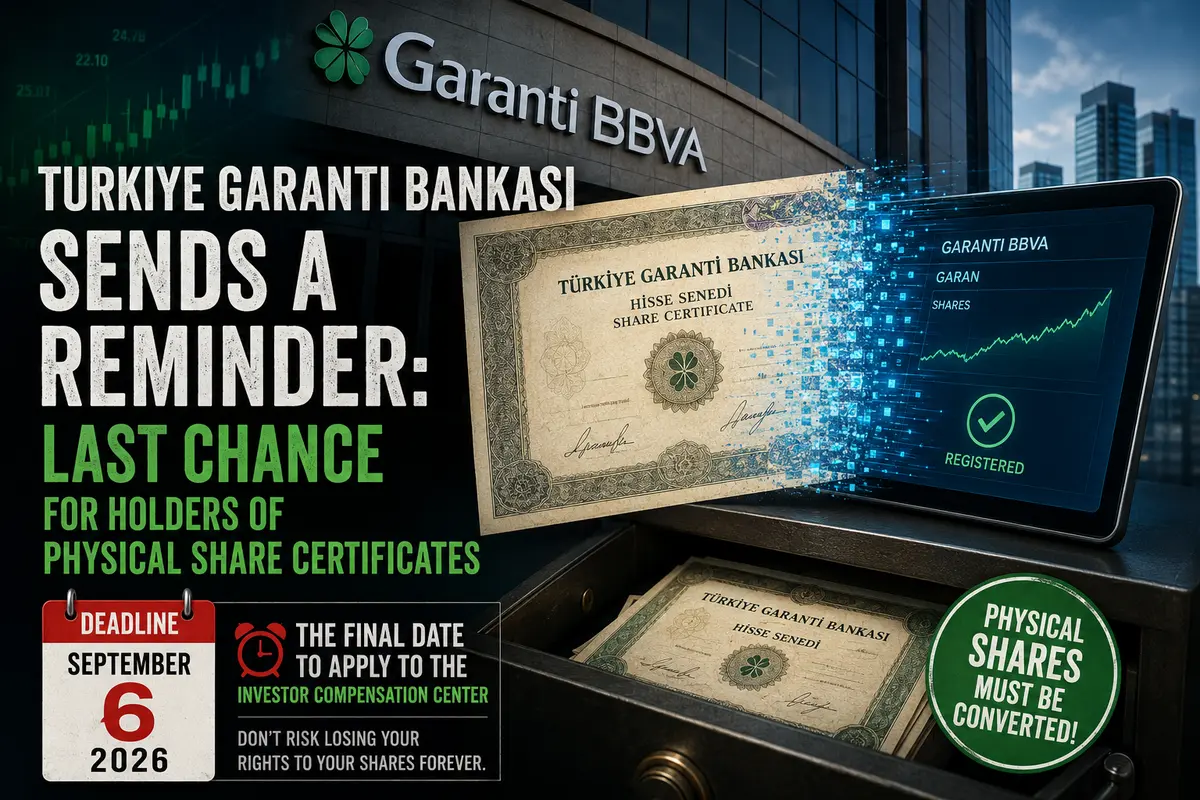
Turkiye Garanti Bankası Sends a Reminder: Last Chance for Holders of Physical Share Certificates
A Ghost from the Past: When Shares Were Beautiful but Inconvenient
There was a time when owning shares meant holding a beautifully designed paper certificate in your hands, complete with watermarks, seals, signatures, and holograms. You could frame it and hang it on the wall, lock it in a safe, or pass it on to your grandchildren as a coming-of-age gift. There was something romantic about it—almost medieval—like owning land proven by a parchment deed.
But progress is relentless. The digitalization of the financial sector, which began in the 1990s, had by the 2020s almost completely eliminated physical share certificates. They were replaced by electronic records held in central depositories. Faster, cheaper, safer. They cannot be lost, stolen, or forged. They can be bought and sold with a single click.
Almost completely, however, does not mean entirely.
In Turkey, as in many other countries, there are still investors who hold physical share certificates of Turkiye Garanti Bankası. Some forgot to convert them into electronic form. Others never knew such a conversion was required. Some passed away, leaving heirs unaware that old certificates stored in a safe still have value. Others simply postponed dealing with the matter for years, assuming there was no urgency.
But the deadlines have now expired.
One of Turkey’s largest banks has announced that shareholders who still hold physical share certificates that were not dematerialized within the prescribed period must submit applications to the Investor Compensation Center no later than September 6, 2026.
This is not merely a formality. It is the last train leaving the station. Those who fail to act risk losing their rights to these shares permanently.
Let’s examine what happened, why the bank has taken this step, and what investors should do if they still possess these attractive—but legally ineffective without proper conversion—paper certificates.
Capital Markets Law No. 6362: When the State Takes Control
To understand the situation, it is necessary to look at Turkish legislation.
Turkey’s Capital Markets Law No. 6362, adopted in 2012, introduced the mandatory dematerialization of shares—meaning the conversion of physical securities into electronic form.
The rationale was straightforward. Physical certificates created numerous problems: they were lost, forged, difficult to transfer, and often complicated inheritance procedures. Electronic records maintained by Turkey’s Central Securities Depository (Merkezi Kayıt Kuruluşu, or MKK) offered a solution to all of these issues.
However, the law also imposed deadlines. Holders of physical certificates were required to convert them into electronic form within a specified period.
Under Article 13 of the law, shares that were not dematerialized within the required timeframe are transferred to a special institution—the Investor Compensation Center (Yatırımcı Tazmin Merkezi).
This may sound alarming, but it is neither confiscation nor nationalization. Rather, it is a mechanism designed to protect investors’ rights.
The Investor Compensation Center temporarily holds the shares, allowing the rightful owner—or their heirs—to apply within a prescribed period to recover either:
-
the shares themselves (in electronic form), or
-
their monetary equivalent.
There is, however, one critical caveat: the application period is not indefinite.
Turkiye Garanti Bankası has now reminded shareholders that the final deadline expires on September 6, 2026.
The procedure established by the Investor Compensation Center consists of two stages:
-
The shareholder presents the original physical certificates to the bank and receives an official receipt.
-
Using that receipt and supporting documents (identification, inheritance documents where applicable), the shareholder then submits an application to the Investor Compensation Center.
The bank emphasizes that beneficiaries must submit their applications within the specified period to exercise their rights and avoid the possible loss of those rights.
Who Is Affected? The Scale of the Issue
A natural question arises: how many people still own paper share certificates in 2026?
One might assume that digitalization solved this problem years ago.
Reality is more complicated.
First, many Garanti Bank shares were issued in physical form during the 1990s and early 2000s, before dematerialization requirements came into force. Their owners are often elderly investors who are accustomed to paper documents rather than electronic systems. They do not actively trade shares; they hold them as family assets or long-term investments.
Second, some certificates belong to foreign investors who purchased them years ago and subsequently lost contact with Turkey. Their certificates may still be sitting in safe-deposit boxes in London, Zurich, Frankfurt, or elsewhere. Many may never have heard of the Turkish legislation.
Third, there is the issue of inheritance. Original owners may have passed away, leaving descendants who discover old certificates in drawers or safes and have no idea what they represent or how to claim them.
The bank has not disclosed the exact number of outstanding physical certificates. However, given Garanti Bankası’s long history and extensive shareholder base, the number of affected investors could be in the thousands, with holdings worth millions of Turkish lira.
What Happens If You Miss the September 6 Deadline?
This is where the situation becomes serious.
If shareholders—or their heirs—fail to submit an application to the Investor Compensation Center by September 6, 2026, they risk permanently losing their rights to the shares.
The Investor Compensation Center cannot hold unclaimed assets indefinitely.
Under Turkish law, once the relevant period expires, unclaimed shares may be sold and the proceeds transferred to the state budget, or otherwise disposed of in accordance with applicable regulations and the type of security involved.
In practical terms, doing nothing is the worst possible option.
If you or a family member possesses physical Turkiye Garanti Bankası share certificates, simply placing them back in a safe and hoping the problem will resolve itself is not a viable strategy.
It will not.
By publishing this announcement, the bank is fulfilling its obligation to inform shareholders. It is not required to locate and contact every certificate holder individually.
The responsibility ultimately lies with shareholders to stay informed about deadlines and procedures.
How to Apply: A Step-by-Step Guide
For those who have discovered old certificates and are unsure what to do, the process can be summarized as follows.
Step 1: Locate the Original Certificates
Find the original Turkiye Garanti Bankası share certificates.
They should be in reasonably good condition, with seals, signatures, and identifying details still visible.
If a certificate is damaged or missing, the situation becomes more complicated, though the bank may still be able to verify ownership through its records.
Step 2: Visit a Bank Branch
Bring the certificates and valid identification to any Turkiye Garanti Bankası branch.
Bank personnel will verify the certificates and issue an official receipt in exchange.
This receipt is critical.
Without it, the Investor Compensation Center will not process the application.
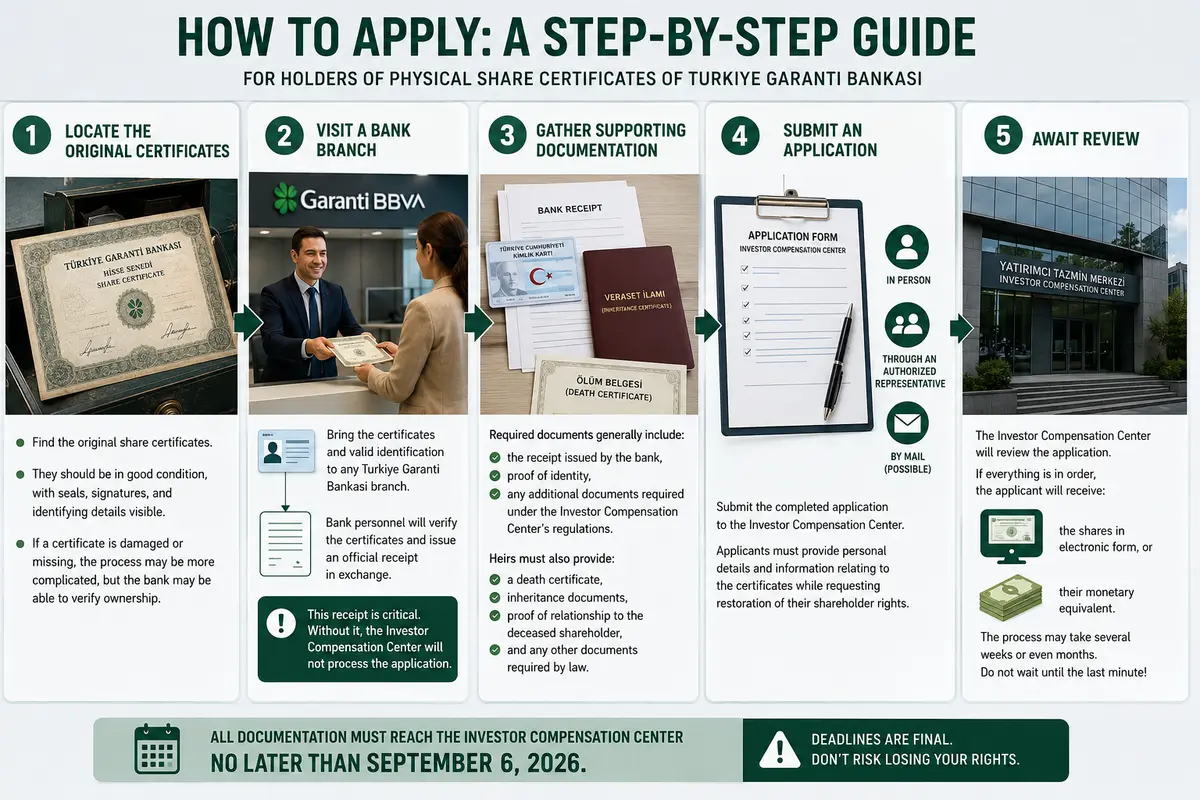
Step 3: Gather Supporting Documentation
The required documents generally include:
-
the receipt issued by the bank,
-
proof of identity,
-
any additional documents required under the Investor Compensation Center’s regulations.
Heirs must also provide:
-
a death certificate,
-
inheritance documents,
-
proof of relationship to the deceased shareholder,
-
and any other documents required by law.
Step 4: Submit an Application
Submit the completed application to the Investor Compensation Center.
Depending on the available procedures, this may be done:
-
in person,
-
through an authorized representative,
-
or potentially by mail.
Applicants must provide personal details and information relating to the certificates while requesting restoration of their shareholder rights.
Step 5: Await Review
The Investor Compensation Center will review the application.
If everything is in order, the applicant will receive:
-
the shares in electronic form, or
-
their monetary equivalent.
The process may take several weeks or even months, which is why waiting until the last minute is strongly discouraged.
All documentation must reach the Investor Compensation Center no later than September 6, 2026.
Why Is the Bank Publishing This Notice Now?
The timing is not accidental.
The regulation referenced by the bank was adopted on September 7, 2016, establishing the procedures and deadlines for investor applications.
Some provisions became effective gradually, and nearly ten years later the final deadline is approaching.
The bank may also have conducted an internal review and concluded that a significant number of physical certificates remain unclaimed.
Another possibility is regulatory pressure. Turkey’s Capital Markets Board (SPK) may have encouraged listed companies to intensify efforts to complete the dematerialization process and notify shareholders.
Whatever the reason, the notice has now been issued.
The next move belongs to the shareholders.
Particular Challenges for Foreign Investors and Heirs
Two groups face especially significant difficulties: foreign investors and heirs.
Foreign Investors
Investors who purchased Garanti Bank shares years ago may not speak Turkish and may never see announcements published on the bank’s website.
Many are unfamiliar with the Investor Compensation Center and Turkish securities regulations.
In such cases, engaging a Turkish lawyer familiar with the procedure may be the most practical solution.
While legal assistance involves costs, losing the investment entirely would be far more expensive.
Heirs
Heirs often face a different challenge.
The original owner may have died years ago without leaving clear records or informing family members about the existence of the shares.
When certificates are discovered unexpectedly, heirs frequently have no idea which institution to contact or how to establish their entitlement.
The process typically requires a chain of documentation, including:
-
death certificates,
-
inheritance certificates,
-
proof of family relationship,
-
certified translations into Turkish,
-
and notarization where necessary.
It is a time-consuming and often frustrating process.
Nevertheless, it may be the only way to preserve ownership rights.
A Language Caveat: Why the Turkish Version Matters More
The bank included an important note in its announcement:
In the event of any discrepancy between the Turkish and English versions of the disclosure, the Turkish version prevails.
This is standard practice for many international companies.
For foreign shareholders, however, it serves as a warning.
Do not rely exclusively on English translations.
If a dispute arises, regulators and courts will refer to the original Turkish text.
Investors who do not speak Turkish should consider obtaining professional translation or legal advice to ensure they fully understand the applicable requirements and deadlines.
What Does This Mean for Garanti Bank Shares?
The bank itself continues to operate normally.
Its shares trade on the Borsa Istanbul under the ticker GARAN and are included in the BIST 100 index.
The dematerialization of the remaining physical certificates is primarily a technical and administrative matter. It does not affect the bank’s profitability, dividend policy, or long-term strategy.
For thousands of small shareholders, however, it could become a very significant issue.
The bank has fulfilled its duty by issuing the announcement.
The responsibility now lies with shareholders, their heirs, and their advisors.
Conclusion: A Final Call for Holders of Physical Share Certificates
September 6, 2026 is more than just another date on the calendar.
For holders of physical Turkiye Garanti Bankası share certificates, it represents the final opportunity to apply to the Investor Compensation Center and reclaim their rights.
After that date, the shares may be deemed unclaimed. They could be sold, canceled, or transferred to the state, making recovery impossible or extremely difficult.
Therefore, if you or your relatives possess old paper share certificates, do not delay.
Find them.
Visit the bank.
Obtain the receipt.
Gather the necessary documents.
Submit the application.
Yes, it is bureaucracy.
Yes, it takes time.
But these shares represent real financial value. They are ownership interests in a business, potential dividend income, and voting rights as a shareholder.
Do not allow the transition from paper to digital ownership to become a reason for losing your investment.
There is still time—roughly three months—but the clock is ticking.
Turkiye Garanti Bankası has issued its reminder.
Now it is up to shareholders to act.

Comments
No comments yet. Be the first to share your thoughts!
Authentication Required
You must be logged in to post a comment.