

Trading the Nigerian Naira: Macro Insights, Oil Dynamics, and Exotic Forex Strategies

The Frontier Market Advantage
Why Look Beyond Major Pairs?
Welcome back, fellow traders and macro enthusiasts. If you have been starring at your screens lately, watching the EUR/USD EURUSD ... grind through twenty-pip intraday ranges or waiting for the algorithms to finish fighting over the GBP/JPY GBPJPY ... order flow, you are not alone. The major currency pairs have become hyper-efficient battlegrounds. As retail and institutional money continues to flood the G10 currency markets, finding genuine, asymmetric alpha has become increasingly difficult. We are living in an era where central bank monetary policies in the developed world are meticulously telegraphed weeks in advance, leaving very little room for the explosive, trend-defining moves that legendary macro traders used to capture in the 1990s and 2000s.
To find true volatility and structural inefficiencies today, you have to venture off the beaten path. You have to step outside the comfort zone of deep liquidity and look towards Frontier and Emerging Markets. Exotic forex trading is not for the faint of heart, but for those willing to do the rigorous macroeconomic homework, the rewards can be staggering. When we talk about exotic pairs, we aren’t just talking about wider spreads; we are talking about geopolitical shifts, commodity-driven economies, and central banks that are actively fighting structural transformations.
In these markets, technical analysis takes a backseat to deep fundamental understanding. You need to understand the pulse of the nation, the underlying export mechanics, and the domestic political pressures. This brings me to one of the most fascinating, volatile, and highly debated currencies in the global financial market today: the Nigerian Naira (NGN).
Relevance of the Nigerian Naira in the Global Financial Market
As we navigate through 2026, the Nigerian economy remains an absolute behemoth on the African continent. As Sub-Saharan Africa’s largest economy and most populous nation, Nigeria sits at a critical intersection of global energy markets and emerging market capital flows. For years, the Nigerian Naira was a heavily managed, often artificially pegged currency that frustrated foreign investors and created a massive divergence between the official exchange rate and the parallel (black) market rate. However, recent years have seen historic structural FX reforms aimed at liberalizing the market, unifying the exchange rate windows, and attracting foreign direct investment (FDI) back into the country.
Why should a global forex trader care about the NGN? Because volatility creates opportunity, and the USD/NGN USDNGN ... pair has seen historical repricing events that offer masterclasses in macroeconomic trading. Trading the Naira isn’t something you do on a standard retail MT4 platform with 1:500 leverage. It is typically accessed via Non-Deliverable Forwards (NDFs) or offshore derivatives by institutional players, macro hedge funds, and sophisticated prop traders. The Naira represents a pure play on several colliding global themes: the future of fossil fuels (specifically Brent Crude BZUSD ... ), the efficacy of orthodox monetary policy in developing nations, and the mechanics of currency devaluation as a tool for economic reset.
When you trade the Naira, you aren’t just trading a chart pattern; you are taking a view on Nigeria’s foreign exchange reserves, its crude oil output from the Niger Delta, the operational status of massive domestic infrastructure like the Dangote Refinery, and the Central Bank of Nigeria’s (CBN) ability to anchor inflation expectations. In this comprehensive guide, we are going to break down the core macroeconomic drivers of the NGN, explore how professional traders build theses around it, and look at the real-world mechanics of executing trades in one of the world’s most dynamic frontier markets.

Core Macro Theses for Trading the Nigerian Naira
The Petro-Currency Correlation
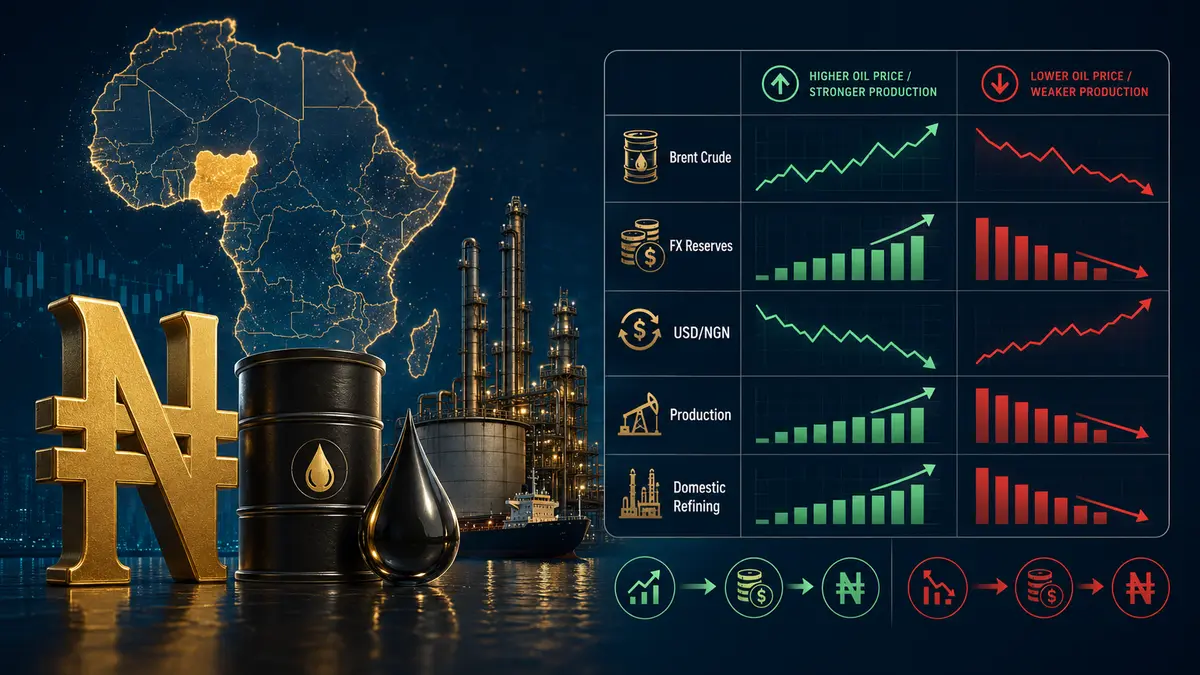
If you want to trade the Nigerian Naira, you must first become an expert in the global oil market. Nigeria is heavily reliant on crude oil exports, which historically account for the vast majority of its foreign exchange earnings and a significant portion of government revenue. Therefore, the foundational thesis for any USD/NGN position is inherently tied to the price of Brent Crude and, equally importantly, Nigeria’s actual daily production volume. It is a classic petro-currency dynamic, but with a unique twist. In a standard petro-currency model (like the Canadian Dollar or Norwegian Krone CADNOK ... ), higher oil prices automatically translate to a stronger currency. However, the Nigerian dynamic has historically been complicated by a lack of domestic refining capacity, meaning that while the country exported crude oil, it had to spend billions of its precious US Dollar reserves to import refined petroleum products (PMS/petrol).
As a trader, your dashboard must monitor not just the Brent front-month futures, but also Nigeria’s OPEC quota compliance and output disruptions caused by infrastructure issues or vandalism in the oil-rich regions. If oil prices crash, Nigeria’s dollar inflows dry up, foreign exchange reserves plummet, and the Central Bank is forced to let the Naira depreciate to balance the fiscal budget.
Conversely, a sustained bull market in crude oil provides the CBN with the firepower to intervene in the FX market, supply dollars to importers, and stabilize or even strengthen the Naira. Furthermore, with the monumental activation of domestic refining mega-projects (such as the Dangote Refinery) altering the import/export balance, traders must constantly model how much foreign exchange is actually being retained within the Nigerian economy.
Central Bank Policy & FX Regime Shifts
The second core pillar of trading the Naira revolves around the Central Bank of Nigeria (CBN) and its monetary policy framework. Unlike the US Federal Reserve or the ECB, where rate decisions move markets by a few basis points, the CBN’s policy shifts can literally gap the market by 20% to 40% overnight. Historically, the CBN operated a complex system of multiple exchange rates (one for government transactions, one for investors/exporters, and others for specific sectors). This fragmented system created massive inefficiencies and discouraged foreign capital. A major thesis for global macro traders has been the “convergence play” — betting on the inevitable unification of these rates into a single, market-reflective floating rate.
When the CBN engages in orthodox monetary policy tightening — aggressively hiking the Monetary Policy Rate (MPR) to combat rampant double-digit inflation — it theoretically makes NGN-denominated assets more attractive. However, professional traders look beyond the nominal interest rate; they calculate the real yield (nominal rate minus inflation). If inflation is running at 30% and the central bank rate is 25%, the real yield is still negative, meaning the currency is structurally biased toward depreciation. Trading the NGN requires parsing through CBN circulars, understanding their open market operations (OMOs), and gauging their willingness to tolerate immediate pain (devaluation and higher import costs) for long-term macroeconomic stability.

Liquidity Dynamics and Parallel Market Arbitrage
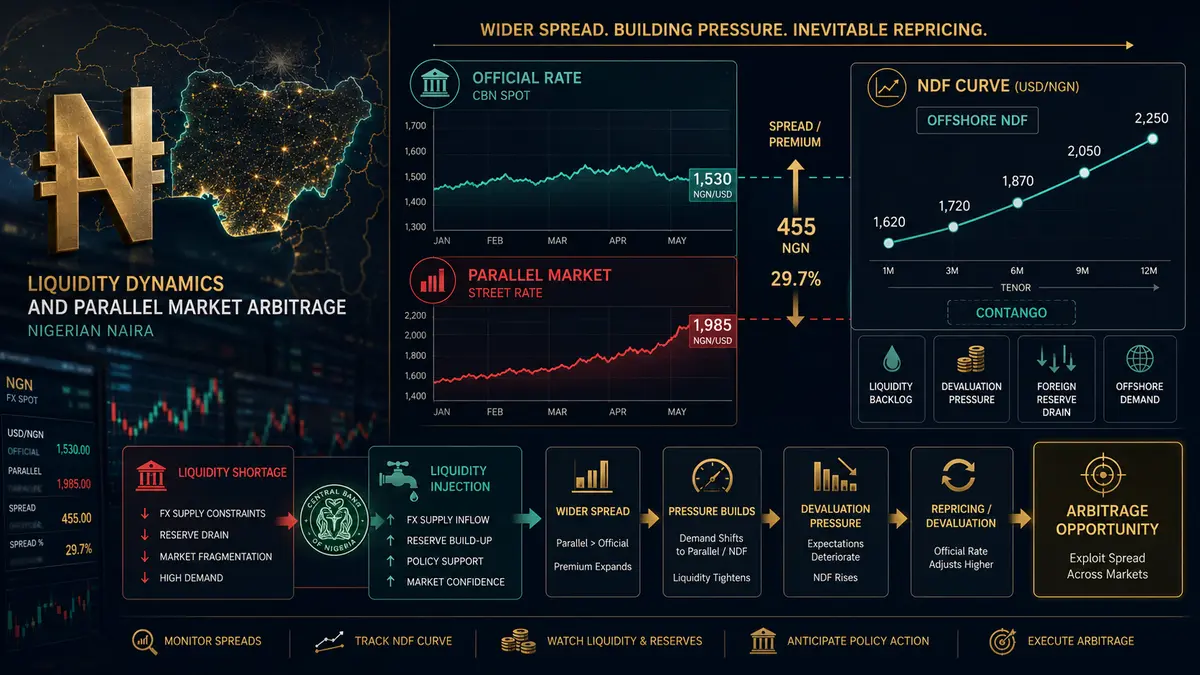
The third thesis focuses on market structure and liquidity. For years, the truest barometer of the Naira’s value was not the official rate printed on Bloomberg, but the parallel (or black) market rate on the streets of Lagos and Abuja. When the CBN artificially pegged the official rate and rationed dollar supply, a massive premium developed in the parallel market. As a macro trader, tracking this premium is crucial. When the spread between the official rate and the parallel market rate widens significantly, it is a glaring leading indicator that a structural devaluation of the official rate is imminent. The pressure simply becomes mathematically unsustainable.
Institutional offshore traders capitalize on these dynamics using the Non-Deliverable Forward (NDF) market in London and New York. Because the NGN is not fully convertible on international spot markets, NDFs allow traders to speculate on the future exchange rate without physically delivering the Naira. The pricing of the NDF curve (whether it is in steep contango, implying future depreciation) reflects the collective wisdom of global banks and hedge funds regarding Nigeria’s liquidity situation. If you can accurately predict when the CBN will inject liquidity to clear the FX backlog, or when they will step away and let the currency free-fall to meet the parallel rate, you can construct highly profitable, asymmetric NDF trades.
Deep-Dive Analysis & Market Mechanics
Macro Breakdown: Crude Oil vs. Foreign Exchange Reserves
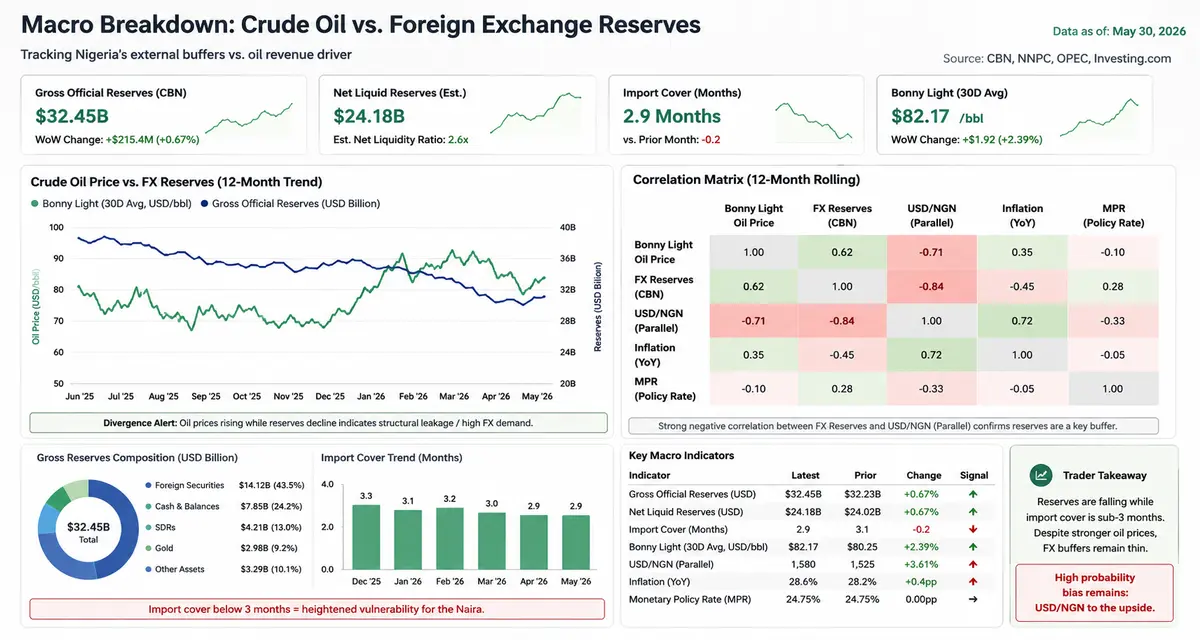
Let’s get our hands dirty with the actual mechanics of analyzing the NGN. The lifeblood of the Naira is the Gross Official Reserves held by the CBN. As a trader, you should be pulling data from the CBN’s official statistics database weekly. But here is the professional edge: do not just look at the headline reserve figure; you need to understand the net liquid reserves. Often, the headline figure includes encumbered funds, swaps, and forward liabilities owed to foreign banks. If you realize that the net liquid reserves have fallen below the equivalent of three months of import cover, flashing red lights should go off on your trading desk. This is the exact fundamental trigger that forces a central bank to capitulate and devalue the currency.
The correlation matrix here is fascinating. You map the 30-day moving average of Nigeria’s Bonny Light crude oil price against the trajectory of FX reserves. If oil is rallying but reserves are still falling, it signals severe structural leakages — perhaps rampant capital flight, massive debt servicing costs, or heavy central bank intervention to artificially prop up the currency. This divergence is a classic macroeconomic trading signal. It tells you that despite a favorable commodity environment, the currency is fundamentally mispriced. When the rubber band snaps, the correction is vicious. Professional traders will model Nigeria’s daily FX demand (from importers, manufacturers, and students abroad) against the CBN’s daily dollar supply. When the deficit reaches a critical mass, a long USD/NGN position becomes one of the highest-probability trades in the frontier space.
Rate Hikes & Inflation: The Carry Trade Illusion
In traditional forex, if a central bank hikes interest rates, you buy the currency. This is the basis of the carry trade. If you trade AUD/JPY AUDJPY ... , you are capturing the yield differential between the RBA and the BOJ. But applying this standard G10 logic to the Nigerian Naira will get your account blown up. In high-inflation frontier markets, aggressive rate hikes are often a desperate measure to mop up excess naira liquidity and fight hyper-inflationary pressures, rather than a sign of economic strength.
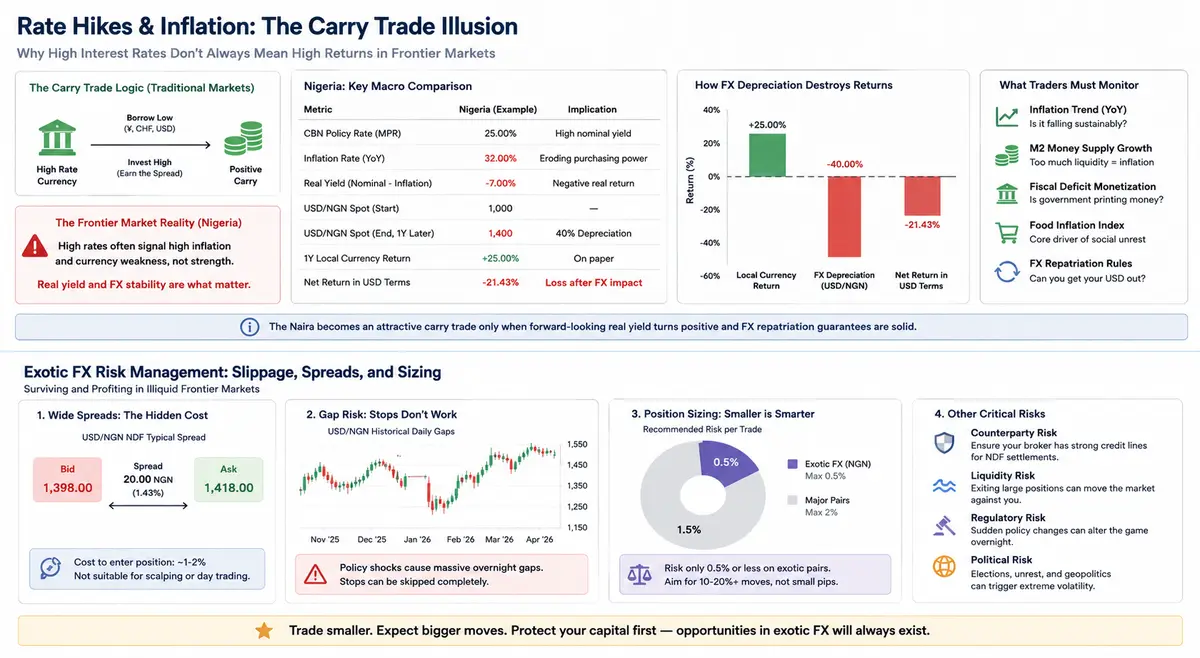
Let’s assume the CBN issues 1-year Treasury bills yielding 25%. On paper, earning 25% risk-free sounds like a dream for an offshore hedge fund. However, if the domestic inflation rate is 32%, the purchasing power of that money is eroding faster than the interest is accruing. Furthermore, what happens to your principal when you try to repatriate your funds? If the USD/NGN exchange rate depreciates by 40% during that one-year holding period, your 25% local currency yield translates into a massive net loss in US Dollar terms. Therefore, deep-dive analysis of the NGN requires forecasting the inflation trajectory, not just the central bank rate. You have to monitor M2 money supply growth, fiscal deficit monetization (how much money the government is printing to fund its budget), and food inflation indices. Only when the forward-looking real yield turns positive, and FX repatriation guarantees are solid, does the Naira become an attractive carry trade.
Exotic FX Risk Management: Slippage, Spreads, and Sizing
We cannot discuss exotic currencies without a heavy emphasis on risk management. The mechanics of trading USD/NGN are entirely different from trading EUR/USD. Firstly, the bid-ask spreads in the NDF market can be exceptionally wide, sometimes costing you 1-2% just to cross the spread and enter the position. This immediately nullifies day-trading or scalping strategies; trading the Naira is strictly for swing traders and long-term macro position takers. You need an anticipated move of at least 10-15% to justify the transaction costs and the illiquidity premium.
Secondly, you must account for “gap risk.” Central bank policy announcements in Nigeria frequently happen over the weekend or late in the evening. You might go to sleep with the official rate at 1,000 NGN per USD, and wake up to find the CBN has floated the currency, and the market opens at 1,500 NGN per USD. Stop-loss orders are practically useless in these extreme volatility vacuum events; you will experience massive negative slippage. Therefore, position sizing is your only true defense. If a standard position size on your desk for a major pair is 2% of your portfolio risk, an exotic frontier position like the NGN should be scaled down to 0.5% or less. You trade smaller, but you aim for significantly larger percentage moves. You must also account for counterparty risk when dealing with offshore derivatives, ensuring your prime broker has the necessary credit lines to honor massive NDF payouts during systemic market shocks.
Case Studies & Practical Trading Examples
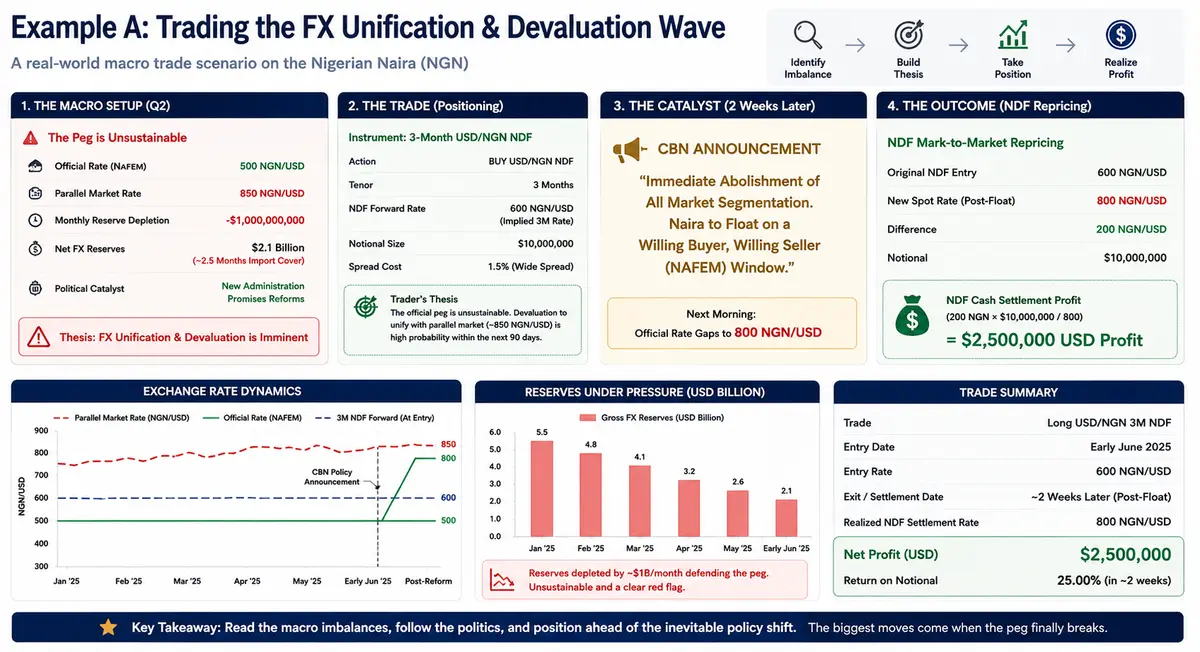
Example A: Trading the FX Unification & Devaluation Wave
Let’s look at a highly realistic, masterclass trading scenario that mirrors the monumental FX reforms seen in Nigeria’s recent history. Imagine it is Q2, and the macroeconomic setup is glaringly obvious: The official exchange rate is artificially pegged at 500 NGN/USD. However, the parallel market is trading at 850 NGN/USD.
The CBN is burning through $1 billion of foreign reserves per month trying to defend the 500 peg, and net reserves have dropped to perilous levels. A new administration has just taken political office, promising market reforms and orthodox economics to appease the IMF and World Bank.
As a macro trader, your thesis is simple: the peg is dead, unification is imminent. You cannot buy spot USD/NGN directly, so you go to the offshore market and buy a 3-month USD/NGN Non-Deliverable Forward (NDF). The market is pricing the 3-month forward at 600 NGN/USD (the market knows a devaluation is coming, so there is a premium, but it hasn’t fully priced in a complete float). You size your position conservatively due to the wide spread. Two weeks later, the new CBN Governor announces the immediate abolishment of all market segmentation and floats the Naira on the “willing buyer, willing seller” NAFEM window. The next morning, the official rate violently recalibrates, instantly gapping up to 800 NGN/USD to match the parallel market. Your 3-month NDF derivative reprices aggressively. Because you locked in the right to buy USD at 600 NGN, and the spot rate is now 800 NGN, the cash-settled difference is credited to your account in US Dollars. This is a classic “breaking the peg” trade, structurally similar to George Soros breaking the Bank of England, albeit on a frontier market scale. The key was reading the political tea leaves and the unsustainability of the reserve depletion.
Example B: Commodity Shock Hedging Strategy
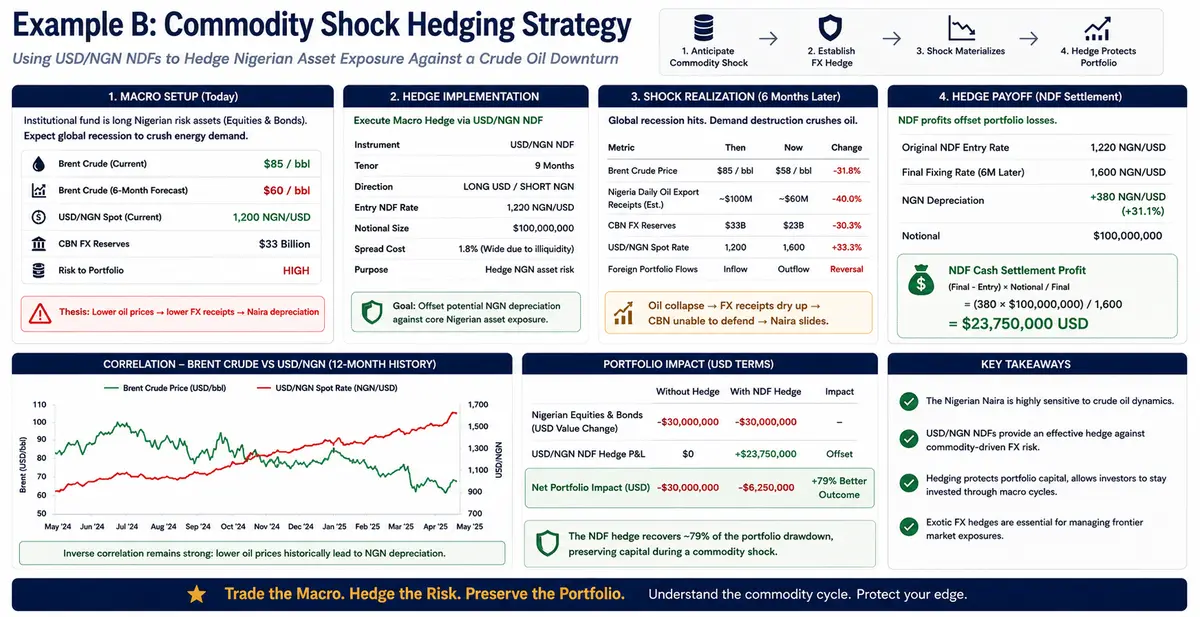
Now let’s look at a scenario from the perspective of an institutional commodities trader managing risk. Your fund is heavily invested in West African sovereign bonds and Nigerian equities, meaning you have massive long exposure to the Nigerian economy. You are monitoring global geopolitics and you anticipate a significant global recession that will crush energy demand. Brent Crude is currently trading at $85 per barrel, but your quantitative models project a drop to $60 over the next six months.
You know that if Brent drops to $60, Nigeria’s FX receipts will plummet. The CBN will face a severe dollar shortage, foreign portfolio investors will scramble for the exits, and the Naira will inevitably depreciate. To protect your equity and bond portfolio (which are denominated in NGN), you need a proxy hedge. You execute a massive macro short position against the Naira. You buy long-dated (6-12 month) USD/NGN NDFs. Over the next few months, your thesis plays out perfectly. Global demand destruction pushes Brent crude down to $58. As predicted, Nigeria’s dollar inflows dry up. The CBN, unable to intervene, lets the Naira slide from 1,200 to 1,600 against the Dollar. While your Nigerian equities take a massive hit in dollar terms, your USD/NGN NDF hedge prints massive profits, entirely offsetting the portfolio losses. This example perfectly illustrates how the Nigerian Naira isn’t just an instrument for pure speculation; it is an absolutely vital hedging tool for global asset managers who understand the deep, unbreakable correlation between frontier economies and the global commodity super-cycle.
The Trader’s Playbook for Frontier Currencies
The Final Verdict on the Naira
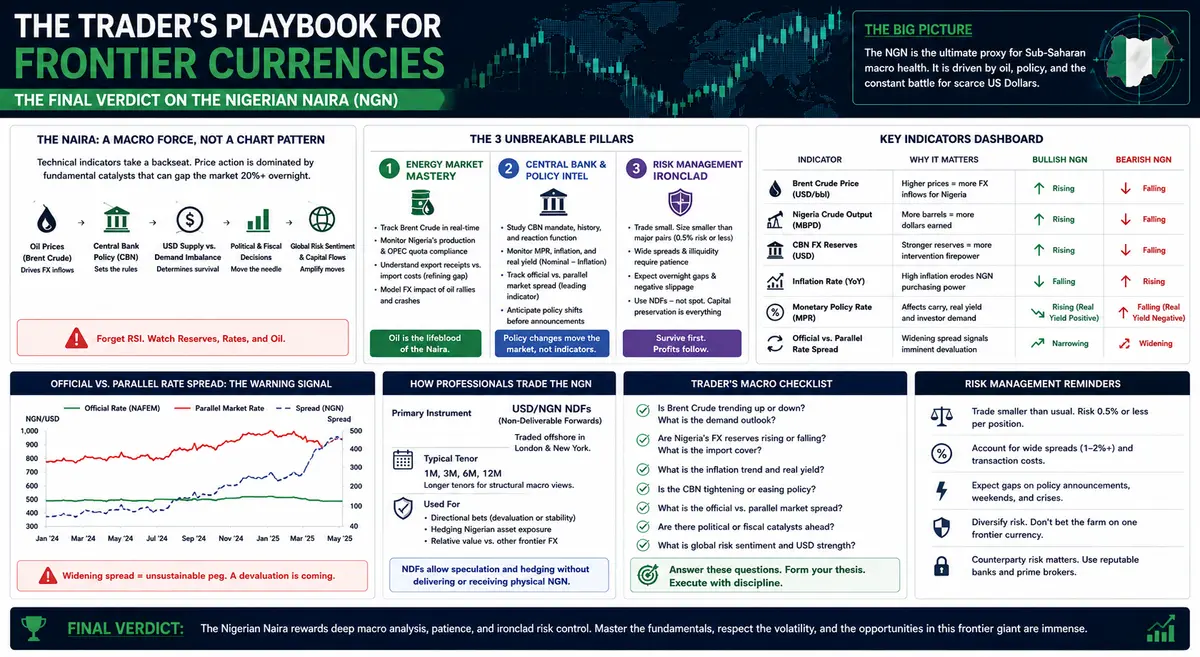
Trading the Nigerian Naira is a formidable intellectual challenge that separates true macroeconomic analysts from standard technical chartists. It is a market where moving averages and RSI indicators are largely meaningless, overridden by the brute force of oil prices, central bank decrees, and raw supply-and-demand imbalances for physical US Dollars. As we have explored in this breakdown, the NGN is the ultimate proxy for Sub-Saharan macroeconomic health. It embodies the struggles and opportunities of frontier markets: high inflation, shifting monetary regimes, liquidity constraints, and the transition toward free-market capitalism.
To successfully trade this exotic pair, your playbook must be built on three unshakeable pillars. First, you must have a real-time, nuanced read on the global energy market. You cannot trade the Naira blindly without knowing exactly what Brent Crude is doing, and how much of that crude Nigeria is successfully pumping and exporting. Second, you must act as a political and central bank analyst. Understanding the mandate, the pressure, and the historical behavior of the Central Bank of Nigeria is just as important as reading a price chart. You must anticipate policy shifts before they are announced, utilizing the spread between official and parallel markets as your primary leading indicator. Finally, your risk management framework must be ironclad. You are trading in a highly illiquid, fragmented market prone to massive overnight gaps and wide spreads. Capital preservation through microscopic position sizing and the strategic use of derivatives like NDFs is non-negotiable.
Signing Off
For the retail traders reading this blog, my advice is to use currencies like the Naira as a macro learning tool. Watch how it reacts to oil shocks and inflation reports; it will make you a much sharper trader when you return to the G10 currencies. For the institutional players and ambitious macro fund managers, the Nigerian Naira offers exactly what Wall Street has been starving for: genuine, uncorrelated volatility and massive structural inefficiencies waiting to be exploited.
The global financial market is shifting. As developed nations deal with stagnant growth and crushing debt, the action, the risk, and the alpha are moving to the frontiers. Nigeria, with its massive economy and dynamic currency reforms, is at the absolute center of this shift. Keep your eyes on the crude charts, monitor the CBN’s foreign reserves, and respect the trend.
Until next time, manage your risk, stick to your macroeconomic theses, and happy trading!

Comments
No comments yet. Be the first to share your thoughts!
Authentication Required
You must be logged in to post a comment.