

The Stock Market: The Backbone of the Global Economy
A Centralized Hub for Capital and Investment
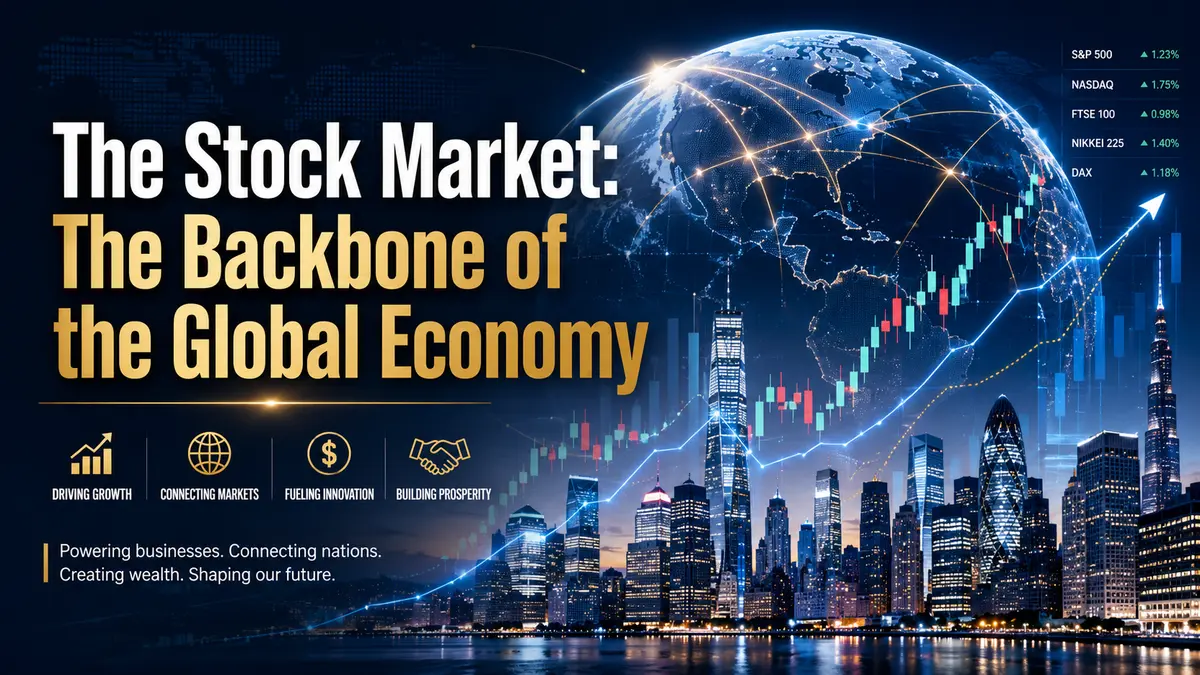
The stock market is a centralized, highly organized platform where the buying and selling of securities takes place. These financial instruments primarily include corporate equities (stocks), government and corporate bonds, Exchange-Traded Funds (ETFs), and various derivative products. In the modern financial ecosystem, the stock market serves as the ultimate engine of capitalism.
It is a critical component of any developed nation’s economy, bridging the gap between those who have capital to invest and those who need capital to grow.
Without these centralized marketplaces — such as the New York Stock Exchange (NYSE) in the United States or Euronext in Europe — large-scale corporate innovation and wealth accumulation would be virtually impossible.
Core Characteristics of the Modern Stock Market
To understand why the stock market is so vital, it is important to examine the fundamental characteristics that govern its daily operations. These features ensure that the market remains fair, efficient, and accessible to millions of participants worldwide.
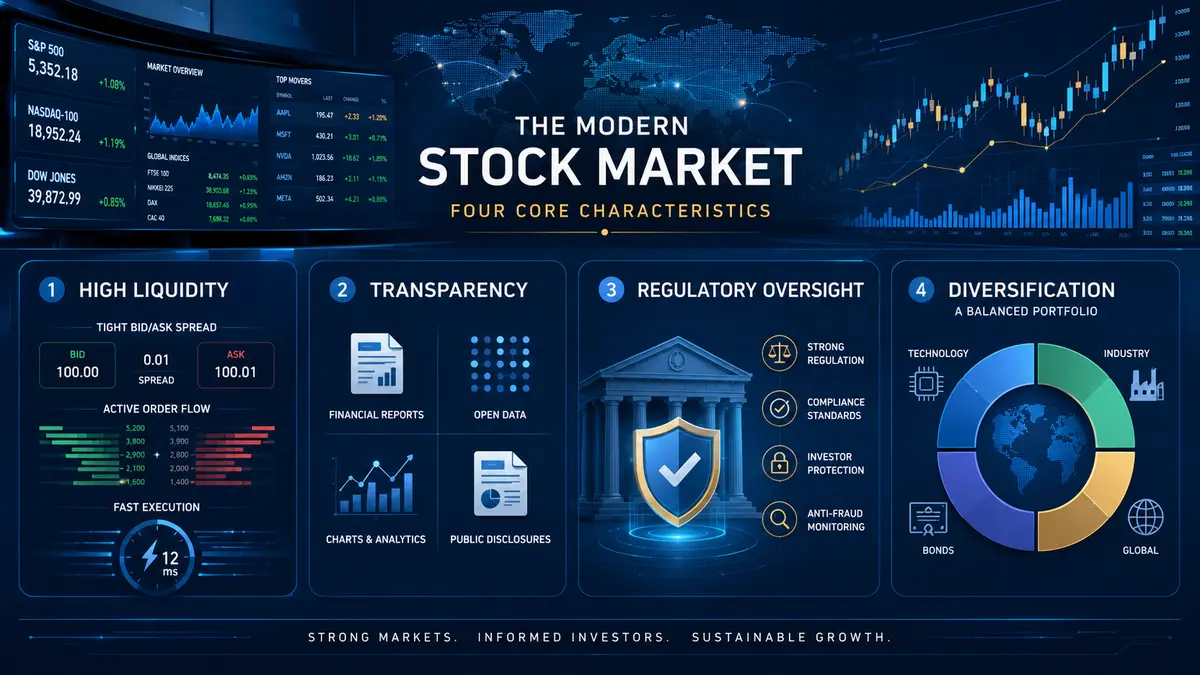
1. High Liquidity
Liquidity refers to how quickly and easily an investor can buy or sell a security without causing a drastic change in its price. The modern stock market offers unparalleled liquidity, especially for large-cap companies.
For example, if you own shares in a major US corporation like Apple or a European giant like LVMH, you can sell them almost instantly during trading hours. High liquidity means that the bid-ask spread (the difference between the highest price a buyer is willing to pay and the lowest price a seller will accept) remains tight. This minimizes trading costs and ensures that individual trades do not artificially skew the asset’s true market value.
2. Uncompromising Transparency
A functional financial market requires trust, and trust is built on transparency. The stock market is characterized by a high degree of informational openness. Publicly traded companies are legally obligated to disclose their financial health, earnings reports, and potential business risks to the public.
In the US, this means filing detailed quarterly (10-Q) and annual (10-K) reports with the SEC, making data accessible to everyone simultaneously. In Europe, directives like MiFID II enforce strict reporting standards. This transparency ensures that all participants have equal access to historical pricing, real-time quotes, and fundamental corporate data.
3. Strict Regulatory Oversight
To maintain stability, prevent fraud, and ensure fair play, stock markets are heavily regulated by independent governmental bodies. These agencies monitor trading activity to prevent insider trading and market manipulation.
In the United States, the Securities and Exchange Commission (SEC) and the Financial Industry Regulatory Authority (FINRA) provide this critical oversight. In Europe, regulatory bodies such as the UK’s Financial Conduct Authority (FCA) or the European Securities and Markets Authority (ESMA) enforce strict rules to protect retail and institutional investors alike.
4. Opportunities for Diversification
Participating in the stock market allows investors to easily diversify their portfolios, which is a fundamental strategy for risk management. Instead of tying all their capital up in a single private business or local real estate, investors can spread their risk across multiple sectors and geographies.
An investor can easily build a portfolio containing US technology stocks, German industrial companies, and European government bonds. If one sector experiences a downturn, the positive performance of other asset classes can help cushion the blow, reducing overall portfolio volatility.
The Key Participants: A Complex Ecosystem
The stock market is a dynamic ecosystem where the interests of various financial actors converge. It provides a venue for companies to raise expansion capital, allows individuals to grow their retirement savings, and offers specialized professionals the chance to profit from price fluctuations.
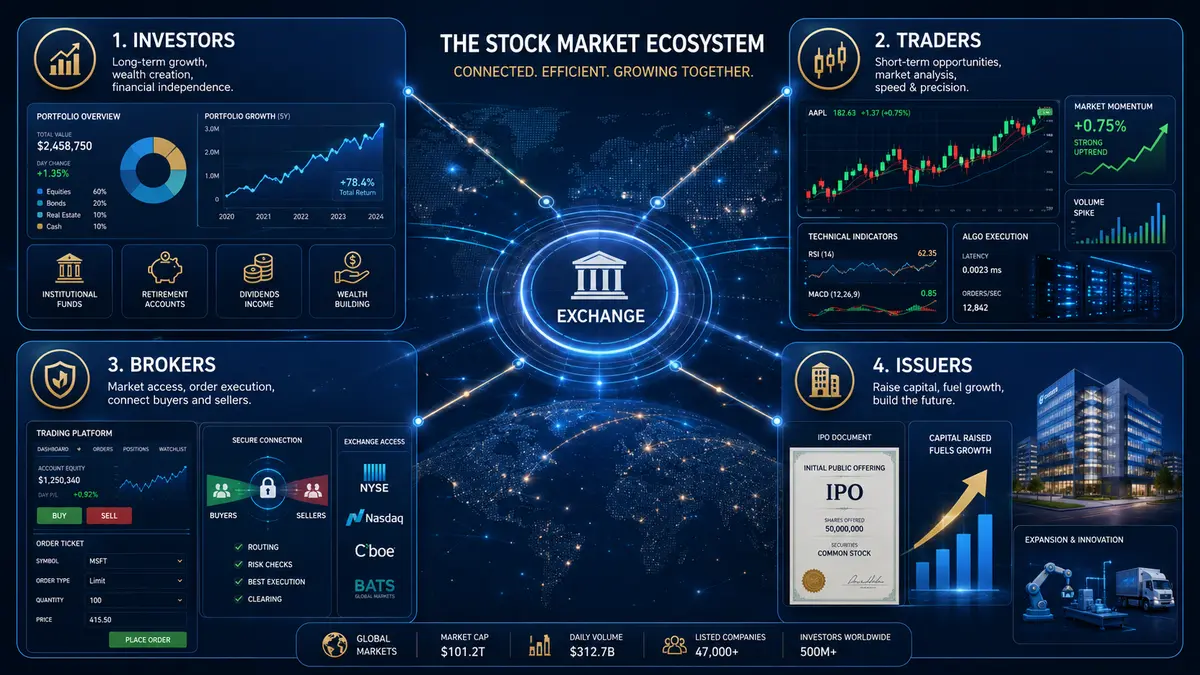
The main participants in this market can be divided into four distinct categories:
1. The Investors
Investors are individuals or organizations that deploy capital into securities with a long-term horizon, aiming for wealth accumulation through capital appreciation and dividend yields. Their collective buying and selling decisions ultimately drive broader market trends.
This group ranges from retail investors using apps like Robinhood in the US or Trade Republic in Europe, to massive institutional investors. Institutional players include pension funds, endowment funds, and colossal asset managers like BlackRock and Vanguard, who manage trillions of dollars and hold significant sway over corporate governance.
2. The Traders
Unlike long-term investors, traders seek to generate profits from short-to-medium-term price fluctuations. They rely heavily on technical analysis, chart patterns, and market momentum rather than fundamental corporate valuation.
Traders can be individual day traders executing multiple transactions within a single session, or swing traders holding positions for a few weeks. At the institutional level, this includes Wall Street hedge funds and quantitative proprietary trading firms in London that utilize high-frequency trading (HFT) algorithms to capitalize on microsecond price discrepancies.
3. The Brokers
Brokers serve as the essential intermediaries connecting buyers and sellers to the exchange. Since retail investors cannot directly place an order on the floor of the NYSE or the Frankfurt Stock Exchange, they must use a brokerage service.
Brokers are categorized into retail (discount) brokers, which offer self-directed trading platforms with low fees (e.g., Charles Schwab or Interactive Brokers), and institutional full-service brokers. Full-service brokers cater to high-net-worth individuals and large funds, offering personalized wealth management, strategic research, and complex trade execution.
4. The Issuers
Issuers are the corporations, municipalities, or national governments that create and sell securities to the public to raise capital. When a private company wants to build a new factory, fund research and development, or expand globally, it may choose to go public.
This process, known as an Initial Public Offering (IPO), transitions a private enterprise into a publicly traded company. Recent examples include high-profile US tech IPOs or European automotive spin-offs like Porsche. Once the shares are issued, they enter the secondary market, where they are actively traded among investors.
Measuring Performance: Stock Market Indices
With thousands of companies trading across various global exchanges, it is impossible to gauge the overall health of the market by looking at a single stock. To solve this, the financial industry relies on stock market indices.
An index is a statistical measure designed to track the performance of a specific basket of securities. Indices act as a barometer for the broader economy, allowing investors to benchmark their own portfolio returns against the overall market. They also serve as the underlying foundation for massive passive investment vehicles, such as index funds and ETFs.
How Indices are Constructed
Indices are built using specific methodologies and inclusion criteria. Factors often include a company’s market capitalization (the total value of all its outstanding shares), trading volume, and industry sector.
Most modern indices are market-cap weighted, meaning that larger companies have a much greater impact on the index’s price movements than smaller ones. This ensures the index accurately reflects the economic reality of the market it represents.
The Most Influential Global Indices
Financial markets feature a wide variety of indices, each tracking a different geographic region, sector, or company size. Some of the most globally recognized benchmarks include:
-
The S&P 500: The premier benchmark for the United States stock market. It tracks the 500 largest publicly traded US companies, weighted by market capitalization. It is widely considered the best single indicator of large-cap US equities and the broader American economy.
-
Dow Jones Industrial Average (DJIA): One of the oldest indices in the world, the Dow consists of 30 prominent, “blue-chip” American companies. Unlike the S&P 500, it is price-weighted, meaning stocks with higher share prices influence the index more heavily, regardless of their actual market size.
-
NASDAQ Composite: A heavily technology-focused index that includes almost all stocks listed on the NASDAQ exchange. It is the go-to barometer for the performance of the tech sector, featuring giants like Microsoft, Amazon, and Nvidia.
-
FTSE 100: Often referred to as the “Footsie,” this index tracks the 100 largest companies listed on the London Stock Exchange by market capitalization. It is the primary indicator for the UK corporate sector.
-
DAX 40 and Euro Stoxx 50: In mainland Europe, the DAX 40 tracks the largest and most liquid German companies trading on the Frankfurt Stock Exchange. Meanwhile, the Euro Stoxx 50 provides a broader blue-chip representation of sector leaders across the entire Eurozone.

Comments
No comments yet. Be the first to share your thoughts!
Authentication Required
You must be logged in to post a comment.