

Elixiron vs. Alzheimer’s: A Taiwanese Hope Based on a Tiny Sample of Seven Patients
In a world where headlines are dominated by missile strikes, falling cryptocurrencies, and corporate scandals, some stories pass almost unnoticed. They do not flood social media feeds, cause traders to panic, or provoke angry political commentary. Yet these are often the stories that truly change the world—stories about science, medicine, and victories over diseases that once seemed like an unavoidable sentence.
One such story has emerged from Cambridge, Massachusetts, and Taipei. Elixiron Immunotherapeutics, a company listed on the Taiwan Stock Exchange (ticker: 7871), has announced interim results from a Phase 2 clinical trial of its drug, enrupatinib, for the treatment of Alzheimer’s disease.
Alzheimer’s is a devastating illness that slowly extinguishes patients’ lives while turning their loved ones into helpless witnesses.
For now, these are only interim data. The evaluable group consists of just seven participants. The study is open-label, with no placebo group and no blinding. The scientific community—hardened by thousands of failed Alzheimer’s trials—approaches such announcements with caution bordering on cynicism. How many “breakthroughs” have collapsed under the weight of larger, more rigorous studies? Far too many.
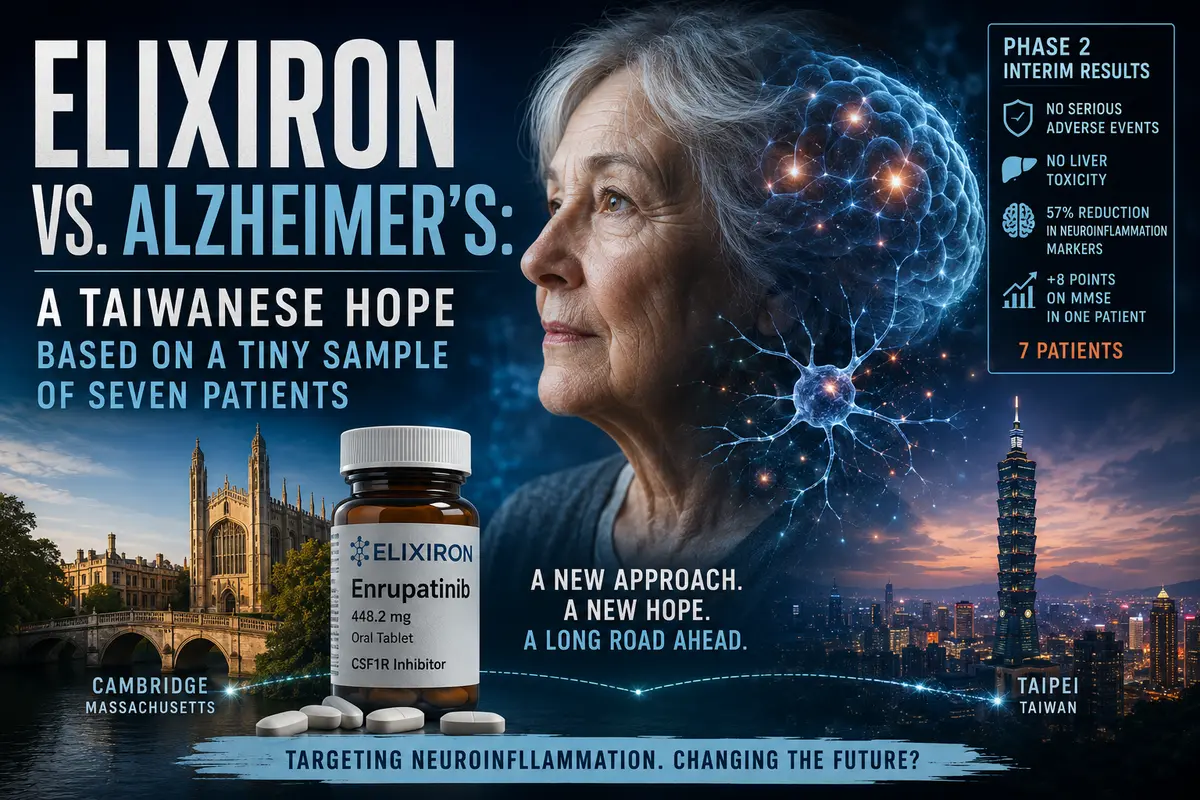
Yet there is something in Elixiron’s data that has made even skeptics take notice: the absence of serious adverse events, the absence of hepatotoxicity (liver toxicity) that doomed many previous drugs in the same class, a reduction in neuroinflammation markers in 57% of participants, and one patient who improved by 8 points on the MMSE (Mini-Mental State Examination).
Eight points.
For those unfamiliar with the MMSE, it is a widely used cognitive assessment scored out of 30 points. A decline of 2–4 points per year is considered typical progression for Alzheimer’s disease. An improvement of 8 points could represent a shift from moderate dementia to mild impairment—or even a return toward normal...
