

Scandinavian Surge: How Kitron Turned a Defense Order into a Financial Firework
Introduction: A Modest Manufacturer Becomes a Star
When we talk about European industry, the first names that come to mind are giants like Siemens, Airbus, or Thales. But sometimes the brightest growth stories are written by those who remain in the shadow of bigger names. Scandinavian electronics manufacturer Kitron is exactly such a case. The company, which most investors outside Northern Europe have probably never heard of, delivered results capable of outshining the reports of many industry heavyweights.
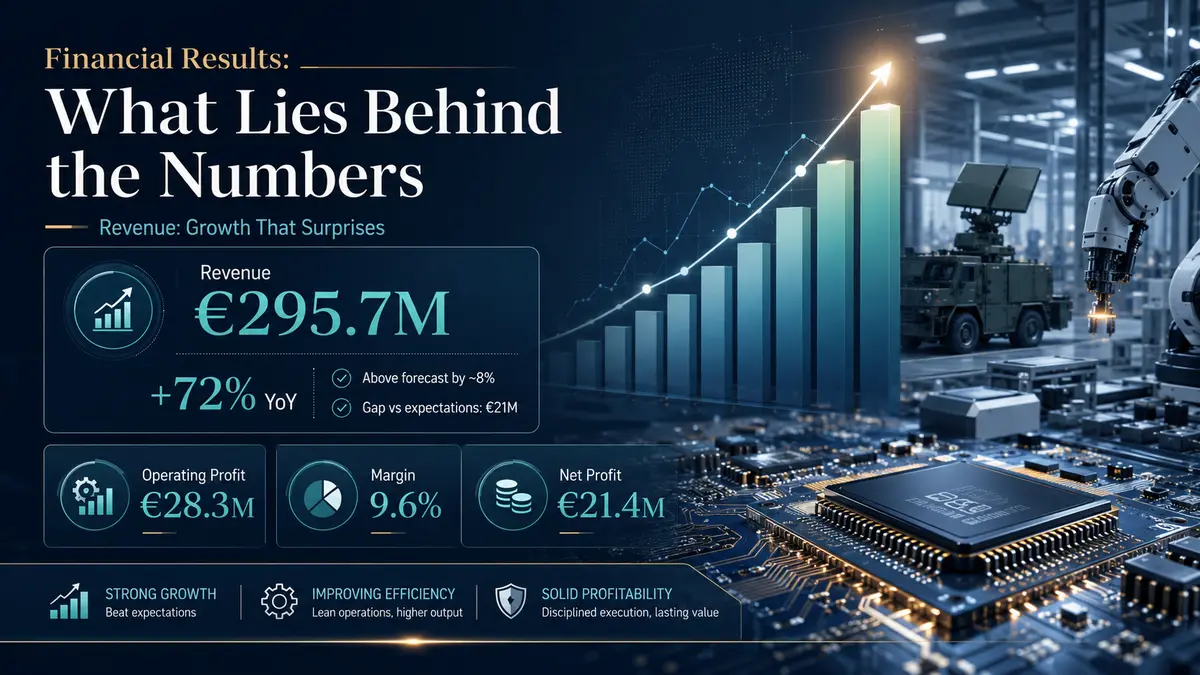
Second-quarter revenue reached €295.7 million, exceeding the expectations of six analysts, who on average had forecast €274.5 million. This is not just a “good result.” It represents growth of 72 percent compared with the same period last year. Seventy-two percent is the kind of number that makes you open the report twice to make sure you did not misplace a decimal point.
Operating profit also pleased shareholders: €28.3 million versus the forecast €27.17 million. A margin of 9.6 percent for an electronics contract manufacturer is a level that not everyone manages to achieve. And net profit of €21.4 million became the cherry on top of this financial feast.
But what stands behind these numbers? Why did Kitron show such explosive growth now, rather than last year or the year before? And most importantly, can this momentum continue?
Main Driver: Defense and Aerospace
The Reset of Europe’s Defense Industry
Kitron’s 72 percent revenue growth did not come out of nowhere. Behind it lies a fundamental shift in European defense policy that has taken place over the past two years. European governments, which had been cutting military budgets for years, suddenly realized that the world was not as safe as it once seemed. And they began rearming on a large scale.
This process affected not only major manufacturers of tanks and aircraft. It spread down the supply chain, reaching subcontractors and component suppliers. Kitron, as a manufacturer of electronics for the defense and aerospace industries, found itself at the epicenter of this demand.
Interestingly, all of the company’s market segments grew compared with last year. This suggests that the upswing is systemic rather than a one-off surge in a single area.
Why Electronics Matter
Today, the defense industry is first and foremost about electronics. A modern fighter jet is a flying computer with wings. A tank is an armored processor on tracks. Drones are essentially microelectronics with propellers.
Kitron specializes precisely in this segment. Printed circuit boards, control systems, navigation equipment, communication systems — this is the company’s bread and butter. Against the backdrop of the arms race now unfolding in Europe, demand for such components has increased many times over.
Notably, the company’s order backlog at the end of the reporting period reached €794.3 million. This figure is higher than almost three quarters of revenue and provides visibility into future income for many months ahead. In an uncertain market, this level of orders is a strategic advantage.
Customers Are Changing Their Philosophy: Reliability Matters More Than Price
A Shift in Procurement Strategies
Kitron CEO Peter Nilsson, in his commentary on the report, highlighted an important trend that explains the company’s success no less clearly than the numbers do. Customers are rebuilding supply chains, emphasizing reliability and product origin rather than the lowest possible cost.
This is a fundamental shift in procurement philosophy. For decades, European manufacturers chased lower production costs by moving manufacturing to countries with cheaper labor and less strict regulation. China, Vietnam, India, Eastern Europe — contracts went there because it was cheaper.
But the geopolitical shocks of recent years have forced companies to reconsider this approach. It is too risky to rely on supply chains that can be cut off by political decisions or military actions. Production downtime becomes too expensive when a key component gets stuck at customs or in a conflict zone.
European Origin as a Competitive Advantage
Kitron, with its Scandinavian production base, found itself in a winning position. Its products are manufactured in Europe, in stable countries with predictable legislation. This is not China with its opaque rules of the game. These are not countries where political risks can wipe out an entire business plan.
For defense customers, for whom supply reliability is critically important, the European origin of components is becoming the number one argument. They are willing to pay more for the guarantee that deliveries will not stop tomorrow because of a decision by a foreign government.
This trend is unlikely to reverse. Even if the geopolitical situation improves, the experience of recent years will stay with customers forever. They have seen how fragile global supply chains are. And now they will build their businesses with this lesson in mind.
Financial Results: What Lies Behind the Numbers
Revenue: Growth That Surprises
€295.7 million is not just a number. It is almost 8 percent above the forecast. The gap between expectations and reality amounts to about €21 million — a sum that would be a solid quarterly result for many companies.
Year-over-year growth of 72 percent is more typical of early-stage startups than of a mature contract manufacturer. Usually, such figures are shown by companies that have found a new niche or launched a revolutionary product. Kitron, however, simply found itself in the right place at the right time.
Operating Profit: Efficiency Is Improving
Operating profit of €28.3 million and a margin of 9.6 percent indicate not just revenue growth, but improved efficiency. The company is not merely selling more; it is selling more profitably.
The increase in operating margin amid such rapid revenue growth is due not only to pricing policy, but also to better utilization of production capacity, optimization of procurement processes, and economies of scale. The larger the production volume, the lower the unit costs.
Net Profit: What Was Left in the Pocket
Net profit of €21.4 million equals roughly 7.2 percent of revenue. Considering that the company operates in a highly competitive industry, this is an excellent result. This money can be directed toward investments, dividend payments, or the creation of reserves for future growth.
Order Backlog: A Window into the Future
Why €794 Million Is More Than Just a Number
The order backlog at the end of the period amounted to €794.3 million. To understand the scale of this figure, it needs to be compared with quarterly revenue of €295.7 million. If the current pace of production is maintained, this backlog will provide the company with work for almost three quarters ahead.
But even more important than the volume itself is its structure. Orders in the defense and aerospace industries usually have a long execution horizon and high margins. This means the company has guaranteed revenue for the foreseeable future and can plan investments and production expansion with a high degree of confidence.
Stability in an Unstable World
In a world where companies often live quarter to quarter, unsure whether there will be work tomorrow, such an order backlog is the number one competitive advantage. It allows Kitron to feel more confident than its competitors, negotiate better prices with suppliers thanks to guaranteed volumes, and invest in production development without fearing that orders will not come.
This is especially valuable during a period of geopolitical uncertainty. While many manufacturers are cutting investments and switching to wait-and-see mode, Kitron can afford to act offensively.
Forecasts for 2026: Ambitious, but Achievable
Revenue Range: From Confidence to Optimism
The company confirmed its 2026 revenue forecast in the range of €900 million to €1.05 billion. For comparison, revenue for the first two quarters amounted to approximately €550 million, based on known second-quarter data and an estimated first quarter.
To reach the lower end of the forecast, the company needs to earn about €350 million in the second half of the year. At the current pace, this looks entirely achievable. The upper end of €1.05 billion would require €500 million over the remaining six months, which is ambitious but not impossible.
Importantly, the company notes that results are trending toward the upper end of the forecast ranges. This is a signal to the market that management is optimistic and does not see serious risks of growth slowing down.
Operating Profit: Margin as a Priority
The operating profit forecast of €84 million to €108 million also looks realistic. With the current margin of 9.6 percent, revenue of €1.05 billion would generate operating profit of around €100 million — almost the midpoint of the forecast range.
In essence, the company is telling investors: we are not going to sacrifice margins for growth. We will increase revenue while preserving, and possibly even improving, business efficiency. This is an approach that the market values more than a simple race for market share.
What Comes Next: Will Growth Continue or Is This the Peak?
Factors Supporting Growth
There are several reasons to believe that Kitron’s current growth is not a one-off event. First, European military budgets will continue to grow. Geopolitical threats have not disappeared, and contracts signed now will be fulfilled over several more years.
Second, the trend toward supply chain localization is not only continuing, but strengthening. European manufacturers increasingly prefer European subcontractors over Asian ones, even if they are more expensive.
Third, the order backlog itself guarantees visibility into future revenue. Building long-term forecasts with this level of orders is much easier than doing so with a half-empty backlog.
Risks That Should Not Be Forgotten
But it would be dishonest to talk only about the positives. Kitron does have risks. First, demand in the defense industry can be cyclical. If the geopolitical situation improves, budgets may be revised downward.
Second, the company depends on supplies of raw materials and components, whose prices may rise. Higher costs for semiconductors, copper, and other materials could squeeze margins.
Third, there is competition. Kitron’s success will not go unnoticed. Major players may try to win back part of the market by offering more aggressive terms or investing in their own production capacities in Europe.
The Company’s Strategy for the Future
Judging by the tone of CEO Peter Nilsson’s commentary, he looks to the future with confident optimism. The company will clearly continue investing in production capacity expansion to cope with its growing order backlog.
There will also likely be increased focus on developing technological capabilities. The defense industry requires not just volume, but quality, reliability, and innovation. Those who can offer more advanced solutions will gain a competitive advantage.
Further work on optimizing supply chains and costs should also be expected. Kitron has shown that it can grow while improving margins at the same time. This skill will become even more important when market growth begins to slow.
Conclusion: A Success Story as a Reflection of the Times
Kitron’s story in the second quarter of 2026 is more than just the financial report of one Scandinavian company. It is a reflection of global processes that are reshaping the map of world industry. Geopolitics, a shift in supply chain philosophy, and Europe’s rearmament — all of this converged at the point where Kitron found itself.
Revenue growth of 72 percent, an operating margin of 9.6 percent, and an order backlog of almost €800 million — figures like these are not accidental. Behind them stand the right strategy, good timing, and the ability to take advantage of historic changes in the global economy.
But the most important takeaway from this story is how the rules of the game are changing for electronics manufacturers. It is no longer enough simply to be cheap. You need to be reliable, predictable, and, importantly, European in origin. Kitron has proven that this new approach to doing business works.
The confirmed full-year forecast, which points to a trend toward the upper ends of the ranges, shows that the company’s management is confident in continued success. And although risks always exist, Kitron’s current position looks significantly stronger than that of many competitors.
The company’s shareholders can sleep soundly — at least until the next quarterly report. And for the rest of the market, Kitron’s story is becoming a clear case study in how to turn geopolitical change into business success.

Comments
No comments yet. Be the first to share your thoughts!
Authentication Required
You must be logged in to post a comment.