

How to Become a Liquidity Provider for Deep Liquidity (DPLQ)
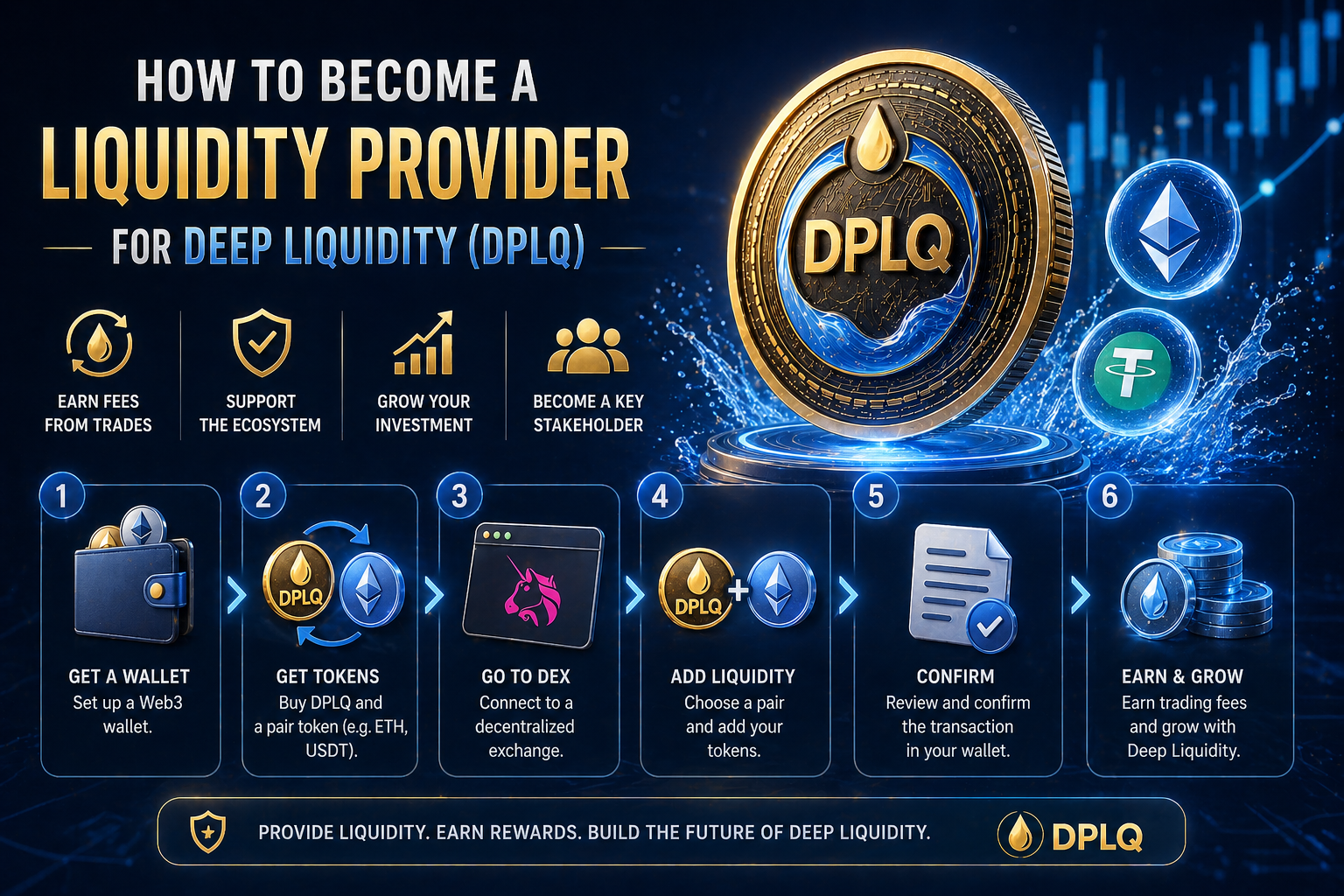
Investing in cryptocurrency is not just about buying tokens and waiting for the price to rise. Modern technology allows you to become an active market participant and earn income comparable to running your own exchange office. In this article, we will break down how to achieve this using the Deep Liquidity (DPLQ) token.
Official DPLQ Contract Address: 0xa8aBE5A7413d76128Da234621969485347Cc4975
Official Corporate Wallet (BNB BEP20): 0x32E84d9aa32eDD4F7E5084500875ec8cfe96108d
What is Liquidity and Your Role in It
Liquidity is the “fuel” for trading. Imagine walking into a traditional currency exchange to buy dollars, but the clerk says, “We don’t have any dollars; wait until someone comes in to sell them to us.” At that moment, the exchange office has no liquidity.
In the digital world, things work differently. For users to instantly buy and sell DPLQ, the system must have a reserve of tokens. This reserve is stored in what is known as Liquidity Pools — shared “digital vaults” where two assets are kept together (for example, DPLQ tokens and BNB coins).
Your Role: When you deposit your assets into such a pool, you become a Liquidity Provider.
- You help the exchange operate without delays.
- You become a virtual “co-owner” of the trading pair.
- In exchange, the system rewards you with a portion of the transaction fees paid by every person who makes a trade.
The DPLQ Philosophy: We encourage you to move from being a passive holder (waiting for the price to move) to an active market participant. By providing liquidity, you not only earn rewards but also make the token stronger and more stable for everyone.
Why Add Tokens to a Pool?
You might ask, “Why not just keep my tokens in my wallet?” Here are three main reasons to become a liquidity provider:
Passive Income from Fees
Every time someone performs a swap involving DPLQ on the PancakeSwap exchange, they pay a small fee (typically 0.25% to 0.3%). This fee does not go to the exchange itself — it is distributed among all liquidity providers based on their share of the pool. If trading volume is high, you receive a constant stream of profit directly into your pool share.
Price Stabilization
As more people add their funds to the liquidity pool, the market becomes “deeper.” In a deep pool, even a large buy or sell order cannot cause a massive price crash or an artificial spike. Therefore, liquidity providers protect the project from extreme volatility (so-called “dumps”), making the investment safer for the entire community.
Exclusive Bonuses
The DPLQ team values significant contributors. For those providing a substantial amount of liquidity, there is an opportunity to obtain the “Excluded from Fee” status. This means your address will be whitelisted to move tokens without paying the internal 1% burn tax, opening the door for professional-grade trading strategies.
Creating a Pool on PancakeSwap
Preparation: Choosing Your Pair
To create a pool, you need two assets of equal value. The most popular pairs for DPLQ are:
- DPLQ/BNB: Best for those who believe in the growth of the Binance ecosystem.
- DPLQ/USDT: Best for those who want to avoid the volatility of BNB and keep the “other half” of their investment in a stable dollar value.
The “Add Liquidity” Interface
- Go to the “Liquidity” section on PancakeSwap.
- Click “Add Liquidity”.
- Select DPLQ and your second asset (e.g., BNB).
- Setting the Ratio: You must provide both tokens in equal dollar amounts. For example, if you add $100 worth of DPLQ, you must also add $100 worth of BNB.
Receiving Liquidity Provider Tokens
Once you confirm the transaction, the exchange will issue you Liquidity Provider Tokens. These tokens are your “receipt.” They prove that you own a certain percentage of the pool and allow you to withdraw your assets along with your earned fees at any time.
Why DPLQ is Destined for Rapid Growth
Hyper-Deflation
DPLQ features a 1% burn mechanism on every transaction. This means the total supply is constantly shrinking. In economics, when the supply of a desired asset decreases while demand stays the same or grows, the price must rise.
The “Anchor” Effect
The team maintains a Direct Sale Price of $1.00 (or higher if the exchange price climbs). This creates a psychological support level. Investors know the project’s intrinsic value, which prevents panic selling and encourages steady growth.
Earning Strategies on Deep Liquidity
- “HODL & Burn”: The simplest strategy. Hold the tokens and let the 1% burn tax from other traders’ activity increase your share of the remaining supply.
- “DCA Micro-Investing”: Invest small amounts ($5–$10) regularly. This allows you to average your entry price and benefit from long-term deflation without worrying about daily price swings.
- “Market Maker”: Buy tokens on the exchange when the price is below the $1.00 “Direct Sale” mark and provide liquidity to profit as the price returns to its target level.
Real Case: Adding Liquidity Without Losing Money to Arbitrageurs
The Danger of Arbitrage
Arbitrageurs are traders (often using automated bots) who exploit price differences between different markets. If you create a new liquidity pool with an incorrect price ratio, these bots will instantly drain value from your pool to equalize the price with other markets.
How to Protect Yourself:
- Calculate the Correct Ratio: Before clicking “Confirm,” ensure the ratio of tokens you are providing matches the current market price exactly. If DPLQ is $1.00 on the exchange, your pool must reflect that $1.00 ratio.
- Concentrated Liquidity (V3) vs. Classic (V2): Using PancakeSwap V3 allows you to set a Price Range. This protects you because your capital is only active within the price boundaries you choose, preventing bots from “sweeping” your liquidity at unfair prices.
- The Golden Rule: Never create a pool with a tiny amount of money (e.g., $10) if you expect large trades. Small pools suffer from “Price Impact,” where a single trade can change the price by 10% or more, allowing bots to profit at your expense.
- Minimizing Impermanent Loss: This happens when the price of one asset changes significantly compared to the other. To minimize this, provide liquidity when you expect the market to be relatively stable or when you plan to hold for a long time so that the earned transaction fees outweigh any price divergence.
Conclusion: By becoming a liquidity provider for DPLQ, you stop being a spectator and start being the “House.” You earn from the volume, protect the price, and benefit from a hyper-deflationary model that rewards those who build the market.
How to Buy and Store Deep Liquidity (DPLQ)
Investment Prospects in DEEP LIQUIDITY (DPLQ)
White Paper: Deep Liquidity (DPLQ)
Disclaimer: Cryptocurrency investments involve market risks. Conduct your own research (DYOR) before making any investment decisions.

Comments
Write a lot, what is your cool token, maybe you will become a sponsor?
Yes, we will consider this possibility.
Deep Liquidity DPLQ, If you still want to become a sponsor of the project, you can conduct an Airdrop and pay for written articles to new authors.
Just write down the terms and clear instructions.
Now new authors are writing 1 article for $1.
The article must match the parameters stated in this article: https://pip.bar/how-to-write-high-quality-informational-articles-and-get-paid-for-them/
Big Pip, Thank you for your trust, here is the information https://pip.bar/airdrop-1-dplq-deep-liquidity-valid-until-august-31/
It would be nice if you created your own community where traders could ask questions, I spent half a day figuring out how to buy your token.
Waiting for x20 💵
Authentication Required
You must be logged in to post a comment.