

Gold Trading on FOREX, April 27, 2026: A New Logic for the Defensive Asset
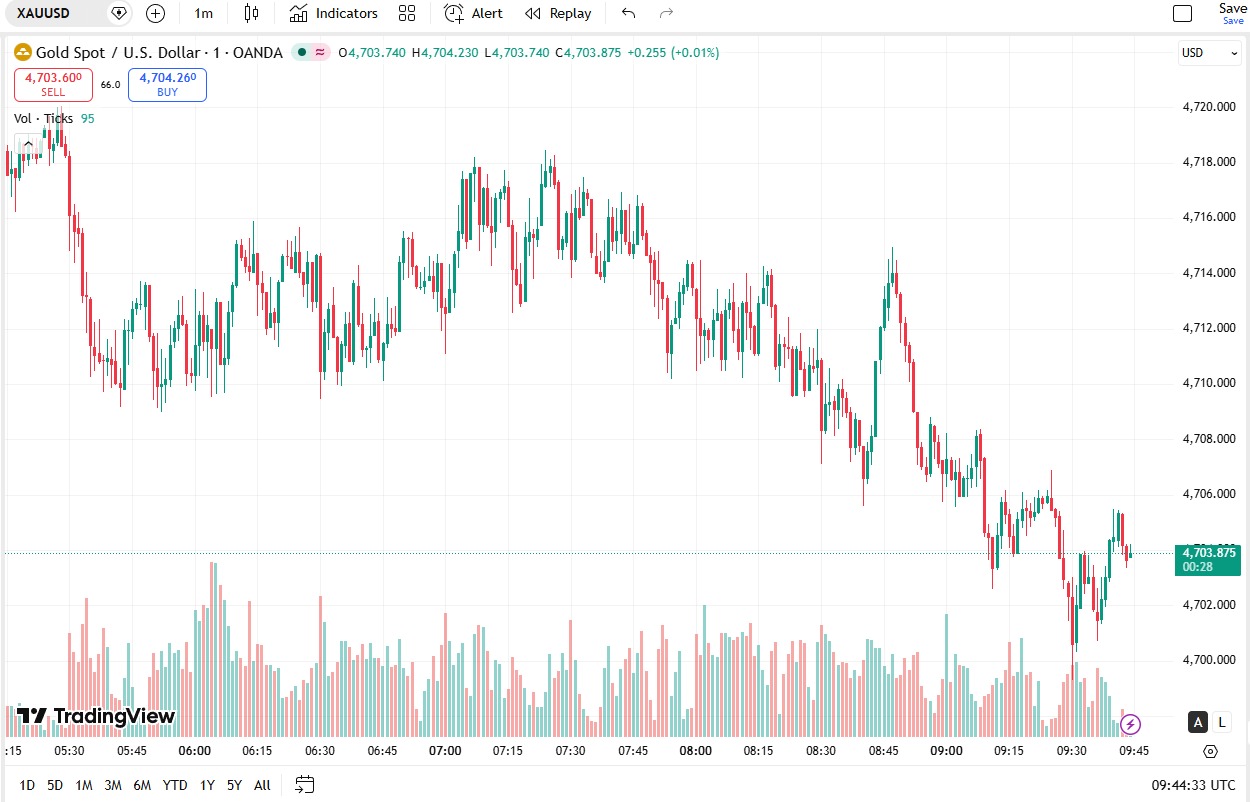
Monday morning, April 27, 2026, found gold in an extremely unstable position. The Asian session began with a collapse — XAU/USD tested the $4,672 level — after attempts to restart peace talks between the US and Iran reached an impasse, and energy flows through the Strait of Hormuz remained blocked for two months already. By midday, however, the situation changed. Information emerged that Iran, via Pakistani intermediaries, had sent the US a new proposal on denuclearization, the opening of the strait and an end to the war with a deferral of nuclear talks. This stirred markets, the dollar weakened, and gold recovered most of its morning losses, consolidating near $4,720 per ounce.
At stake is far more than just another speculative wave. The gold market finds itself in a new, paradoxical reality: the war in the Middle East, which by classical standards ought to push prices higher, is today, on the contrary, suppressing the asset — because it pushes oil higher and fuels inflation, forcing the Fed to keep monetary policy tight. As Nikki Shiels, Head of Research and Metals at MKS Pamp, succinctly put it: gold is in “technical no man’s land — conviction is minimal, large volumes of capital remain on the sidelines, and the most honest word to describe the market right now is ‘lost’.”
Technical Picture: Below the Moving Averages
The technical picture is shaping up in the bears’ favor. On the daily chart, the price closed below the 50-day and 200-day moving averages, confirming a short-term bearish shift. On the 2-hour timeframe, the price is trading below the 50 EMA ($4,738) and the 200 EMA ($4,748). RSI and MACD are in neutral territory, pointing to consolidation rather than a well-defined trend.
The key support zone today is $4,680–4,700. A break below this range will open the way to $4,650–4,660 and then to $4,550, which InstaForex highlights as the next major bearish target. The upper resistance boundary stands at $4,730. A hold above this level would shift the focus to $4,740 and $4,760. On the daily chart, InstaForex identifies supports at $4,550 and $3,933, and resistances at $4,710 and $5,010.
On the 4-hour chart, gold formed a bullish reversal “Hammer” pattern near the lower Bollinger Band. If the upward momentum gathers strength, the nearest target will be resistance at $4,970 (an alternative scenario envisages a pullback to $4,640 before a fresh rally). On the hourly chart, after the morning drop to $4,672, the price bounced and climbed above the middle Bollinger Band — the KDJ formed a “Golden Cross,” and the MACD turned upwards. This offers hope for a short-term upward impulse. However, on the daily timeframe, the 5-day and 10-day moving averages are pointing downwards, and bearish momentum on the MACD is building. Therefore, even with intraday bounces, selling into rallies towards resistances is recommended.
Geopolitics and the Fed: Three Fronts of One War
From a fundamental analysis perspective, gold is under pressure today from three key factors:
First — the breakdown of US–Iran peace talks. President Trump cancelled his envoys’ trip to Pakistan, citing that the Iranian proposal was “insufficient.” Iran, for its part, stated it would not take part in “talks imposed under threats.” As a result, the Strait of Hormuz remains blocked, disrupting roughly one-fifth of global oil flows, which fuels inflation and deters central banks from easing policy.
Second — a change in the logic of the “safe haven.” The classic “geopolitical crisis = buy gold” model no longer works in its pure form. The war in the Middle East pushes oil prices higher. This stokes inflation and forces the Fed to keep rates high. And high real rates make holding non-yielding gold increasingly expensive. Gold has temporarily lost its status as a defensive asset, ceding primacy to the dollar.
Third — anticipation of the Fed meeting on April 29. The market is 99.5% certain that the rate will remain unchanged in the 3.50–3.75% range. The key question is the rhetoric of Chair Powell at his last press conference before handing over to Kevin Warsh. If the signal proves “hawkish,” the dollar will continue to strengthen, and gold could tumble towards $4,600. If, however, the signal turns out more dovish, it will act as a powerful bullish catalyst. Over the past week, the probability of a rate cut in 2026 has collapsed from 45% to 27% — the market is rapidly repricing expectations towards tightening.
Forecast for Today and Tomorrow
Today, April 27, gold is likely to continue consolidating in the $4,680–4,730 range with a bearish tilt. The session’s outcome depends on how the geopolitical situation develops. If no fresh news on peace talks emerges, pressure on prices will persist.
Tomorrow, April 28, a rise in volatility is expected. The market will be positioning ahead of Wednesday. Under the current backdrop, the most probable scenario remains trading within $4,690–4,750. However, any leaks about the Fed’s decision or “hawkish” signals from central bank officials could trigger a breakdown and a move towards $4,600.
Some major investment banks (Goldman Sachs) maintain a long-term forecast of $5,400 by the end of 2026, linking it to the expected easing of Fed policy in the second half of the year and continued gold purchases by central banks (estimated at 60 tonnes per month). But for this scenario to materialize, the Fed’s “hawkish” pause needs to end — and until then, bearish risks remain dominant.

Comments
Technology shows that bears are currently ruling the market, so it’s still dangerous to buy the whole cutlet.
Authentication Required
You must be logged in to post a comment.