

Dark Pools and Hidden Orders — How Institutions Move Size Unseen
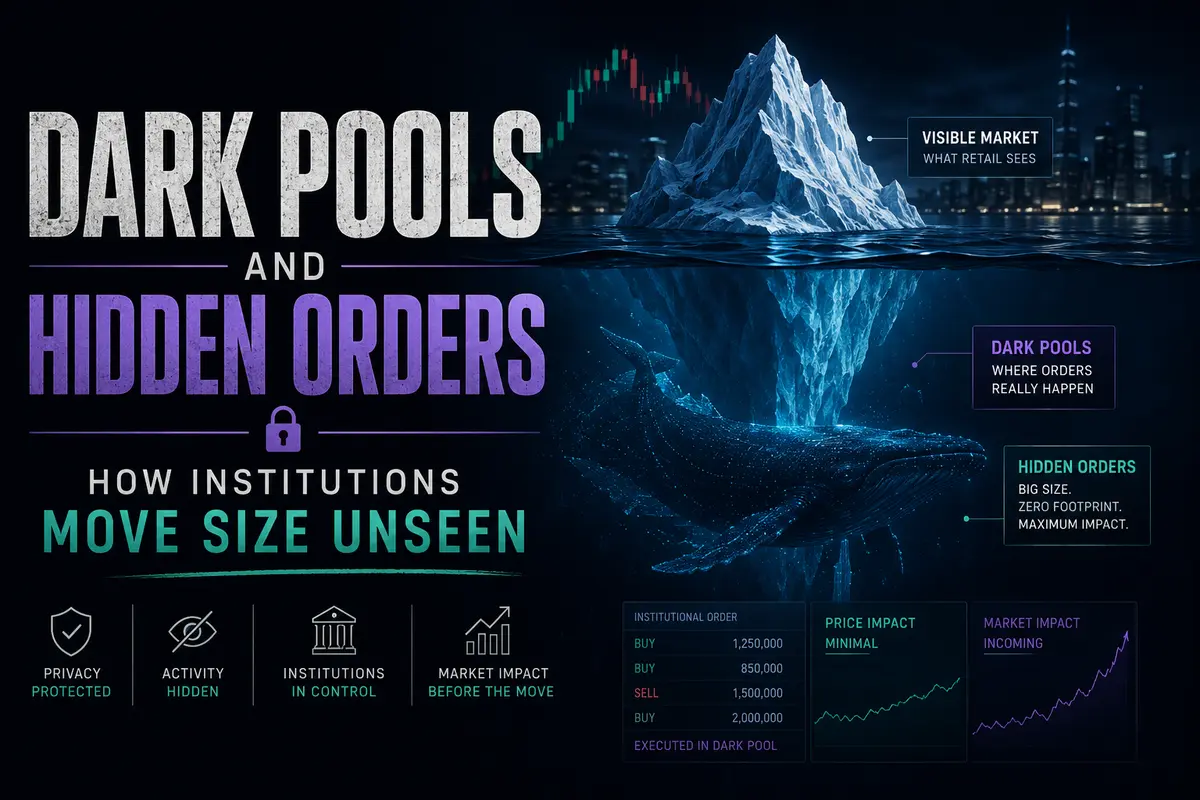
When a large institutional asset manager needs to acquire or liquidate millions of shares in a publicly traded company, they face a severe execution dilemma. If the fund manager dumps a massive multi-million-dollar order directly onto a lit exchange like the New York Stock Exchange or NASDAQ, the transparent order book immediately reveals their intentions. High-frequency trading algorithms and opportunistic retail participants will detect the size imbalance, front-run the order, buy up all the available asks, and force the institution to execute at drastically inflated average prices.
To prevent this severe market impact, institutional capital turns to alternative execution venues. These venues are known as dark pools, and the orders executed within them rely on hidden order types designed to mask intentions from public scrutiny. Understanding how dark pools and hidden orders operate provides a critical window into institutional execution dynamics that never show up on a standard public price chart.
The Architecture of Lit Exchanges vs. Dark Pools
To understand why dark pools exist, you have to contrast them with standard lit exchanges. A lit exchange operates under a completely transparent mandate. Every single bid, ask, and completed trade is published in real time via public market data feeds. Anyone sitting at a retail trading terminal can view the Level 2 order book, see the resting limit orders, and track volume as it happens.
A dark pool, officially classified as an Alternative Trading System (ATS), is a private financial exchange or forum for matching security trades where pre-trade transparency is completely eliminated.
-
Pre-Trade Anonymity: When an institution places an order into a dark pool, no other market participant can see the price, size, or direction of the order. The resting liquidity is entirely invisible.
-
Post-Trade Reporting: Trades executed inside a dark pool are eventually reported to public tape data feeds, but this reporting is often delayed by seconds, minutes, or even aggregated at the end of the trading day. This delay prevents market participants from reacting to institutional size in real time.
Dark pools were originally created by major investment banks to allow institutional investors to trade large blocks of stock quietly, minimizing price disruption and reducing transaction costs for pension funds, mutual funds, and large-scale asset managers.
Hidden Orders and Iceberg Mechanics on Lit Venues
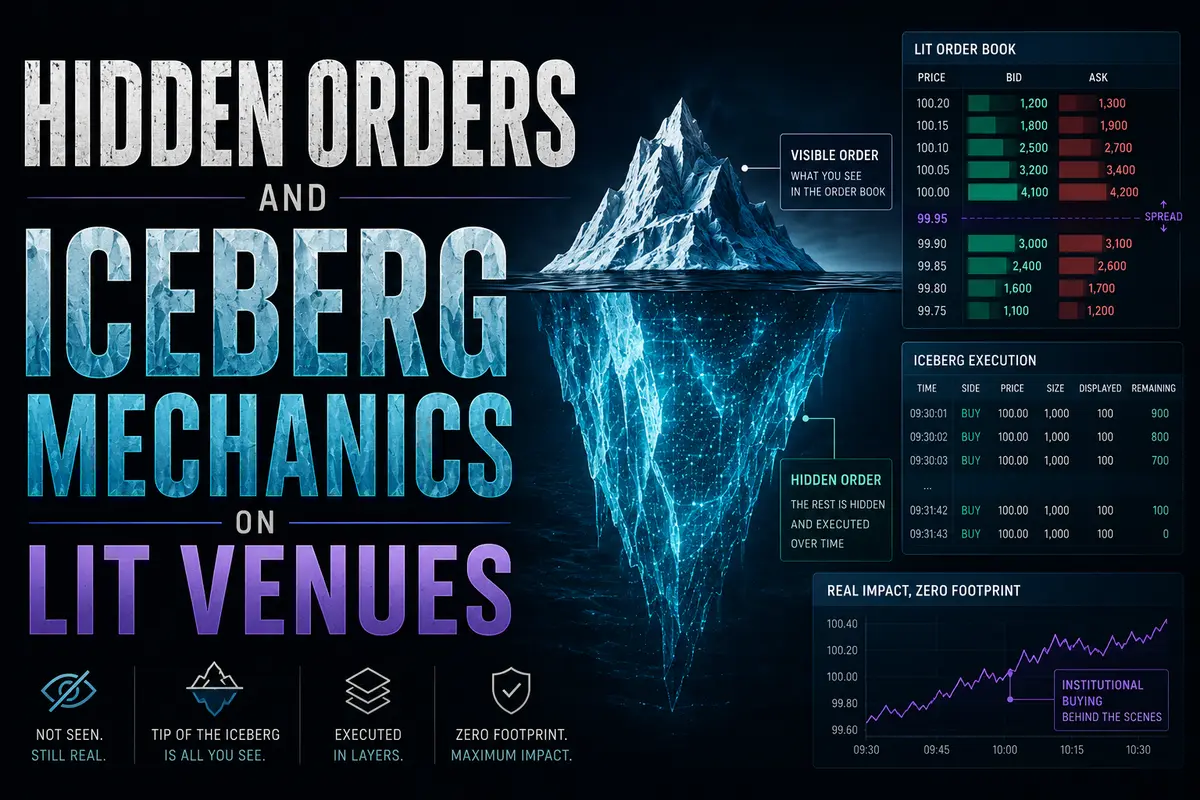
Institutions do not rely exclusively on off-exchange dark pools; they also utilize specialized hidden order types directly on lit exchanges. The most common of these is the Iceberg Order.
An iceberg order is a large single order that has been divided by an institutional algorithmic execution engine into two distinct components:
-
The Displayed Portion: A small visible slice of the total order size displayed on the public order book (e.g., showing 100 shares available at the best bid).
-
The Hidden Reserve: The vast majority of the order size remaining completely concealed behind the displayed slice (e.g., 50,000 shares sitting silently in the reserve queue).
              THE MECHANICS OF AN ICEBERG ORDER

   Publicly Visible Order Book View:
   - Best Bid: $150.00 (Size: 100 shares)

   Underlying Execution Reality:
   - Visible Slice: 100 shares (Refills automatically as filled)
   - Hidden Reserve: 49,900 shares waiting silently behind the scenes
   - Total Order: 50,000 shares
As aggressive market sellers hit the displayed bid and exhaust the initial 100 shares, the institutional algorithm instantly replenishes the visible quote with another 100 shares from the hidden reserve. This process repeats continuously until the entire 50,000 shares are filled. To an ordinary chart observer, the bid at $150.00 appears to possess endless buying support, even though it is simply a single iceberg order being automatically refilled from an invisible reserve.
The Hidden Risks of Dark Pools: Information Leakage and HFT Predation
While dark pools offer a mechanism to shield orders from immediate public impact, they are not a risk-free utopia for institutional traders. Over time, the fragmentation of liquidity across dozens of private dark pools has introduced complex competitive dynamics.
1. Information Leakage
If an institutional fund manager breaks a massive order into smaller chunks and sends them simultaneously to multiple dark pools, advanced high-frequency trading algorithms can detect statistical patterns in execution timing. By monitoring the frequency and size of hidden executions across various alternative venues, high-frequency firms can reverse-engineer the institution’s directional intent and position themselves ahead of the remaining unexecuted volume.
2. Adverse Selection in Dark Venues
Dark pools often match trades using midpoint pricing—meaning buyers and sellers are matched at the exact mathematical center of the current national best bid and offer (NBBO). While this saves both parties money on the spread, it attracts opportunistic algorithmic participants. High-frequency liquidity providers use dark pools to offload toxic inventory or snipe institutional orders when momentum shifts on the lit exchange, leaving the slower dark pool participant holding an adverse position.
Practical Takeaways for Active Market Participants
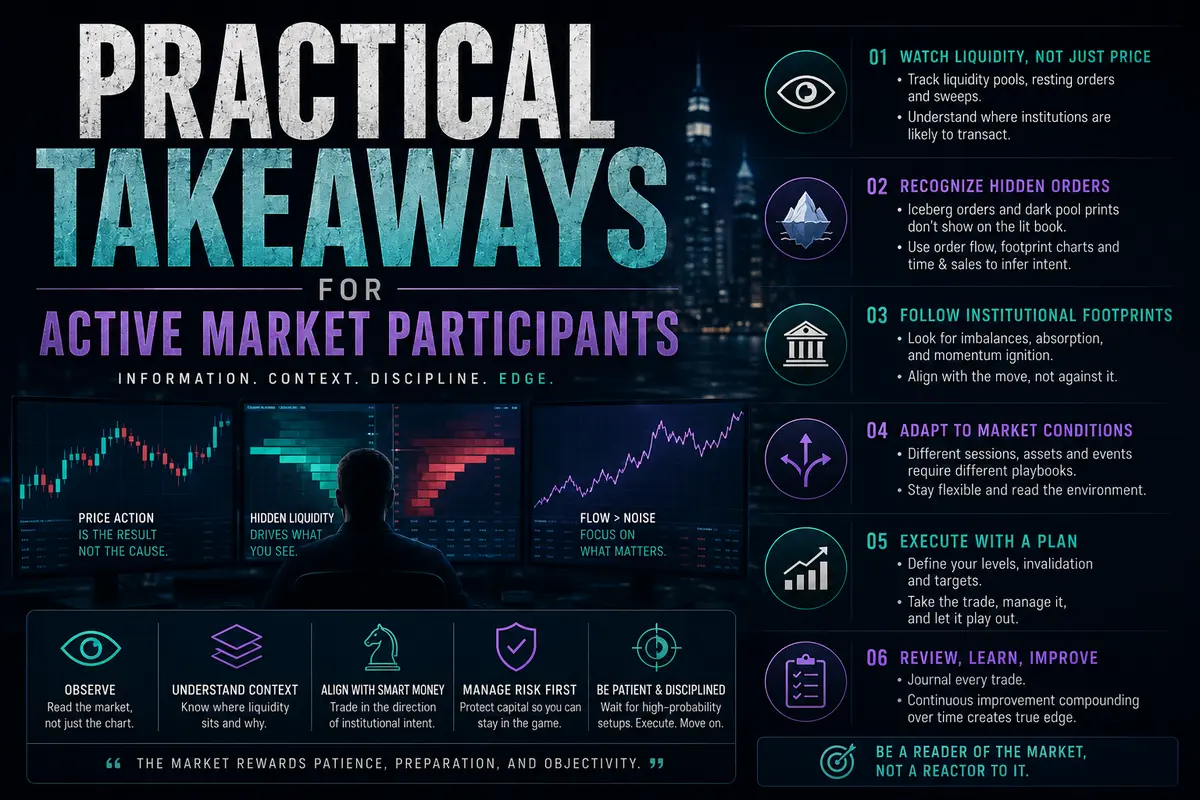
Recognizing the existence of dark pools and hidden orders changes how you interpret chart behavior and volume anomalies:
-
Beware of Apparent Walls at Key Levels: When you see a massive block of resting limit orders sitting at a round number or a technical level on a lit order book, do not assume it is an immovable wall. Large institutional size is frequently canceled or shifted the moment price approaches, because visible orders are often used as signaling tools rather than genuine intent.
-
Understand Unexplained Volume Surges: If an asset’s price remains completely range-bound, yet volume indicators show millions of shares trading hands silently without moving the price, you are witnessing institutional execution via dark pools or hidden iceberg orders. Respect the underlying volume—it signals that accumulation or distribution is actively taking place beneath the surface.
-
Avoid Chasing Breakouts Blindly: Many false breakouts occur because retail traders see a sudden surge in volume and assume institutional participation is driving momentum. In reality, that volume may simply be the clearing of a hidden iceberg order or dark pool cross, after which the institutional sponsorship vanishes and price collapses back into its prior range.
By accounting for hidden liquidity and off-exchange execution venues, you stop viewing market charts as simple two-dimensional lines and start recognizing the complex, multi-layered institutional battlefield operating just out of sight.

Comments
No comments yet. Be the first to share your thoughts!
Authentication Required
You must be logged in to post a comment.