Bar Pipa
We pay for a post of 10$

Analytics

Asian Session | Friday 26 June 2026 The Yen Just Hit a 40-Year Low. Tokyo CPI Came In Hot. And Asia’s Tech Selloff Didn’t Stop for Micron
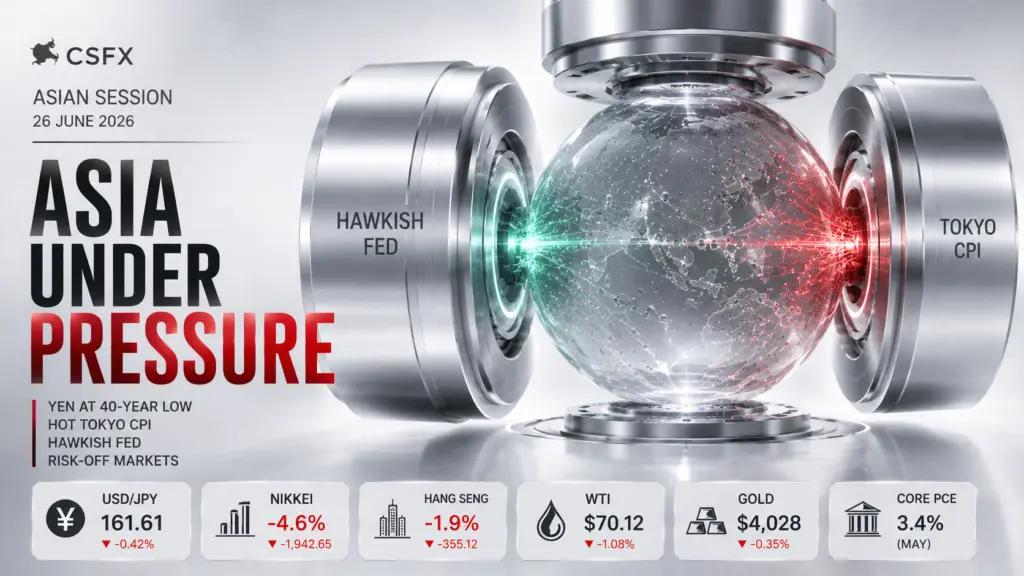
Asian Session | Friday 26 June 2026 The Yen Just Hit a 40-Year Low. Tokyo CPI Came In Hot. And Asia’s Tech Selloff Didn’t Stop for Micron

USD/JPY at 161.61, just below 162.00 -- a 40-year yen low with intervention watch live. Tokyo headline CPI 1.7% YoY, core 1.6% -- data that should be yen-bullish but isn't. Nikkei -4.6% below 69,000. Hang Seng -1.9% at 22,648. Nasdaq futures -1.6%. Gold eyeing a fourth straight weekly loss. XRP at $1.00 -- the psychological pivot after $1.48B in liquidations.

LIVE INTERVENTION WATCH: USD/JPY 161.61 -- one tick from 162.00, the level MoF has historically defended with capital.


The most counterintuitive fact of Friday's Asian session is that Tokyo's June CPI print -- headline at 1.7% year-on-year, core at 1.6% -- is being treated as bullish for the yen's structural case and simultaneously bearish for the yen's immediate price. That paradox needs unpacking because it defines the session's entire analytical architecture. Hot Tokyo inflation hardens the case for the BoJ to hike again -- perhaps as early as September -- which is structurally yen-supportive over weeks and months. But in this morning's session, with the Fed still at 3.50 to 3.75% and the DXY near a 13-month high at 101.6, the immediate read is simply: higher Japanese inflation means higher Japanese import costs, which means a weaker yen compounds faster, which is a reason for intervention rather than a reason for yen strength. The data and the price are telling different stories on different timescales.

Meanwhile, Asia's tech selloff has deepened in a way that Micron's genuinely historic earnings beat -- $41.46 billion in revenue, $25.11 EPS, $50 billion Q4 guidance -- has been entirely unable to arrest. The Nikkei 225 fell below 69,000, posting a decline of approximately 4.6%. The KOSPI triggered circuit-breakers for the second time this week. The Hang Seng is down 1.9% at 22,648. Nasdaq futures are pointing to a 1.6% decline for Friday's US...
Continue reading...
0
0

US Session | Thursday 25 June 2026 The $400 Billion Rally Nobody Saw Coming Three Days Ago — Micron, Sandisk, PCE, and the Week That Changed Everything

US Session | Thursday 25 June 2026 The $400 Billion Rally Nobody Saw Coming Three Days Ago — Micron, Sandisk, PCE, and the Week That Changed Everything

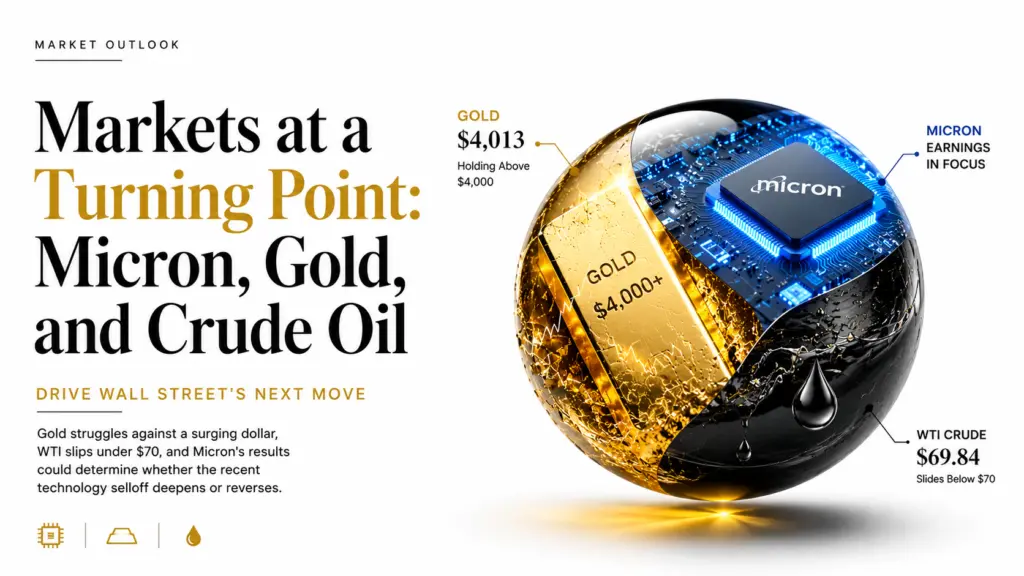
Three days after the worst chip sector rout in three years, Micron delivered $41.46B revenue (+346% YoY), $25.11 EPS, and $50B Q4 guidance. Sandisk is up 15%. Gold is above $4,000 again. PCE printed 3.4% -- marginally hot but broadly in-line. The Dow is at a record high. The week that looked like a market break is ending as a market validation.

Tuesday looked like a reckoning. The AI chip complex triggered circuit-breakers in South Korea. Sandisk fell 13.6%. Gold broke below $4,000 for the first time in 2026. Silver hit a seven-month low. The narrative forming -- that the AI memory investment cycle had reached its mid-cycle plateau -- was coherent and gaining traction. Then Micron reported.

Adjusted EPS of $25.11 against roughly $20.78 expected. Revenue of $41.46 billion, up 346% year-on-year, against consensus near $35.85 billion. Q4 guidance of $50 billion versus the $43 billion Street estimate. Gross margins approaching 85%. These are not merely good numbers. They are numbers that make the AI-capex-plateau thesis look, in retrospect, like what it was: positioning anxiety dressed up as fundamental analysis, triggered by a single SK Hynix production-scheduling decision and amplified by the worst possible market conditions for that narrative to land in.

Reuters put the size of the single-session chip rally at approximately $400 billion. Sandisk -- Tuesday's biggest loser at minus 13.6% -- is Thursday's biggest winner at plus 15%, now at $2,150 with Citi lifting its target to $2,500. Qualcomm added 6 to 14% on its own raised 2029 data-centre revenue target of $15 billion. The week that looked like a break is ending as a validation.


THE WEEK'S VERDICTS

AI CAPEX CYCLE  Not plateauing. Micron's Q4 guidance of $50B and 85% gross margin is the definitive refutation. The Tuesday rout was positioning, not signal.

...

Continue reading...
0
0

Asian Session | Thursday 25 June 2026 Equities Are Up. Everything Else Is Still Breaking. The Dollar Doesn’t Care About the Chip Rally

Asian Session | Thursday 25 June 2026 Equities Are Up. Everything Else Is Still Breaking. The Dollar Doesn’t Care About the Chip Rally

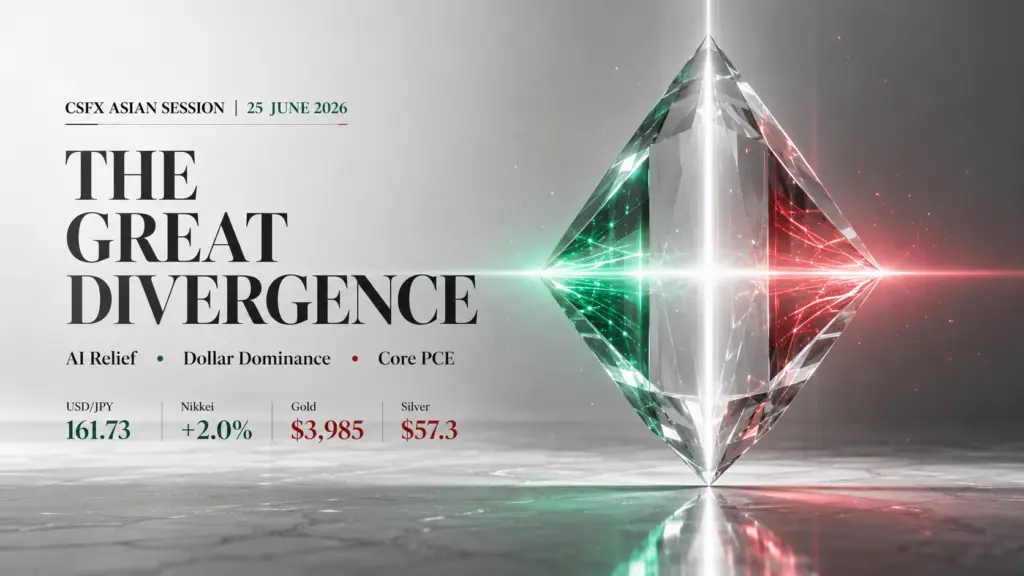
Micron's $22B order commitment rescued the Nikkei (+2%) and KOSPI (+5.5%). But that relief rally is happening on the same morning that gold is below $4,000, silver is down 25% in a month, oil is at a three-month low, the Hang Seng printed a fresh 52-week low at 23,004.75, and USD/JPY is at 161.73 -- one tick from the level that hasn't been seen since 1986. The dollar at a 13-month high is the story that matters more than the chip bounce.

Thursday's Asian session is defined by a tension that will not resolve until US Core PCE lands this afternoon: equities are recovering hard on Micron's blowout $22 billion order commitment and Qualcomm's $15 billion data-centre revenue guidance through 2029, but every non-equity asset is behaving as though the macro regime is getting worse, not better. Gold sub-$4,000 for the first time in 2026. Silver down 25% in a month. Oil at $69.31, its lowest since March. The Hang Seng printing 23,004 before attempting to stabilise. NZD/USD at 0.5645 -- a seven-month low and six consecutive losing sessions. These are not noise. They are the same dollar-dominance signal that has been running since Warsh's hawkish hold, expressing itself in every non-equity asset class simultaneously.

The relief in equities is real and the chip story behind it is genuinely positive. Micron's memory-chip order commitments of $22 billion directly contradict the SK Hynix HBM4 slowdown reports that triggered Tuesday's 'Black Tuesday' circuit-breaker rout in South Korea. Qualcomm's $15 billion data-centre revenue guidance through 2029 adds a second positive signal from the AI hardware supply chain. But the market's fundamental question -- whether Tuesday's selloff was sector positioning noise or a genuine AI capex plateau signal -- is now answered. It was positioning noise. The AI memory investment cycle has not peaked....

Continue reading...
0
0

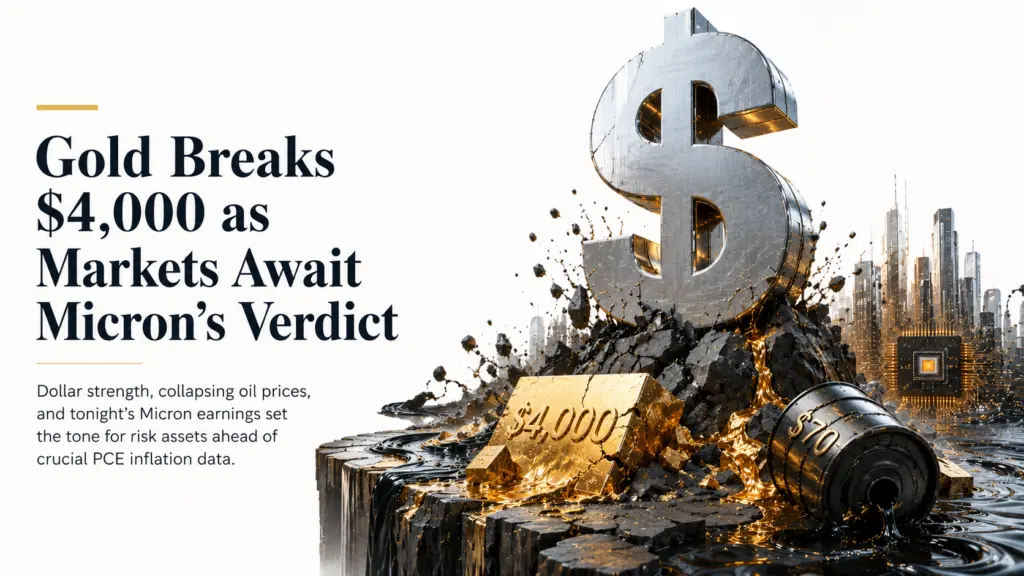
US Session | Wednesday 24 June 2026 Gold Through $4,000. Oil Through $70. Micron Reports Tonight. Three Lines That Define the Rest of the Week

US Session | Wednesday 24 June 2026 Gold Through $4,000. Oil Through $70. Micron Reports Tonight. Three Lines That Define the Rest of the Week

DXY above 101 at fresh 2026 highs. Gold at $3,987 intraday -- its first sub-$4,000 print since November 18, 2025. WTI at $69.84 -- its first sub-$70 print since March 2. Sandisk off 13.6% Tuesday. S&P recovering 0.35%. Micron earnings after the bell. PCE and GDP Thursday. The market is asking one question right now: did Tuesday's AI chip rout change the trend, or is Micron the answer?

Gold breaking below $4,000 and oil breaking below $70 in the same session is not coincidence. Both are expressing the same macro regime: the dollar is the dominant force in global markets right now, and a DXY above 101 is compressing every non-dollar asset simultaneously. Gold's $3,987 intraday low was its weakest print since November 18, 2025. WTI's $69.84 session low was its first sub-$70 trade since March 2, representing roughly a 40% collapse from the wartime peak as the International Maritime Organization confirms that hundreds of vessels have resumed transit through the Persian Gulf under security assurances.

The dual mechanism is straightforward: the dollar is stronger because Warsh's hawkish hold removed 2026 cuts from the Fed's dot plot and Bank of America has joined the chorus projecting up to three Fed hikes this year, keeping the DXY bid. Oil is weaker because the 60-day Iran waiver enabling Iranian barrels to sell on international markets, combined with Hormuz transit normalisation, has restored the supply that the conflict removed. When the dollar strengthens and oil normalises simultaneously, the two largest components of most inflation-risk calculations both move in the same direction -- lower. That is why gold is falling even as equity volatility rises.

The Session's Central Question

Tuesday's 13.6% collapse in Sandisk (SNDK), layered on top of Samsung and SK Hynix both falling roughly 12% in Seoul while triggering exchange-level circuit breakers...

Continue reading...
0
0

The Market Must Fall Before the Renaissance Can Rise

The Market Must Fall Before the Renaissance Can Rise

Rise

Space. AI. Quantum. Three revolutions entering public markets simultaneously at the second-most expensive valuation in 145 years of recorded financial history.

Capital Street FX Research Desk  |  Seven Parts  |  16 Trade Setups


Overview

This is not a daily briefing. It is an attempt to answer a single question with the full weight of the historical record behind it: when genuinely transformational technology meets an historically extreme market valuation, what happens next?

The week of June 12, 2026 produced three events that, taken together, represent the most concentrated moment of technology-meets-capital the markets have seen since late 1999. SpaceX listed on the Nasdaq as SPCX and within days was trading at 73 times annual revenue -- a price-to-sales ratio that makes Amazon's 1997 IPO look conservative. Anthropic filed its S-1 for an IPO targeting October 2026 at a private valuation of $965 billion, with $47 billion in annualised revenue and its first operating profit visible on the horizon. OpenAI filed its S-1 days later, valued at $852 billion, projecting losses of $25 to $27 billion in 2026 and positive cash flow not until 2030. And IonQ, a quantum computing company almost no one outside the technical field had heard of, reported first-quarter revenue growth of 755% year over year.

At the same moment, the Cyclically Adjusted Price-to-Earnings ratio -- the CAPE, the valuation measure that strips out short-term earnings volatility and averages a decade of results -- stood at 40.43. The second-highest reading in 145 years of data. The only time it was higher was December 1999, at 44.19. The Warren Buffett Indicator -- total market capitalisation as a percentage of GDP -- was 233.8%, an all-time record. The top ten companies in the S&P 500 represented 40% of the total index, also an all-time record. The last...

Continue reading...
0
0

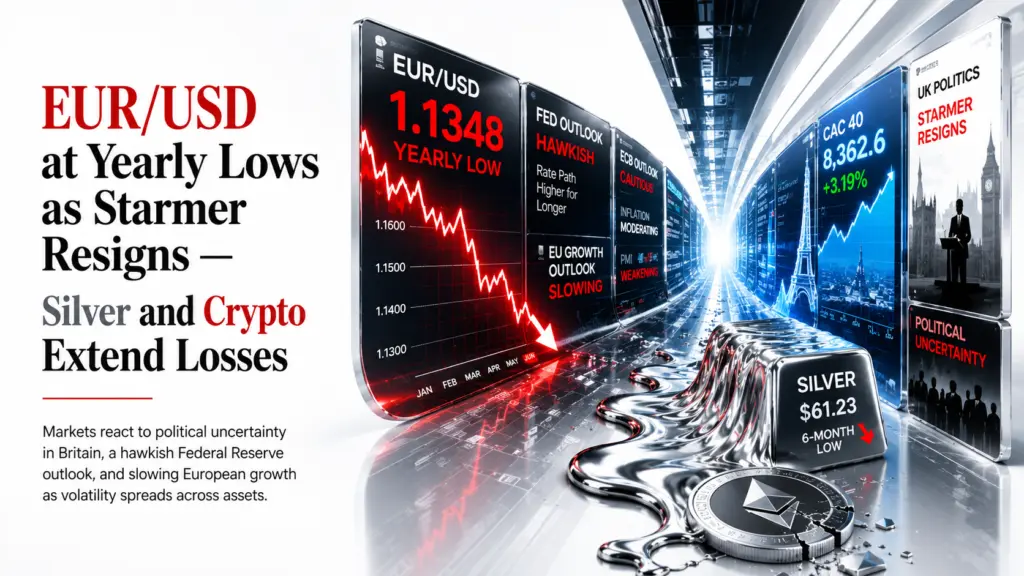
European Session · Wednesday 24 June 2026 EUR/USD At Yearly Lows. UK Has No PM. The CAC 40 Is Up 3.19%. And Silver Just Hit a Six-Month Low

European Session · Wednesday 24 June 2026 EUR/USD At Yearly Lows. UK Has No PM. The CAC 40 Is Up 3.19%. And Silver Just Hit a Six-Month Low

EUR/USD at 1.1348 -- yearly lows. UK Composite PMI 49.4, a 14-month low. Starmer functionally gone; Burnham frontrunner with 200+ MPs, leadership contest opens 9 July. CAC 40 up 3.19% as France leads Europe. Silver at $61.23 -- six-month lows. EU gas storage 45.56% vs 54.38% yr-ago. Ethereum at $1,668. PCE Thursday decides the dollar's next leg.

Wednesday's European session opens to a continent navigating simultaneous political and macro turbulence. UK Prime Minister Keir Starmer formally resigned on Monday -- the seventh British leader in a decade. Andy Burnham is the frontrunner with over 200 MP backers and the leadership contest opens on 9 July. EUR/GBP at 0.8605 tells you the market is not yet buying the Burnham relief story fully: GBP is holding but not surging, because a leader in waiting is not a leader with a fiscal mandate.

At the same moment, EUR/USD is at yearly lows of 1.1348 -- driven by two simultaneous forces: the Fed's hawkish hold removing dollar downside, and the ECB's position becoming incrementally less hawkish as soft PMI data accumulates. Germany Composite PMI was 48.0 yesterday. The UK Composite PMI fell to 49.4 today -- a 14-month low. Lagarde's comment that inflation is 'manageable' is being read as a signal that the ECB is entering a hold debate. EUR/USD at yearly lows is the market's verdict on that reading.

EUR/USD at yearly lows. The ECB hiked and is now seen as pivoting toward hold. The UK has no PM. Silver is at six-month lows. The CAC 40 is up 3.19%. Wednesday is the session where everything went in different directions simultaneously.

The UK Political Void: Why GBP Isn't Falling Further

Starmer's resignation creates a vacuum that would normally be materially GBP-negative. The currency has not collapsed for a specific reason: the succession path...

Continue reading...
0
0

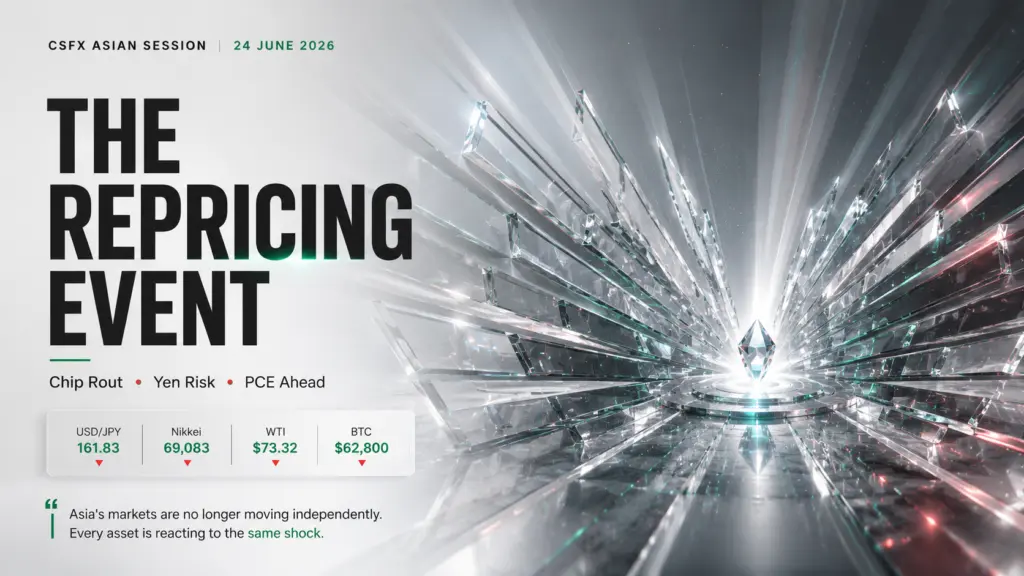
Asian Session · Wednesday 24 June 2026 The Nikkei Just Crashed 3.6%. The KOSPI Hit a Double Circuit-Breaker. USD/JPY Is at a 1986 High. And Today Micron Tells You Whether the AI Trade Is Intact

Asian Session · Wednesday 24 June 2026 The Nikkei Just Crashed 3.6%. The KOSPI Hit a Double Circuit-Breaker. USD/JPY Is at a 1986 High. And Today Micron Tells You Whether the AI Trade Is Intact

SoftBank -10.1%. Kioxia -15.1%. KOSPI down 8.1% and triggering circuit-breakers twice. The Nikkei has snapped an eight-session winning streak from all-time highs. USD/JPY at 161.83, just below Tuesday’s 162.22 cycle high. AUD/JPY on a six-day losing streak to 111.51. Australia’s CPI surprised 4.0% versus 4.4% expected. And today’s Micron earnings will tell the market whether this is a healthy correction or the beginning of a mid-cycle AI exhaustion.

Wednesday's Asian session opens in the shadow of the sharpest single-session AI sector unwind since late 2022. Japan's Nikkei 225 crashed 3.55% — 2,566 points — to close at 69,083, snapping an eight-session winning streak that had taken it to all-time highs above 72,095. SoftBank fell 10.1%. Kioxia collapsed 15.1%. Tokyo Electron shed 6.2%. Ibiden lost 6.6%. South Korea's KOSPI was far more extreme: down 8.1% to 8,375, triggering the Korea Exchange's circuit-breaker mechanism twice in a single session. Samsung Electronics and SK Hynix both fell roughly 12%.

The selloff is not purely technical. The catalyst was a combination of three things arriving simultaneously: reports that SK Hynix is slowing its HBM4 memory expansion and reallocating back toward conventional DRAM — which is the single most bearish possible signal for the AI memory investment thesis; SpaceX's massive debt issuance creating liquidity anxiety across high-growth names broadly; and broader concern about whether hyperscaler AI capex is approaching its mid-cycle plateau. Wednesday shows tentative stabilisation — the Nikkei opening approximately 0.3% lower, KOSPI recovering roughly 4% — but the defining event today is Micron Technology's earnings report. Micron is the proxy for whether the AI memory investment cycle is intact. What Micron says tonight is what the market will use to decide whether Tuesday was a buying opportunity or a warning.

SoftBank -10.1%. Kioxia -15.1%. KOSPI double circuit-breaker. The AI chip rout that started...

Continue reading...
0
0

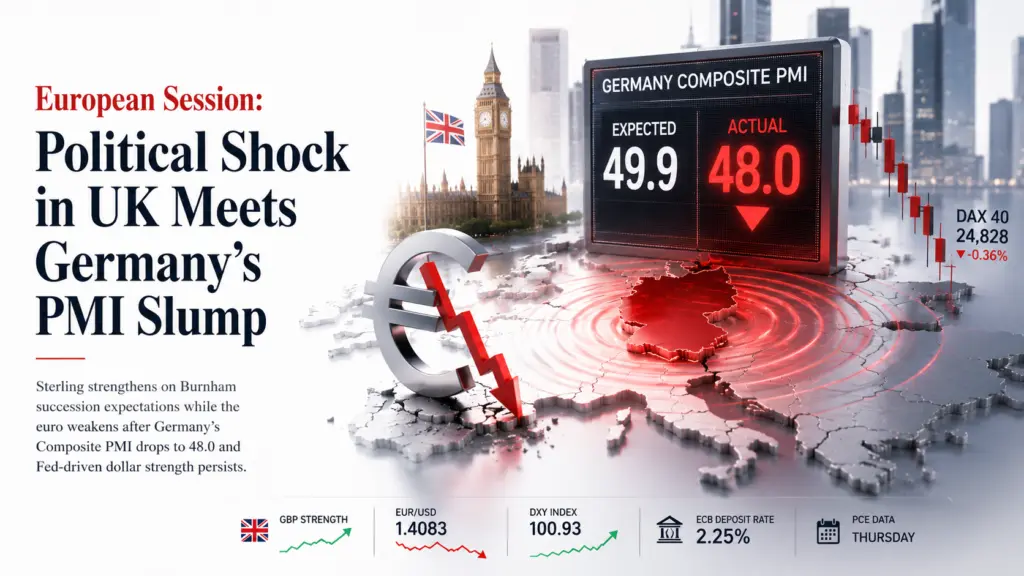
Starmer Is Out. Germany’s PMI Just Missed Badly. And EUR/USD Is Pinned Below 1.4100 With the ECB Having Just Hiked Into a Contraction

Starmer Is Out. Germany’s PMI Just Missed Badly. And EUR/USD Is Pinned Below 1.4100 With the ECB Having Just Hiked Into a Contraction

Two events landing simultaneously: UK Prime Minister Keir Starmer resigns and Andy Burnham is frontrunner for No. 10. Germany’s June Composite PMI slumps to 48.0 against 49.9 expected, with services collapsing to 46.8. EUR/USD at 1.4083 is stalling below 1.4100 resistance. Sterling is outperforming on political clarity. And the ECB has just hiked into a private sector contracting for the third month running.

There are sessions where the macro and the political arrive simultaneously and create a genuinely complex picture — and Tuesday's European session is exactly that. UK Prime Minister Keir Starmer has confirmed his resignation, becoming the seventh British leader in a decade. Andy Burnham, the former Mayor of Greater Manchester, is the frontrunner to succeed him, with Wes Streeting's endorsement carrying significant weight in the Labour party's internal succession. Sterling is bid on the news — not because Burnham is inherently bullish for GBP, but because political uncertainty is worse for a currency than an orderly succession, and the market is pricing the orderly version.

At the same moment, Germany's June flash Composite PMI landed at 48.0 — a reading below 50 signals contraction — against a 49.9 consensus and a prior reading of 48.8. The services component was the real shock: 46.8 versus 48.7 expected. This is the third consecutive month of private-sector contraction in Germany, and it lands in a week when the ECB — which just raised rates to 2.25% on June 11 for the first time since 2023 — is being watched closely for signals about whether a July follow-up is still credible. The PMI answers that question with uncomfortable clarity: the economy is not withstanding higher rates as smoothly as Philip Lane suggested.

Germany’s PMI at 48.0 is the third consecutive month of contraction. The ECB hiked two weeks ago. These two...

Continue reading...
0
0

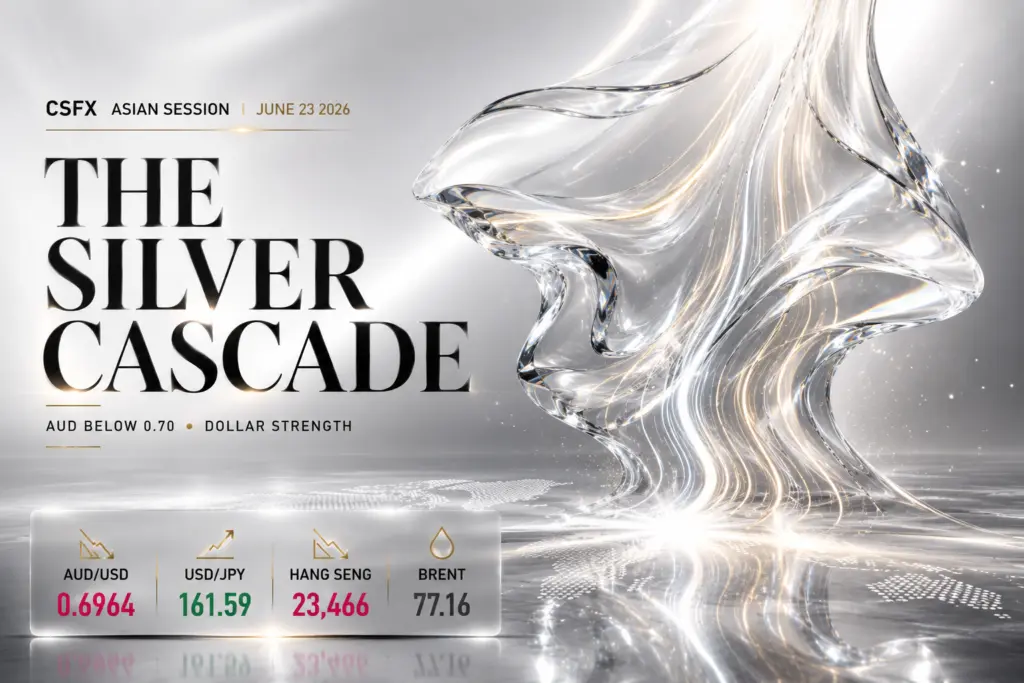
ASIAN SESSION · TUESDAY 23 JUNE 2026 AUD/USD Just Broke Below 0.70. The Hang Seng Is Down 1.68%. And Iran-US Talks in Switzerland Are Showing Encouraging Progress

ASIAN SESSION · TUESDAY 23 JUNE 2026 AUD/USD Just Broke Below 0.70. The Hang Seng Is Down 1.68%. And Iran-US Talks in Switzerland Are Showing Encouraging Progress

Three things happening simultaneously in Tuesday’s session: AUD/USD has broken a floor it hasn’t tested since the March conflict lows. The Hang Seng is sliding on China-specific headwinds that the Iran diplomacy story can’t rescue. And USD/JPY at 161.59 is sitting at a 1986-era high with Tokyo’s intervention rhetoric getting louder by the day. Thursday’s US Core PCE ties all of it together.

Tuesday's Asian session opens in the immediate aftermath of the first high-level US-Iran diplomatic exchange in Switzerland, where Qatar and Pakistan mediators reported “encouraging progress” on Monday before lower-level technical talks began today. That language is doing what diplomacy-adjacent language always does to markets: Brent has slid 1.4% to $77.16, continuing its gradual unwind from conflict-era highs above $100. Copper is firm at $6.31 per pound on the theory that a world moving away from war has more appetite for the industrial metals that build things. And the broader risk picture is split in exactly the way this kind of session usually is — good news on one front, bad news on another, and a dollar that doesn't care about either.

The AUD/USD break below 0.7000 to 0.6964 is the session's dominant story. That number is the pair's lowest since the conflict-era energy shock in March. The mechanism is a dual squeeze: a DXY near 100.93 — a 13-month high — as markets price roughly 40 basis points of additional Fed tightening by year-end, up from 20 basis points a week ago; and softer risk appetite from the Hang Seng's 1.68% decline and China demand uncertainty, which weighs on Australia's commodity-export story. The forward look matters: ANZ is projecting Australian underlying CPI to edge higher in May and unemployment to fall to 4.4%, both due later this week. Those numbers will directly shape RBA expectations ahead of...

Continue reading...
0
0

US MARKETS WEEKLY · 22–26 JUNE 2026 Warsh Delivered His Message. Now Iran Has Collapsed the Peace Talks. Thursday’s Core PCE Is the Week’s Verdict

US MARKETS WEEKLY · 22–26 JUNE 2026 Warsh Delivered His Message. Now Iran Has Collapsed the Peace Talks. Thursday’s Core PCE Is the Week’s Verdict

USD/CAD just broke its 52-week high. USD/CHF has flipped to a Strong Buy. The 10Y yield is at 4.46%. Gold is fighting a stronger dollar while Iran talks have collapsed and the Strait of Hormuz risk premium is live again. And Thursday's Core PCE either validates Warsh's hawkish hold — or begins to unwind it.

Markets expected Kevin Warsh to be Trump's concession to looser policy. What arrived instead was a man who stress-tested the Fed's inflation-fighting credibility on his very first outing: held rates at 3.50 to 3.75%, raised the PCE inflation forecast to 3.6%, and signalled that roughly half of FOMC members now see at least one more 2026 hike. The dollar heard that as a mandate. USD/CAD broke above its 52-week high of 1.4147 for the first time. USD/CHF flipped to a Strong Buy technical reading despite the franc's safe-haven role. The 10-year yield climbed 5 basis points to 4.46%. And the S&P 500, which had been holding near record territory on the strength of semiconductors and AI names, started to feel the weight of what higher-for-longer actually means for valuations.

Then, late Friday, the floor dropped out of the Iran peace process. US and Iranian negotiators called off the latest round of talks with no resumption date set. The Strait of Hormuz risk premium — which had been deflating steadily as the MOU signed in Switzerland on June 19 seemed to be holding — snapped back into crude oil. WTI firmed to $76.54 into the weekend close. Gold held at $4,161 despite a stronger dollar pushing against it. The week ahead carries two competing forces that pull every trade in this report in different directions — and Thursday's US Core PCE is where they resolve.

Warsh delivered his hawkish message. Iran walked away from the table....

Continue reading...
0
0
Navigation menu
instaforex banner