

USD/KRW – Semiconductor Flows, the Capital Outflow Gap, and Bank of Korea Desk Dynamics
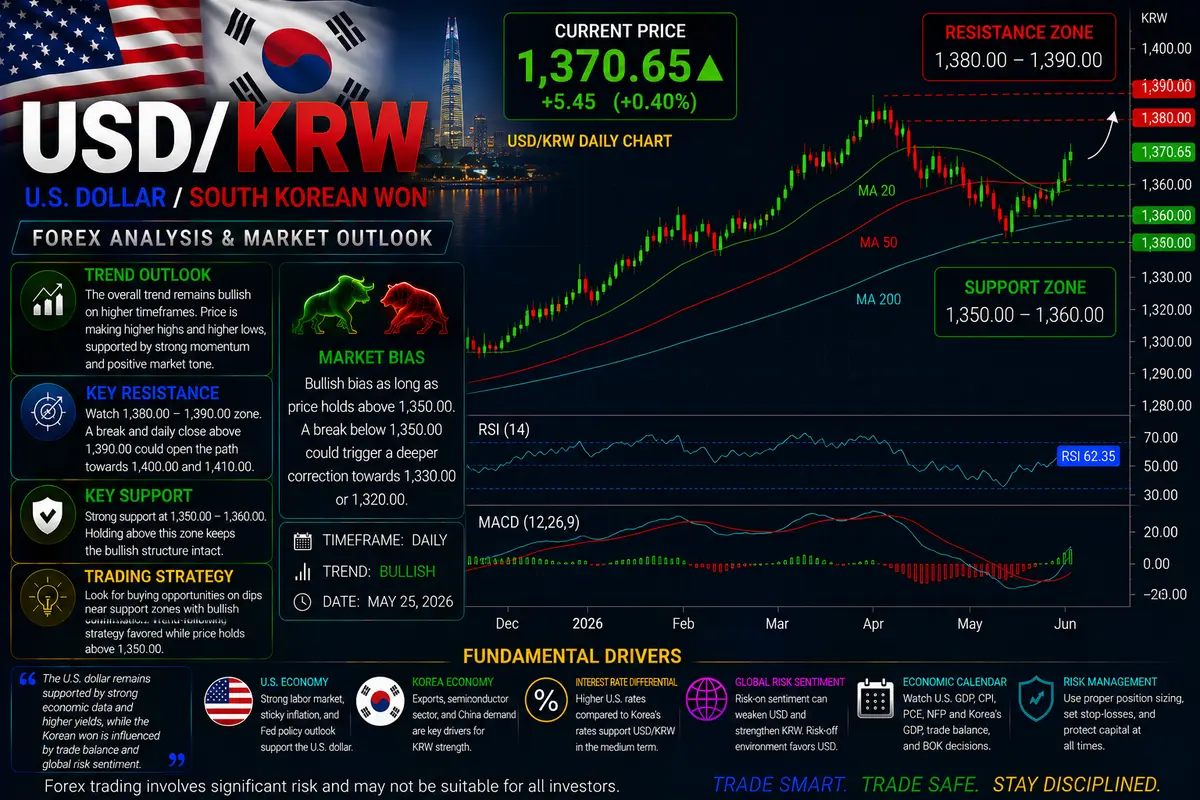
Ask anyone who has spent time running an Asian FX book about the Korean Won, and they’ll tell you the exact same thing: you aren’t just trading a country’s fiat currency. You’re trading a real-time sentiment tracker on global tech hardware and AI infrastructure spending.
USD/KRW gives macro funds some of the cleanest exposure you can get to the global silicon cycle. South Korea sits right in the middle of the electronics supply chain, cranking out the DRAM, high-bandwidth memory (HBM), and specialized components that feed global tech builds. When tech capital expenditure surges, money hits Korean markets fast. When hardware demand cools off or tech stocks pull back, capital moves out just as quickly.
The Tech Export Paradox
In a simple textbook world, record-breaking tech exports should automatically drive the Won higher. But real-world institutional flows don’t work like a textbook.
Look at how order flow actually hits the market:
Export Revenues Take Time to Convert
Tech giants like Samsung Electronics and SK Hynix generate massive dollar revenue streams when memory chip prices surge. But corporate treasuries don’t dump all those dollars into the spot market at once. They hold offshore dollar cash piles, hedge their currency exposure, and time their conversions over extended windows.
Capital Outflows Act Fast
While export conversions trickle in slowly, foreign equity flows on the KOSPI and offshore retail investments move instantly. When domestic investors buy overseas shares or foreign funds liquidate local stock holdings, those spot orders clear immediately on dealing desks.
This creates sharp disconnects where chip exports hit record highs, yet USDKRW ... stays elevated or rallies anyway because structural capital outflows outrun daily export conversions.
Central Bank Intervention and the 00:00 UTC Window
The Bank of Korea (BOK) doesn’t try to stop broad market trends, but they actively police speed and panic.
Because South Korea relies so heavily on imported crude oil and food, a rapid spike in USD/KRW imports instant inflation into the local economy. When spot moves too fast toward key psychological figures, FX authorities step onto dealing desks to execute “smoothing operations.”
These interventions aren’t meant to flip the primary trend. They’re designed to swallow excess order flow, clear out one-sided order books, and force speculative longs to trim leverage.
Seasonal Flow Watch: The April Dividend Drain
Every spring, USD/KRW traders mark April on their calendars.
Korean corporations traditionally pay out their annual stock dividends during April. Because foreign investors hold a significant portion of blue-chip KOSPI stocks, billions of Won leave corporate accounts and head straight for the spot desk to be converted back into US Dollars.
This yearly dividend repatriation creates a reliable seasonal tailwind for USD/KRW, giving the pair a clear upward bias during the early part of the second quarter regardless of broader market sentiment.
Execution Rules for USD/KRW
Trade Onshore Seoul Hours
Focus your spot execution between 00:00 and 06:30 UTC when the onshore Seoul market is active. That is where real institutional volume trades, keeping spreads tight and slippage manageable.
Watch the Philadelphia Semiconductor Index (SOX)
Semiconductor equities lead USD/KRW price action. Broad momentum shifts in US tech and chip makers almost always bleed directly into the next morning’s Asian FX session.
Respect Nominal Lot Sizes
USD/KRW trades in the four-figure range (routinely between 1,250 and 1,500+ Won per Dollar). Calculate position sizing using total portfolio cash risk, not a fixed pip value adapted from G10 pairs.
The Dollar Is Still Part of the Equation
There is another layer that traders sometimes overlook: USD/KRW is not purely a Korean growth trade. The Dollar itself can dominate the pair when global monetary expectations shift.
When US Treasury yields rise sharply, the opportunity cost of holding emerging-market currencies increases. Global investors can become more comfortable holding dollar assets, especially when the move in yields is accompanied by stronger US economic data. That can push USD/KRW higher even if South Korean export figures remain healthy.
The reverse can happen when US inflation cools, Federal Reserve expectations turn more accommodative, and Treasury yields fall. In that environment, investors may become more willing to add exposure to Asian assets, creating additional demand for the Won.
This is why watching the dollar index, US yields, and USD/KRW together can reveal more than looking at the Korean pair by itself.
Risk Sentiment Can Override the Chip Story
The Won is also highly sensitive to global risk appetite. South Korea’s economy is deeply connected to international trade, technology demand, and global investment flows. During periods when investors are comfortable taking risk, capital can move toward equities and higher-beta Asian currencies.
But when markets suddenly turn defensive, the calculation changes.
A geopolitical shock, sharp equity selloff, unexpected inflation report, or major policy surprise can trigger a rush toward liquidity. In those moments, USD/KRW can climb quickly as investors seek the US Dollar while reducing exposure to risk-sensitive assets.
This is where traders can get trapped by a bullish Korean export narrative. Strong semiconductor demand does not necessarily protect the Won from a broad global risk-off event. Macro flows can overwhelm company-level fundamentals in a matter of hours.
Reading the Chart Without Getting Fooled
Technically, USD/KRW often rewards traders who respect major levels rather than chasing every candle.
Round numbers matter because large institutional orders frequently cluster around psychologically important prices. If price repeatedly fails around a major resistance area, the rejection becomes more meaningful when it is accompanied by falling momentum and weaker semiconductor equities.
Likewise, a clean break above resistance should not automatically be treated as a guaranteed continuation. Traders should look for confirmation through closing prices, volume conditions, broader dollar strength, and the behavior of Asian equity markets.
The best setups often appear when technical structure and macro flow point in the same direction.
The Bottom Line
USD/KRW is one of those pairs that can look straightforward until you understand what is actually moving underneath it. Semiconductor exports, AI investment, foreign equity flows, dividend repatriation, US Treasury yields, oil prices, global risk appetite, and Bank of Korea policy can all collide inside one chart.
That is why the Won should not be treated like a normal G10 currency. It is a high-information market where global technology demand and capital movement leave fingerprints on price.
For traders, the goal is not to predict every move. It is to understand which force is dominating the pair at a particular moment. If semiconductor stocks are strong, Korean exports are improving, risk appetite is healthy, and the Dollar is losing momentum, USD/KRW may face pressure.
But if US yields climb, the Dollar strengthens, foreign investors pull money from Korean equities, and global markets turn defensive, the same pair can accelerate higher even when Korea’s underlying trade data looks impressive.
That is the real lesson behind USD/KRW: don’t trade the headline—trade the flow behind the headline.

Comments
No comments yet. Be the first to share your thoughts!
Authentication Required
You must be logged in to post a comment.