

USD/ZAR – Mining Commodity Cycles, SARB Policy, and the High-Beta Risk Gauge
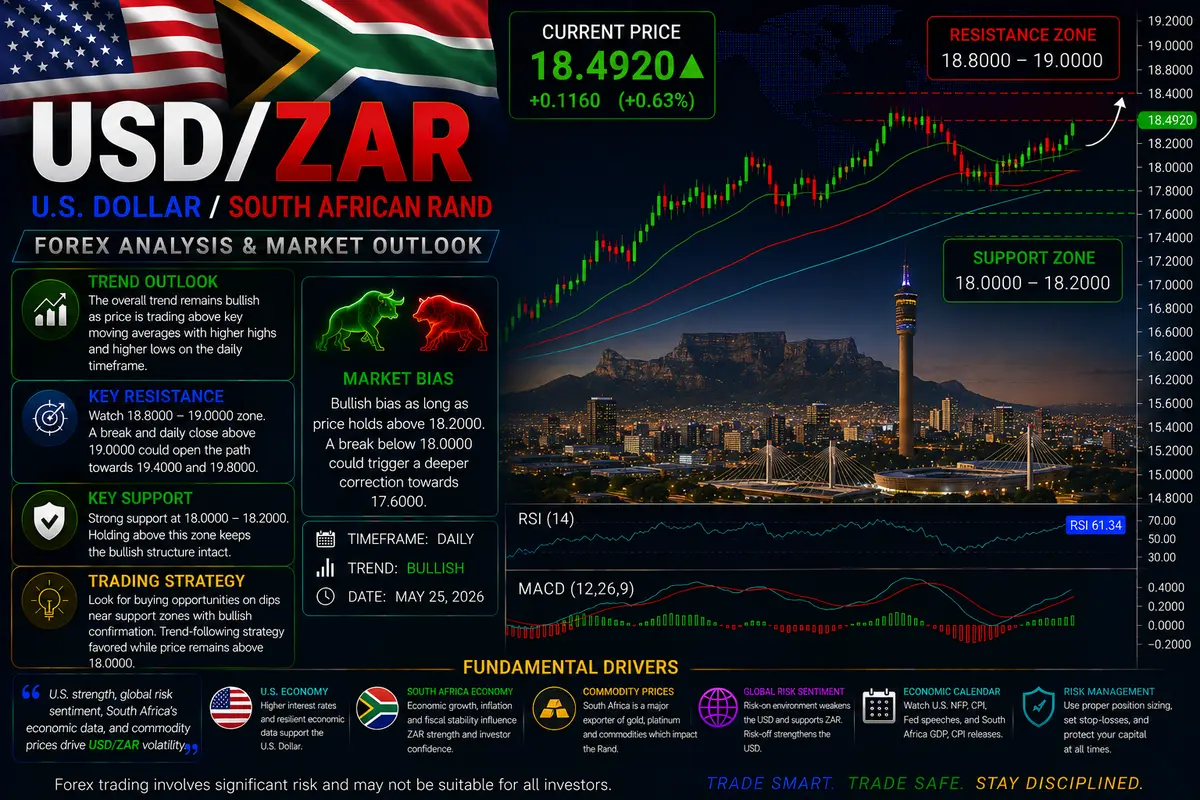
Ask emerging market traders to rank the most explosive major crosses, and USDZAR ... usually sits near the top of the list. The South African Rand is a unique financial beast: it operates simultaneously as a high-carry yield play, a commodity-export proxy, and the ultimate global “risk-on / risk-off” barometer.
Where developed pairs like EURUSD ...
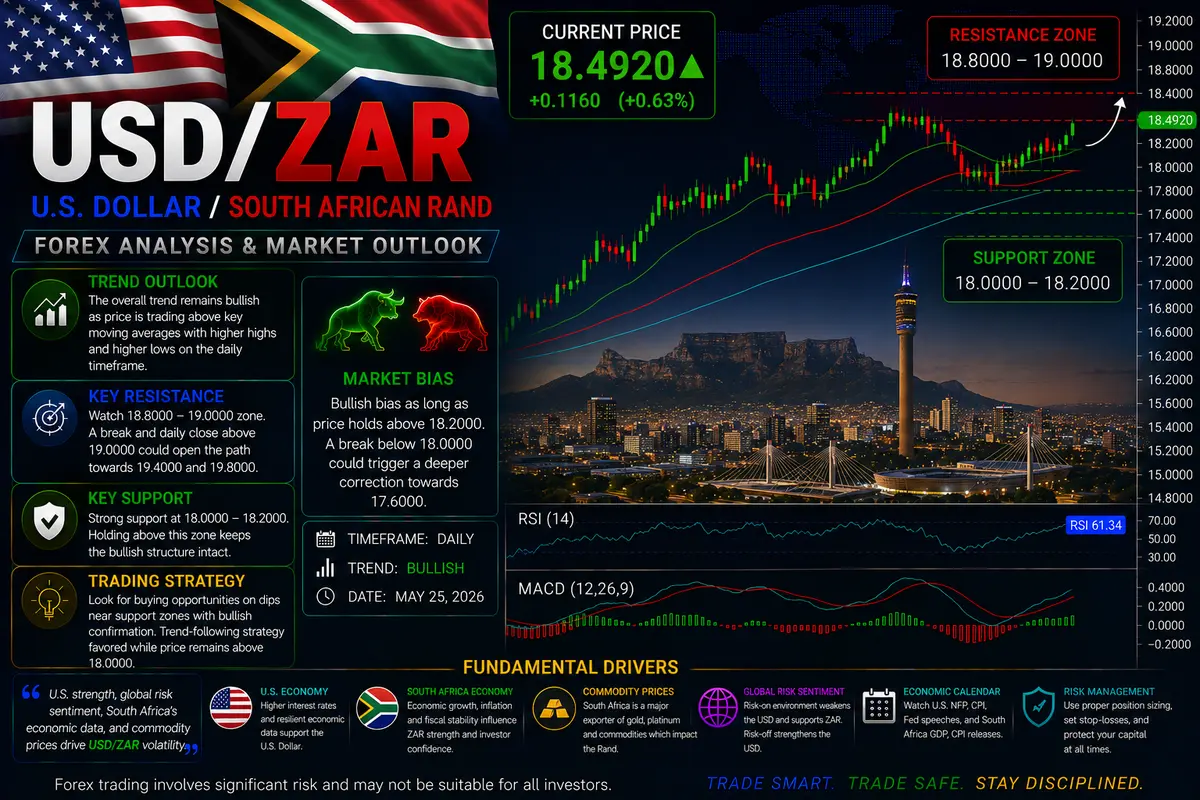
might grind out 70 pips during a active session, USD/ZAR routinely rips through 300 to 500 pips in a matter of hours. For institutional desks, ZAR is one of the most liquid emerging market currencies on the planet. For retail traders, it’s a high-reward minefield that will ruthlessly wipe out accounts using tight stops or excessive leverage.
Understanding how to trade USD/ZAR requires looking past simple chart patterns and mastering three core macro engines: precious metals output, South African Reserve Bank (SARB) policy, and domestic structural headwinds.
1. The Commodity Cushion: Gold, Platinum, and Terms of Trade
South Africa’s underlying current account balance is fundamentally anchored to what comes out of its ground. As a leading global exporter of platinum group metals (PGMs), gold, coal, and iron ore, the country’s trade performance shifts dramatically alongside global raw material prices.
When precious metal prices rally, South Africa’s terms of trade improve. Mining giants earn foreign currency on global markets, convert those profits back into Rands to settle local tax obligations and pay miners, and boost the national trade surplus. This structural inflow acts as a natural brake against Dollar strength, frequently driving multi-week downward trends in USD/ZAR.
However, the correlation isn’t always linear.
If gold surges because of extreme global panic or geopolitical escalation, the Rand faces two competing forces:
-
A positive push from higher export revenues.
-
A negative pull as global funds dump all emerging market assets to seek safety in cash US Dollars.
During pure “flight-to-safety” panics, the safety bid for the Greenback almost always overpowers the commodity tailwind, sending USD/ZAR shooting upward regardless of gold’s performance.
2. The SARB Cushion and Real Yield Differentials
The South African Reserve Bank (SARB) has long been recognized as one of the most orthodox and disciplined central banks in the developing world. Its Monetary Policy Committee (MPC) treats price stability with aggressive seriousness, maintaining a conservative inflation targeting framework.
To keep capital anchored inside South Africa, the SARB keeps its benchmark repo rate significantly higher than US Federal Reserve rates. This creates a substantial interest rate differential.
Macro hedge funds take advantage of this through carry trade strategies. They borrow US Dollars at lower interest rates and invest in high-yielding South African sovereign bonds. As long as global market volatility stays calm (low VIX environment), this steady yield differential rewards ZAR buyers and puts downward pressure on USD/ZAR.
The catch? When global interest rates rise or risk appetite sours, those carry positions get unwound instantly. Because ZAR market order books are deep, institutions use the Rand as their exit valve to cut risk, triggering massive short squeezes in USD/ZAR.
3. Structural Headwinds: Power Grids and Fiscal Debt
While global factors dictate the pair’s macro swings, domestic issues set the structural baseline.
South Africa has struggled for years with infrastructure constraints—most notably power generation challenges at state utility Eskom. Rolling blackouts (known locally as load-shedding) directly kneecap industrial output, choke off mining production, and drag down GDP growth.
When load-shedding intensifies or state-owned enterprise bailouts expand government debt burdens, international rating agencies issue warnings. Foreign investors respond by selling off local government bonds, forcing capital out of the country and causing sudden, sharp devaluations in the Rand.
Execution and Desk Strategy
-
Trade the London/New York Overlap: The highest liquidity and cleanest price action occur between 13:00 and 17:00 UTC, when Johannesburg, London, and New York desks are all active simultaneously.
-
Adjust Pip Sizing: PIP values on ZAR are significantly smaller in Dollar terms than on G10 pairs. Don’t let a 300-pip daily range scare you—calculate your position size based on actual percentage risk rather than standard pip counters.
-
Respect the VIX: Keep an eye on global risk sentiment indicators. If equity volatility spikes globally, shorting USD/ZAR against a raging Dollar trend is akin to standing in front of a freight train.

Comments
No comments yet. Be the first to share your thoughts!
Authentication Required
You must be logged in to post a comment.