

NZD/JPY – Trading the Kiwi-Yen Cross, Carry Trade Liquidation, and Soft Commodity Dynamics
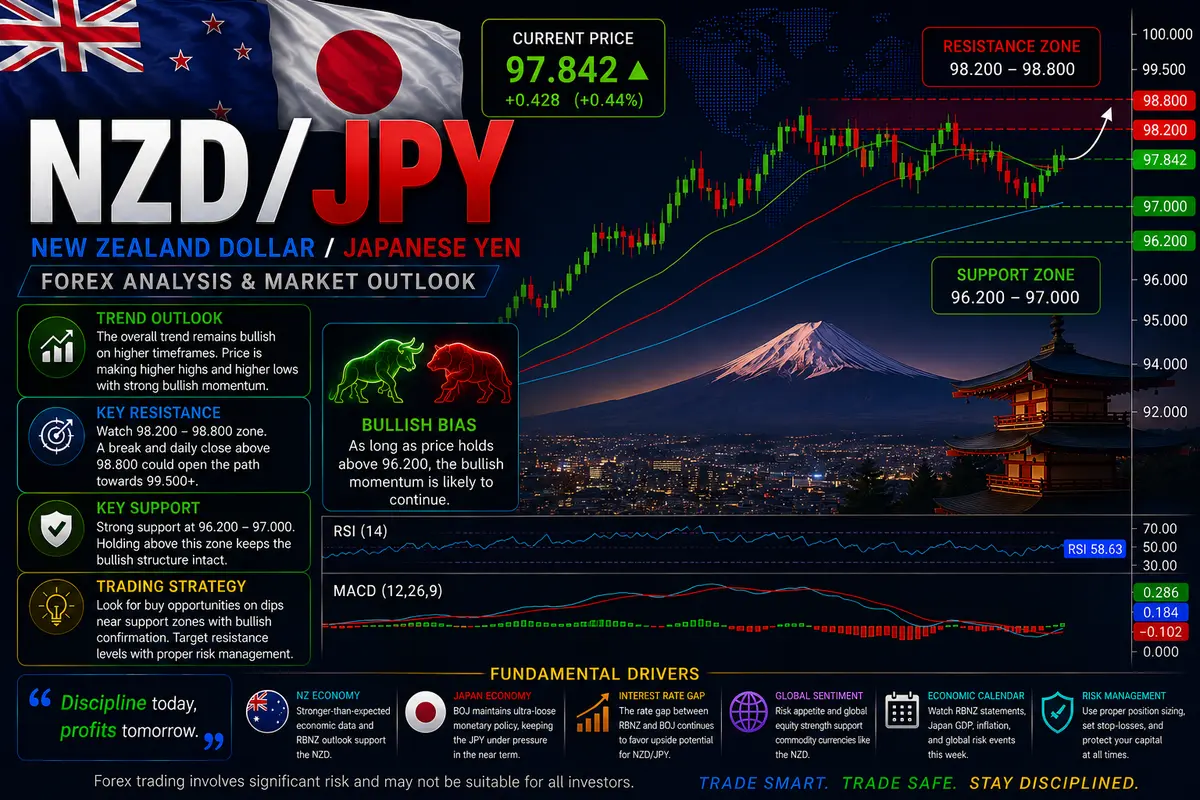
If you ask ten desk traders to name the ultimate gauge for global risk appetite, at least half of them will point straight to NZDJPY ... . The cross-rate doesn’t get as much retail airtime as GBPJPY ... —often dubbed “The Dragon”—but behind the scenes, institutional money treats the Kiwi-Yen as a pure, unfiltered expression of market sentiment. On one side, you have the New Zealand Dollar, a lightweight, commodity-driven growth currency tied to dairy exports and Chinese industrial demand. On the other side sits the Japanese Yen, the world’s most persistent funding currency and default safe haven when things go sideways.
When those two forces collide on the chart, you don’t get messy, range-bound chop for very long. Instead, you get prolonged, trending channels punctuated by fast, brutal liquidations that punish anyone sitting on the wrong side of the leverage fence.
The Macro Engine: Yield Gaps and the Mechanics of the Carry Trade
To trade NZD/JPY with real confidence, you have to understand why the macro money loves it. For decades, Japan’s central bank has kept domestic borrowing costs parked near zero (or negative) to fight sluggish growth. New Zealand, meanwhile, relies heavily on international capital inflows and soft commodity exports, meaning the Reserve Bank of New Zealand (RBNZ) frequently pushes benchmark interest rates much higher to keep inflation in check.
That yield gap creates what traders call the carry trade.
Here is how it plays out in practice. A hedge fund or institutional desk borrows Japanese Yen at virtually no cost, swaps those Yen for New Zealand Dollars, and deposits them into higher-yielding Kiwi assets. Every day the position sits open, the fund collects the interest rate differential—known as positive swap.
When the broad market feels optimistic (a “risk-on” climate where global stock indexes are grinding higher and volatility index readings are low), capital steadily accumulates in NZD/JPY. You’ll see smooth, multi-week uptrends where pullbacks are shallow and technical support levels hold with surprising consistency.
The danger comes when the general market freaks out. The moment a geopolitical headline drops, an earnings season turns sour, or a credit crisis looms, those same institutional funds want out immediately. They sell their Kiwi assets and rush to buy back Japanese Yen to pay off their original loans. This creates a panic unwind. What took three weeks for NZD/JPY to gain can vanish in three hours. If you’ve ever watched a 300-pip red candle slice straight through multiple support levels without slowing down, you’ve witnessed a classic carry trade unwind.
Dairy Auctions, Chinese Demand, and Economic Ties
Beyond the interest rate story, New Zealand’s economy has a specific engine you cannot ignore: milk.
It sounds basic, but dairy products—particularly whole milk powder—account for a massive chunk of New Zealand’s total export revenue. The GlobalDairyTrade (GDT) auction takes place twice a month on Tuesdays, and macro traders watch those price updates like hawk eyes. If auction prices beat estimates, New Zealand’s national balance sheet improves, giving the RBNZ leeway to stay hawkish. If auction prices slump, the currency usually takes a hit within minutes.
Then there is the Chinese connection. China is New Zealand’s biggest single buyer of agriculture and forestry products. When factory managers in Shanghai and Beijing report strong Purchasing Managers’ Index (PMI) numbers, or when Beijing announces major domestic stimulus packages, the Kiwi Dollar gets a direct bump. If Chinese consumer spending stalls out, NZD struggles to find buyers, even if Western stock markets are floating higher.
Handling the Session Rhythm: From Wellington to Tokyo
One common mistake newer traders make with NZD/JPY is applying standard European session timing. This pair moves on a very specific Pacific-Asian clock.
The action starts earlier than almost every other pair on the board. Around 22:00 to 23:00 UTC, Wellington and Sydney open up. High-impact local releases—like New Zealand CPI, quarterly employment numbers, or RBNZ rate decisions—typically hit the wire during this low-liquidity transition window. Spreads can temporarily widen here, but if the numbers surprise the market, the initial directional impulse for the day gets established right on the spot.
By 00:00 UTC, Tokyo dealing desks come online. This is where Japanese commercial accounts, asset managers, and retail margin traders step in. If the Asian session sets a tight 30-pip range overnight, don’t assume the pair is dead. When London opens at 07:00 UTC, institutional algorithms love to run price past the Asian high or low to sweep resting stop-loss orders before initiating the real trend for the rest of the day.
Execution Principles for Swing and Day Traders
Trading NZD/JPY effectively requires a slightly different tactical approach than handling EUR/USD or USD/JPY:
- Respect the Trend Filters: During risk-on phases, simple moving averages (like the 50-period and 200-period EMA on the 4-hour chart) work surprisingly well. Don’t try to pick tops when the carry trade is flowing; look for minor dips into prior resistance-turned-support.
- Account for Spreads at Rollover: Avoid placing market orders between 21:00 and 22:00 UTC. Interbank liquidity thins out dramatically during the daily broker settlement window, and spreads can briefly blow out.
- Keep an Eye on Stock Futures: Keep a live ticker of S&P 500 futures on your second screen. If global stock futures start falling sharply during the European morning, taking long trades on NZD/JPY is akin to standing in front of a freight train.

Comments
No comments yet. Be the first to share your thoughts!
Authentication Required
You must be logged in to post a comment.