

GBP/NZD – The Flying Kiwi, Massive Pip Spikes, and Navigating Thin Liquidity
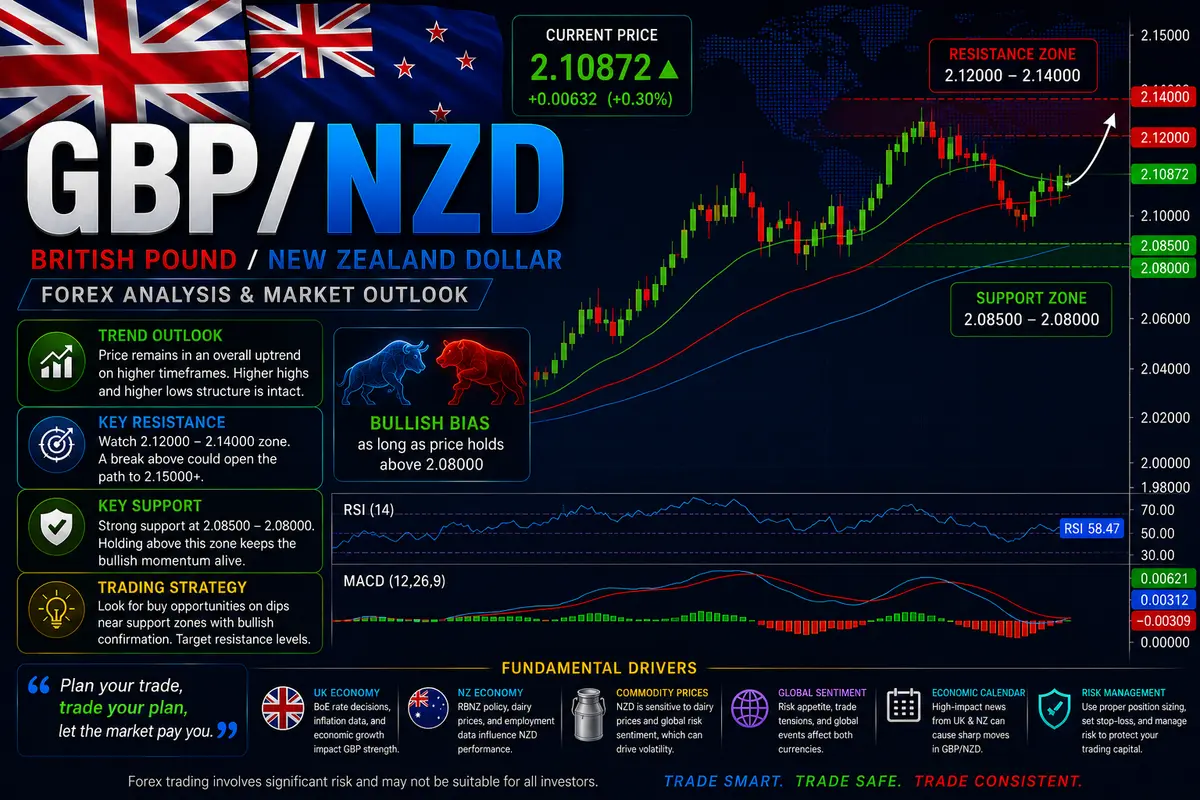
If you thought GBP/AUD was violent, wait until you watch GBP/NZD move.
Known across dealing desks as “The Flying Kiwi” or “The Beast’s Twin,” GBP/NZD sits right at the extreme end of the forex volatility spectrum. It is not unusual for this pair to carve out a 300 to 400-pip range in a single 24-hour cycle. When a major central bank surprise or global commodity shock hits, that daily range can easily explode past 600 pips.
Because of this sheer velocity, GBP/NZD is an absolute landmine for beginner traders using tight stop losses. But for disciplined traders who know how to size down, handle wide wicks, and exploit the illiquid hand-off between Wellington and London, it offers some of the most profitable trend expansions on the entire market.
The Fundamental Divergence: Sterling Sentiment vs. The Global Milk Machine
To understand why GBP/NZD moves with such terrifying speed, you have to look at the massive fundamental disconnect between the United Kingdom and New Zealand.
1. New Zealand’s Agricultural Export Engine
New Zealand is a small island economy whose exchange rate is tied directly to agricultural exports—specifically whole milk powder and dairy products.
-
When global dairy demand is hot and milk prices surge at the bi-weekly Global Dairy Trade (GDT) auctions, the Reserve Bank of New Zealand (RBNZ) gets hawkish and capital floods into the Kiwi Dollar.
-
When dairy prices slump or Chinese import demand cools off, the Kiwi bleeds value fast.
2. Great Britain’s Service & Rate Differential Mechanics
Sterling, meanwhile, reacts aggressively to UK inflation metrics, Bank of England (BoE) policy shifts, and European trade flows.
3. The Cross-Rate Formula
GBP/NZD isn’t an isolated ticker—it’s calculated directly by dividing GBP/USD by NZD/USD:
GBP/NZD=NZD/USDGBP/USD
When GBP/USD rallies on hawkish Bank of England comments at the exact same moment NZD/USD crashes due to a disastrous dairy auction, GBP/NZD experiences a vertical upward explosion. The two leg-pairs work in tandem to launch price into orbit.
The Liquidity Black Hole: Why the Wicks Are So Insane
The real secret to surviving GBP/NZD lies in understanding market depth.
Unlike EUR/USD, which has deep institutional liquidity running 24/7, GBP/NZD suffers from thin order books for large stretches of the day.
GBP/NZD Session Liquidity Profile:
+---------------------------------------------------------------------+
| 17:00 - 21:00 EST | Wellington/Sydney Open | Paper-thin liquidity
|                   |                        | Spreads widen, erratic
| 02:00 - 05:00 EST | London Open            | Volume surge, heavy
|                   |                        | stop-hunting sweeps
| 08:00 - 11:00 EST | NY Overlap             | US Dollar leg impacts
|                   |                        | directional trend       |
+---------------------------------------------------------------------+
1. The Early Asian Spread Expansion
Between 17:00 and 20:00 EST (when New Zealand opens but the rest of the financial world is asleep), liquidity on GBP/NZD dries up completely.
-
Spreads can temporarily widen from a normal 3 pips to a brutal 12 or 15 pips.
-
A modest commercial order executed during this thin window can knock price 40 pips in a split second, throwing terrifying wicks on lower-timeframe charts.
2. The London Overlap Explosion
When European dealing desks wake up at 02:00 EST, institutional volume hits that thin market like a sledgehammer.
-
Algorithms love running price past the Asian High or Asian Low by 40 to 60 pips to grab built-up stop losses before reversing.
-
If you don’t account for these deep sweeps, you will constantly get stopped out right before price launches 200 pips in your predicted direction.
The “Flying Kiwi” Survival Rules & Execution Blueprint
-
Cut Your Position Size By 60%: If you normally trade 1.0 lot on EUR/USD, you should trade no more than 0.25 to 0.35 lots on GBP/NZD. You must give your trade room to breathe with a 40-to-60 pip stop loss, and the only way to do that safely without risking more dollars is by downsizing your lot size.
-
Never Trade the Asian Open Market Orders: Avoid opening new market orders between 17:00 and 20:00 EST. Spread widening will instantly put you at a severe execution disadvantage.
-
Wait for the London Liquidity Sweep: Identify the Asian High and Low set between 18:00 and 01:00 EST. Let the London open (02:00–04:00 EST) sweep one of those boundary levels into a 1-Hour or 4-Hour Fair Value Gap.
-
Demand Candle Body Confirmation: Ignore 5-minute wicks that pierce key levels. Wait for a clear 15-minute or 1-hour candle body close to confirm whether structure actually broke or if it was just a temporary stop hunt.
-
Target Distant Structural Swings: Don’t settle for tiny 15-pip profit targets on this pair. When GBP/NZD turns off a valid higher-timeframe level, target the opposite side of the daily range or unmitigated 4-hour imbalances to capture 100+ pip moves.

Comments
No comments yet. Be the first to share your thoughts!
Authentication Required
You must be logged in to post a comment.