

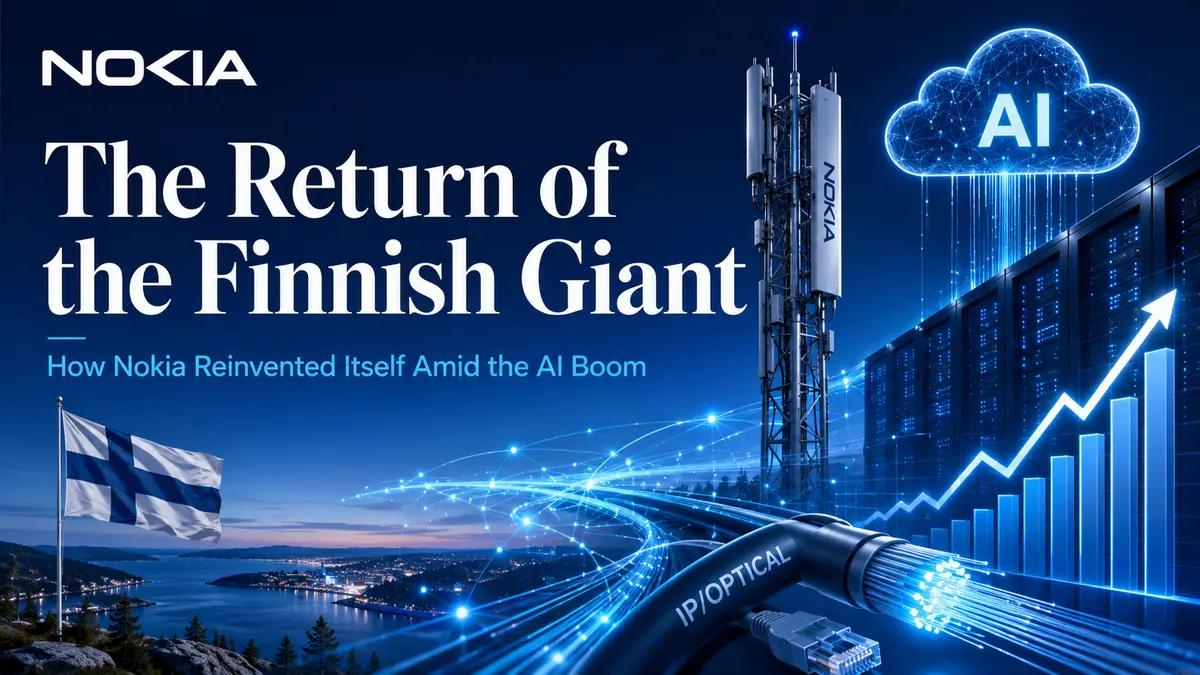
The Return of the Finnish Giant: How Nokia Reinvented Itself Amid the AI Boom
A Morning of Triumph: When Financial Results Speak Louder Than Doubts
Thursday began with a pleasant surprise for NOKFF ... shareholders. The Finnish telecommunications equipment manufacturer opened with a sharp upward move: its shares climbed to EURUSD ... €9.762, reached an intraday high of €9.800 and, even after a correction, remained 1.3% higher at €9.286.
This was not merely a technical market movement. It was the market’s recognition that a company many had already written off as a “dying giant” had found a second wind—and it proved to be a powerful one.
What was behind this rise? Nokia’s results for the second quarter of 2026 were not merely good. They represented a direct challenge to the pessimists who had predicted the company’s decline for years.
Comparable operating profit increased by 18% year over year to €434 million, significantly exceeding analysts’ expectations of approximately €382 million. Revenue reached €4.82 billion, representing growth of 9% in constant currency. In a world where many technology companies struggle to achieve even a few percentage points of growth, this was an impressive result.
However, the main factor that made investors smile—and, more importantly, raise their expectations—was the company’s own confidence. Nokia increased its full-year comparable operating profit forecast to a range of €2.1 billion to €2.6 billion.
The company also announced a dividend of €0.04 per share. These were not merely optimistic statements, but specific commitments to shareholders demonstrating that management believes the current growth is sustainable.
AI as a Growth Engine: Sales Double and Orders Nearly Triple
The new Nokia is no longer simply a company that sells networking equipment. It has become an indispensable partner for artificial intelligence giants—and the figures demonstrate this with remarkable clarity.
Sales to customers in the AI and cloud technology segment more than doubled, rising by 105% year over year. This was not a gradual improvement, but explosive growth that changed the structure of the company’s business within a single quarter.
Even more impressive was the volume of new orders. In the second quarter, orders from AI and cloud customers reached €2.8 billion. By comparison, the figure stood at only €1 billion in the first quarter.
An almost threefold increase in just three months was not merely the result of one successful quarter. It was a signal of a fundamental shift in demand. Companies building data centres for training neural networks and supporting AI applications are choosing Nokia equipment.
This is entirely logical. Artificial intelligence requires enormous bandwidth, ultra-low latency and exceptionally reliable networks. Nokia’s optical networking business, which grew by 20%, and its IP networking division, which expanded by 16%, have become essential components of this new digital infrastructure.
Without these technologies, modern data centres would simply be unable to operate at full capacity. Nokia found itself in the right place at the right time, equipped with the right technologies.
The network infrastructure segment, which is the most sensitive to AI-related spending, recorded revenue growth of 12% in constant currency. This was more than a recovery from a downturn—it represented a transition to an entirely new level.
A company once associated almost exclusively with mobile phones has now become a major player behind the scenes of the global AI boom.
Defeating Pessimism: Market Reaction and Analyst Commentary
It is important to understand that this success was far from guaranteed. In recent weeks, Nokia shares had been under pressure after its main competitor, Ericsson, warned about rising costs for AI-related components.
The market feared that Nokia would encounter the same challenges as its Swedish rival. However, the company’s financial results demonstrated that Nokia’s demand momentum was stronger than the pressure from rising costs.
The company is not merely coping with higher expenses—it is growing faster than those expenses are increasing.
Analysts reacted quickly and positively. JPMorgan reaffirmed its Overweight rating with a price target of €18, almost twice the current share price. Analysts highlighted the substantial EBIT outperformance, which demonstrated Nokia’s strong operational efficiency.
SEB Equities upgraded Nokia to Buy even before the earnings release, citing the company’s growth trajectory in the AI and cloud technology segments. Such support from major investment institutions provided additional confidence to the shares.
Nevertheless, some caution remained despite the overall positive picture. During the session, part of the initial gains was erased as investors reacted to the announcement of an additional €200 million in restructuring expenses in Europe.
However, after weighing the advantages and risks, the market kept the shares in positive territory. This suggests that investors are prepared to tolerate short-term costs in exchange for long-term growth.
Market Context: When Corporate Success Outweighs Global Trends
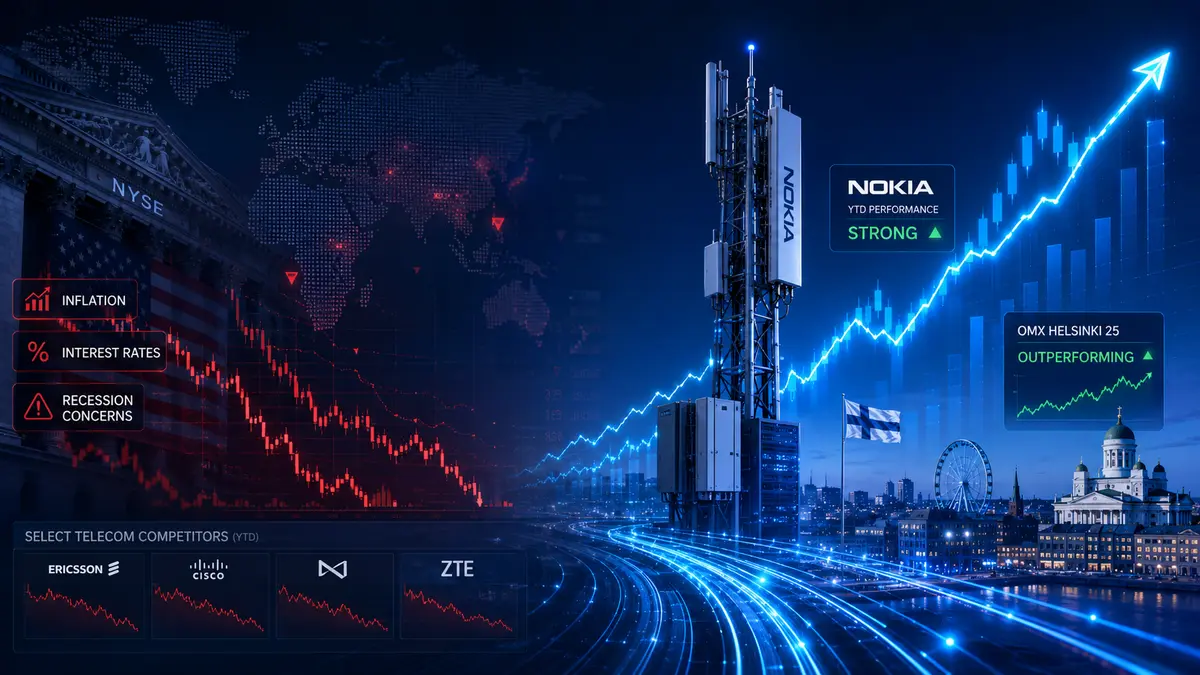
On the day Nokia published its financial results, the broader market environment remained moderately cautious. US stock indices were trading in negative territory, reflecting investor concerns about inflation, interest rates and the possibility of a recession.
Nevertheless, these conditions did not prevent Nokia shares from rising, highlighting the strength of the company’s individual corporate narrative.
The OMX Helsinki 25, Finland’s benchmark stock market index, had already advanced during the previous session in anticipation of Nokia’s results. This indicated that regional investors were optimistic and expected positive news—and they received it.
The rise in Nokia shares became one of the few bright spots against a backdrop of general market caution.
Nokia’s competitors, including Ericsson, provided little support. As previously noted, the Swedish company had warned about increasing costs, and its shares were trading without significant enthusiasm.
Nokia’s success was therefore its own achievement rather than the result of a broader rally across the telecommunications equipment sector.
What Comes Next: Sustainable Growth and Future Challenges
Nokia must now prove that its current growth is sustainable and not merely a temporary surge. Raising its full-year operating profit forecast to between €2.1 billion and €2.6 billion was a confident step.
However, investors will closely monitor every future quarter to ensure that demand for AI infrastructure continues to expand.
The announcement of additional restructuring expenses in Europe caused some concern, but these costs are part of the company’s long-term optimisation strategy.
Nokia is seeking to reduce expenses in its traditional business segments and redirect resources towards faster-growing areas. This is a reasonable approach, although it will take time to implement fully.
The company also faces macroeconomic risks, including slower economic growth in Europe and China, as well as the possibility of a stronger euro, which could affect the competitiveness of exporters.
However, Nokia is geographically diversified, and its revenue is distributed across numerous regions. This reduces the company’s dependence on any single country or market.
Conclusion: Nokia Is No Longer Just About Mobile Phones
Nokia shares rose by 1.3%, and this was not merely a random short-term increase. It confirmed that the company has successfully transformed itself from a mobile phone manufacturer that lost the smartphone battle into one of the leading infrastructure providers for the digital economy.
The AI boom has not become a threat to Nokia. Instead, it has created an opportunity that the company has taken full advantage of.
Investors who believed in this transformation have been rewarded. However, a great deal of work still lies ahead.
The company must continue investing in research and development, preserve its leadership in optical and IP networking, and expand its presence in cloud technologies. Competitors are not standing still, and Nokia will need to maintain a constant pace of innovation to remain at the forefront of the industry.
Nevertheless, the latest results demonstrate that the company possesses all the essential ingredients for success: strong leadership, an effective strategy and exposure to a growing market.
Nokia shares remain significantly below their historical highs and may still have room for further appreciation. Should the company maintain its current momentum, investors may witness the return of the Finnish giant to the elite ranks of the world’s leading technology companies.

Comments
OOH NICE💵
Authentication Required
You must be logged in to post a comment.