
Multi-Timeframe Alignment: Building Your Complete Institutional Strategy
Multi-Timeframe Alignment: Building Your Complete Institutional Strategy
You can spot market structure in your sleep. You know how to identify liquidity sweeps, order blocks, and fair value gaps. Yet, if you try to trade every setup you see on a 1-minute chart, your account will bleed out.
Why? Because a 1-minute order block is completely meaningless if it’s pushing directly into a massive 4-hour supply zone.
The secret to turning these individual trading tools into a high-win-rate system comes down to Multi-Timeframe (MTF) Alignment. Higher timeframes dictate the macro direction, while lower timeframes give you the low-risk entry.
The Top-Down Analysis Framework
Think of timeframes as a zoom lens on a camera. Zooming in too far without looking at the big picture makes you miss the cliff right in front of you.
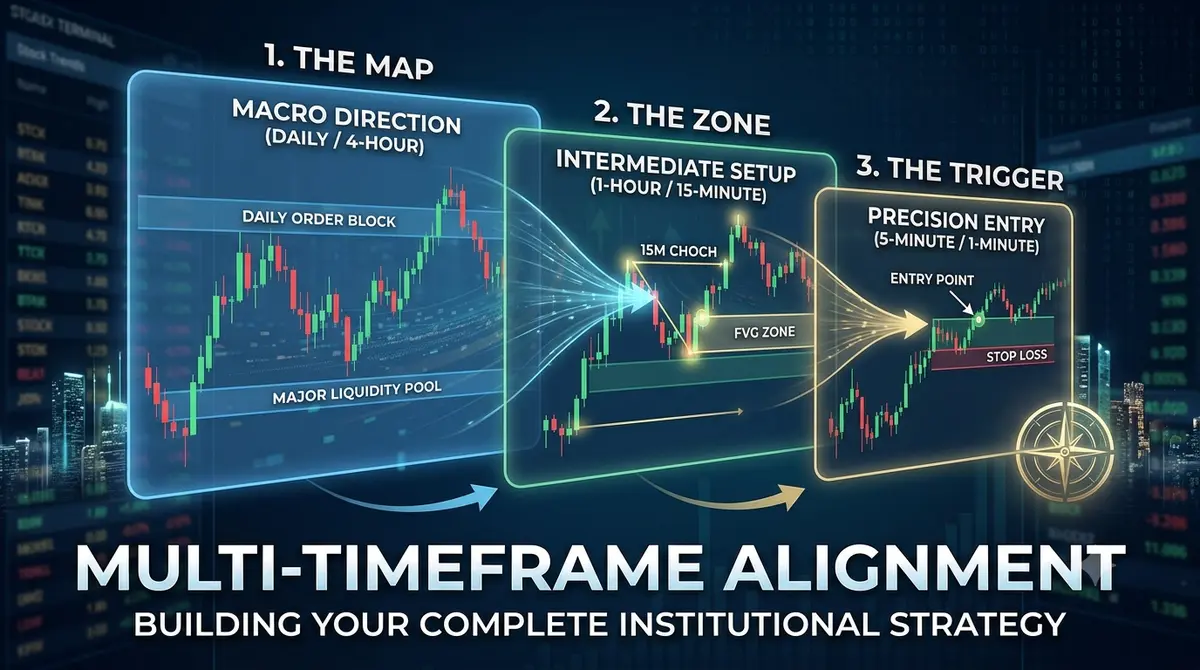
To execute top-down analysis like a professional, structure your workflow across three distinct timeframe tiers:
-
The Directional Bias (Daily / 4-Hour): This is your high-altitude map. Identify the macro market structure, major liquidity pools, and higher-timeframe order blocks. Are big institutions buying or selling? Your only job here is determining whether you should be a buyer or a seller today.
-
The Intermediate Setup Zone (1-Hour / 15-Minute): Zoom in to find structural shifts (CHOCH) and key confluence zones—like a fresh Fair Value Gap sitting inside a 4-hour demand area. This narrows down the exact price area where you expect price to react.
-
The Precision Execution (5-Minute / 1-Minute): Once price enters your 15-minute setup zone, drop to the micro timeframe. Wait for a local Change of Character to confirm smart money is stepping in, then trigger your entry with a tight, protected stop loss.
Putting the Pieces Together: A Real Trade Scenario
Let’s map out how all these concepts chain together into one high-probability trade:
-
Daily Chart: You notice the USCL.TO ... or EURUSD ... is in a clear macro uptrend, making higher highs and higher lows. Price is pulling back toward a clean, unmitigated Daily Order Block.
-
4-Hour Chart: Price drops into the Daily Order Block and aggressively sweeps the low of the previous day, wiping out impatient retail buyers (Liquidity Sweep).
-
15-Minute Chart: Immediately after sweeping the liquidity, price violent bounces, breaks the recent swing high, and creates a Change of Character (CHOCH). The explosive push leaves a clean Fair Value Gap behind.
-
1-Minute Chart: You patiently wait for price to dip back into that 15-minute FVG. The moment price touches the 50% mark of the gap, you enter long. Your stop loss sits safely below the sweep wick, giving you a tight risk bracket and a 1:4 Risk-to-Reward setup.
Timeframe Alignment Across Asset Classes
-
Forex Day Trading: Use the Daily and 4-Hour charts for macro direction, the 15-Minute for key zones, and the 1-Minute/5-Minute for session open entries during London or New York.
-
Stock & Index Swing Trading: Focus on Weekly and Daily charts to identify major supply/demand levels, using the 1-Hour chart to catch pullbacks into Fair Value Gaps.
-
Crypto Scalping: Track Bitcoin’s 4-Hour structure to make sure you aren’t trading against the broader trend, then trade 15-Minute to 3-Minute market structure shifts on altcoins.
The Golden Rule of Alignment
Never trade against the higher-timeframe trend just because a lower-timeframe pattern looks tempting. A 1-minute bullish CHOCH inside a 4-hour bearish breakdown is almost always a trap.
Align your higher-timeframe bias with your lower-timeframe entries, manage your risk consistently, and let institutional order flow do the heavy lifting for you.
Final Thoughts: Systematizing Your Edge
Trading with institutional precision isn’t about finding a magic indicator or predicting where the market will go next. It’s about discipline, alignment, and execution.
By tying higher-timeframe directional bias to intermediate setup zones and executing with lower-timeframe triggers, you eliminate emotional decision-making, drastically shrink your risk, and trade alongside the true drivers of market order flow. Stay disciplined, trust the framework, and let the timeframes align before you trigger your trade.


Comments
No comments yet. Be the first to share your thoughts!
Authentication Required
You must be logged in to post a comment.