
NAS100: Momentum Is Still Bullish, but the Real Test Begins When Everyone Expects Higher Prices
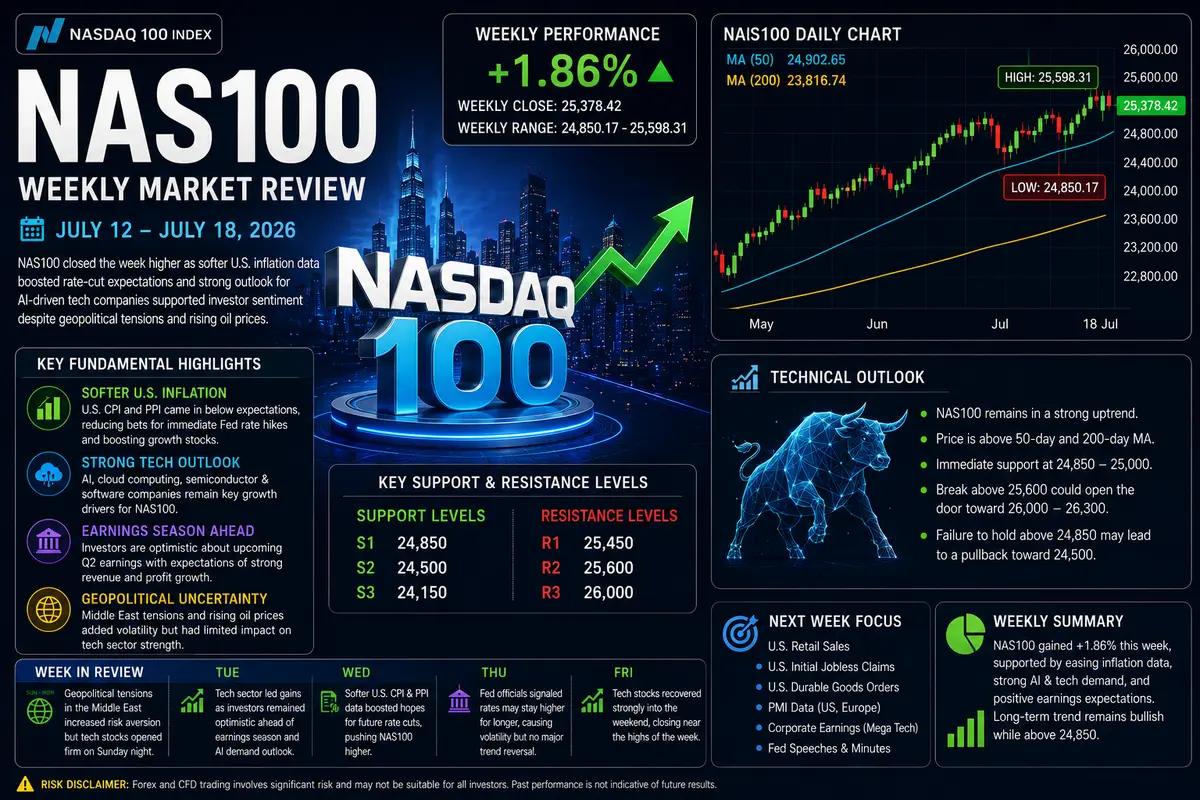
Technology stocks have once again become the centre of attention, and NAS100 continues reflecting that optimism. Over the last several sessions, buyers have controlled the direction of the market with impressive consistency. Every meaningful dip has found support, and every attempt by sellers to force a larger correction has struggled to gain momentum. Looking at the bigger picture, the trend remains firmly constructive.
However, I don’t think the most important question today is whether NAS100 has been bullish.
The more important question is whether buyers still have enough confidence to continue paying higher prices after such a strong run.
That is where I believe the market has reached an interesting stage.
The first thing I noticed while studying the chart was not the strength of the rally but the change in its rhythm. Earlier in the trend, bullish candles appeared with very little hesitation. Buyers seemed comfortable stepping into the market almost immediately after every pullback. Recently, the movement has become more controlled. The index is still respecting higher lows, but it has also started spending longer periods moving sideways beneath important resistance.
Many traders see that as a warning.
Personally, I don’t think it’s that simple.
Markets often slow down before making their biggest moves. A period of consolidation allows traders to reassess positions, institutions to build exposure and momentum indicators to cool after an extended rally. Without those pauses, strong trends usually become unstable because prices rise too quickly without developing healthy support underneath.
That’s why I don’t immediately interpret slower movement as bearish.
What matters is how the market behaves during the consolidation.
If buyers continue defending every small pullback while refusing to allow sellers much control, the pause often becomes the foundation for another breakout. If the opposite happens and every attempt to move higher is rejected more aggressively than before, then confidence may gradually begin shifting toward the bears.
At the moment, I think both outcomes remain possible.
One reason I continue giving buyers the benefit of the doubt is the quality of the recent pullbacks. They haven’t looked particularly aggressive. Instead of sharp declines that erase several days of gains, corrections have generally been controlled and relatively shallow. That usually suggests investors remain comfortable holding positions rather than rushing to exit the market.
Another point worth considering is the broader environment surrounding technology companies.
Investor interest in artificial intelligence, cloud computing, semiconductor development and digital infrastructure continues supporting sentiment across the technology sector. Large companies remain influential within the index, meaning strong performance from only a handful of major stocks can have a noticeable impact on the overall direction of NAS100.
Even so, optimism has limits.
Valuations eventually become part of the conversation. After prolonged rallies, investors naturally begin asking whether future earnings can justify current prices. Those questions don’t always produce immediate selling pressure, but they often contribute to slower movement as institutions become more selective with new positions.
The bond market also deserves attention.
Technology stocks generally perform better when investors feel comfortable with interest-rate expectations. If Treasury yields begin rising sharply again, some investors may reconsider the balance between growth stocks and fixed-income assets. That doesn’t automatically create a bearish market, but it can reduce the pace of buying.
From a technical perspective, I think resistance deserves more respect than many traders are currently giving it.
Every previous high represents a point where supply entered the market. Traders who sold successfully before often return with the expectation that history may repeat itself. At the same time, buyers who entered much lower are now protecting profits, creating another source of potential selling pressure.
That combination explains why breakouts sometimes take longer than expected.
I’m also paying close attention to the daily candle closes.
Strong closes near the highs of the session would tell me buyers remain comfortable despite resistance. Repeated upper shadows and weaker closes would suggest sellers are quietly becoming more active.
Neither signal should be ignored.
Volume may provide the deciding factor.
A breakout supported by increasing participation usually has a greater chance of continuing because it reflects broader conviction among market participants. A breakout that occurs while participation remains weak often struggles to maintain momentum and becomes vulnerable to failure.
Psychology may be the most interesting part of the current setup.
After several weeks of impressive gains, many traders now assume every pullback should be bought. That confidence has been rewarded repeatedly, which naturally strengthens the belief that the trend will continue.
History reminds us that markets often become unpredictable when confidence becomes one-sided.
I’m not suggesting NAS100 is ready for a major reversal.
I’m simply suggesting that confidence should always be supported by fresh evidence rather than recent performance alone.
My View
Looking at the current structure, I still believe the broader advantage belongs to the buyers. The trend remains healthy, higher lows continue holding and sellers have not yet produced the kind of sustained pressure that normally appears before larger reversals.
However, I also believe the market has entered a stage where patience becomes increasingly important.
If buyers manage to break above the current resistance with convincing daily closes and continued institutional participation, I think NAS100 has the potential to continue its longer-term advance. Such a move would confirm that demand remains strong despite elevated prices.
If resistance continues rejecting price and the index begins producing lower highs followed by deeper pullbacks, I would expect the market to spend more time correcting before attempting another rally.
For now, my outlook remains cautiously bullish. I don’t see convincing evidence that the larger trend has changed, but I also don’t think traders should assume higher prices are guaranteed simply because the recent trend has been positive. The coming sessions should reveal whether this consolidation is simply another pause in a healthy advance or the beginning of a broader period of correction. Until then, I believe the smartest approach is to let price confirm the next direction rather than forcing an opinion before the market has finished making its decision.

Comments
No comments yet. Be the first to share your thoughts!
Authentication Required
You must be logged in to post a comment.