

Understanding Financial Reporting: The Global Language of Business
Financial reporting is the cornerstone of modern global commerce. At its core, a financial report is a comprehensive document — or a series of documents — that contains detailed information about a company’s financial position and its operational results over a specific period. However, in the context of the global economy, it is much more than just a regulatory requirement. It is the universal language that businesses use to communicate their health, viability, and strategic direction to stakeholders across the world.
Whether it is a tech giant in Silicon Valley, a massive automotive manufacturer in Japan, or a rapidly growing e-commerce platform in Latin America, all businesses rely on standardized financial reporting. This standardization, often guided by International Financial Reporting Standards (IFRS) or Generally Accepted Accounting Principles (GAAP), ensures that investors and regulators anywhere in the world can understand a company’s financial narrative.
Core Components of Financial Statements
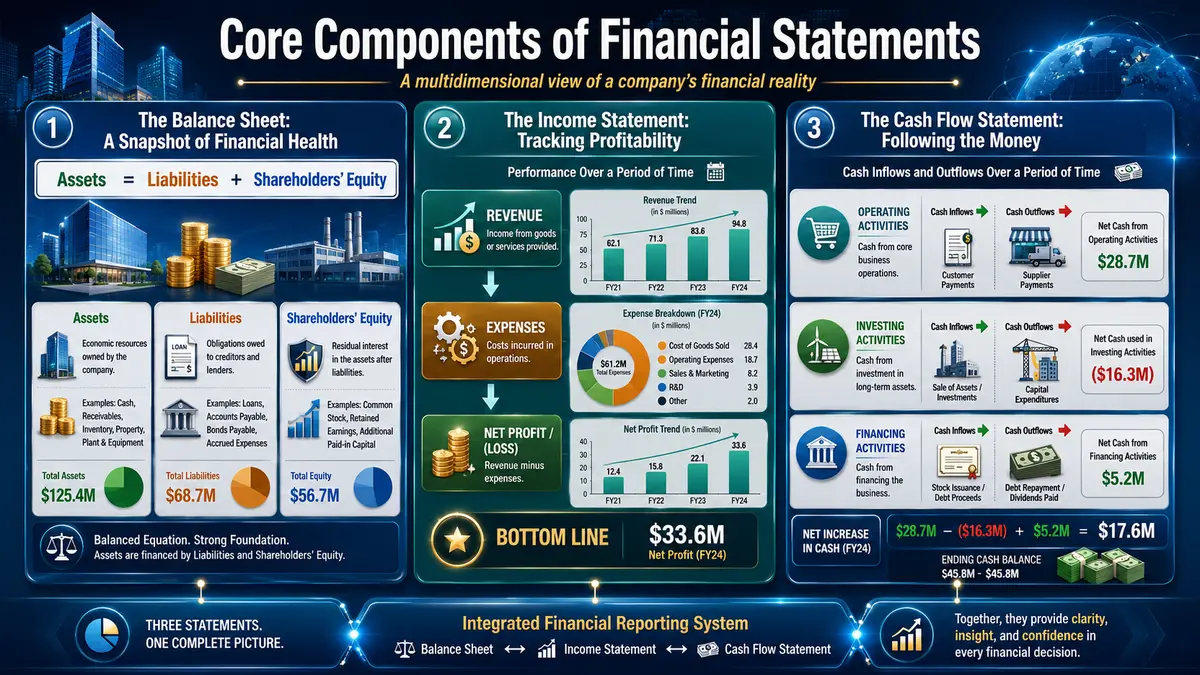
A complete set of financial statements provides a multidimensional view of a company’s economic reality. It consists of several primary components, each serving a distinct and critical purpose.
The Balance Sheet: A Snapshot of Financial Health
The balance sheet represents the financial position of a company at one specific moment in time — often the last day of the fiscal year or quarter. It is built on the fundamental accounting equation: Assets = Liabilities + Shareholders’ Equity.
-
Assets: These are the resources owned by the company that hold economic value. This includes highly liquid assets like cash and cash equivalents, as well as tangible assets like real estate, factories, and heavy machinery. For a global technology corporation, assets might also include massive intellectual property portfolios, patents, and global data centers.
-
Liabilities: This represents what the company owes to external parties. It encompasses short-term obligations like payroll and accounts payable to suppliers, as well as long-term liabilities such as multi-million-dollar corporate bonds or syndicated bank loans used to fund international expansion.
-
Shareholders’ Equity: Often referred to as the net worth of the company, this is the residual interest in the assets of the entity after deducting all its liabilities. It represents the actual value that belongs to the shareholders.
The Income Statement: Tracking Profitability
While the balance sheet is a snapshot, the income statement (also known as the Profit and Loss statement, or P&L) is a motion picture. It presents a detailed account of the company’s revenues, expenses, and the resulting net profit (or loss) over a defined period, such as a quarter or a full year.
This statement tracks the core operational success of a business. It starts with the “top line” (total revenue generated from sales) and deducts various costs. For example, an international airline’s income statement would show revenues from global ticket sales, from which they must deduct massive operating expenses like aviation fuel, international airport fees, pilot salaries, aircraft depreciation, and taxes. The final number at the bottom — the “bottom line” — reveals the net income, showing whether the company ultimately made a profit from its global operations.
The Cash Flow Statement: Following the Money
Profitability on an income statement does not necessarily equal cash in the bank, which is why the cash flow statement is absolutely vital. This document tracks the actual movement of cash in and out of the business during the reporting period. It is typically divided into three main categories:
-
Operating Activities: Cash generated from the core business operations (e.g., cash received from customers minus cash paid to suppliers and employees).
-
Investing Activities: Cash spent on or generated from long-term investments. For instance, if a global energy company spends billions building a new offshore wind farm, this massive cash outflow will be recorded here.
-
Financing Activities: Cash related to borrowing, repaying debt, or issuing stock. If a multinational corporation issues new shares on the New York Stock Exchange to raise capital, that influx of cash appears in this section.
The Primary Objectives of Financial Reporting
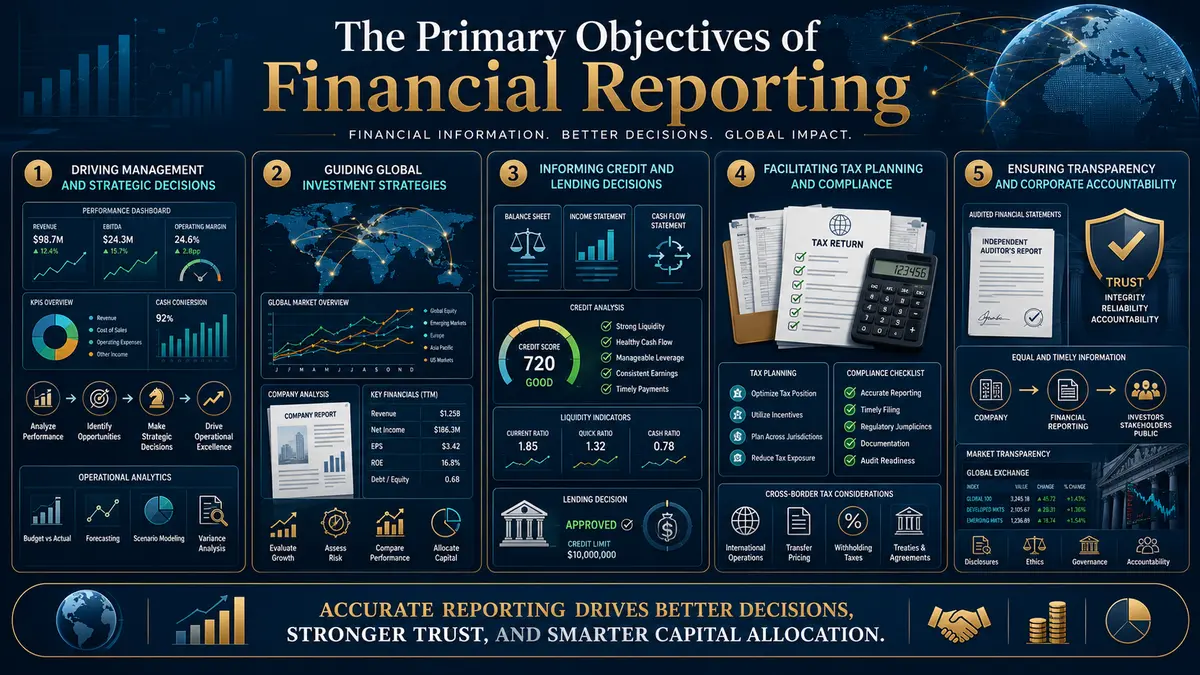
The overarching goal of financial reporting is to provide actionable, accurate, and timely information to a wide variety of stakeholders so they can make informed economic decisions.
Driving Management and Strategic Decisions
Internally, financial reports are the dashboard that executives and management teams use to steer the company. The data provided helps corporate leaders analyze performance metrics, identify inefficiencies, and make strategic operational decisions. For example, if a multinational consumer goods company notices declining profit margins in its European division on the income statement, management can immediately intervene to restructure operations, cut costs, or pivot their marketing strategy in that specific region.
Guiding Global Investment Strategies
Investors, ranging from individual retail traders to massive global asset management firms, rely heavily on financial reporting to evaluate a company’s financial health and future prospects. Before committing capital to buy shares or bonds, investors analyze these reports to assess profitability, growth trends, and risk exposure. An institutional investor in London looking to invest in a South Korean electronics manufacturer will scrutinize their financial statements to ensure the company is generating enough free cash flow to justify the investment.
Informing Credit and Lending Decisions
Creditors, such as international commercial banks or private debt funds, use financial statements as a primary tool to evaluate solvency and creditworthiness. When a major corporation applies for a loan to build a new manufacturing facility, the bank’s underwriters will closely analyze the company’s balance sheet and cash flow statement. They need absolute assurance that the company generates sufficient liquidity to cover interest payments and eventually repay the principal sum, even during economic downturns.
Facilitating Tax Planning and Compliance
Operating a business across borders introduces immense complexity regarding taxation. Financial reporting serves as the foundational data used to calculate corporate tax liabilities across different jurisdictions. It allows multinational corporations to engage in efficient tax planning, anticipate future tax payments, and ensure strict compliance with the varying demands of international tax authorities.
Ensuring Transparency and Corporate Accountability
Publicly traded companies have a fiduciary duty to their shareholders, and financial reporting is the mechanism that enforces this transparency. By regularly publishing audited financial statements, companies build trust with a vast network of stakeholders, including shareholders, customers, suppliers, and government regulators. This transparency is what allows global stock exchanges (like the NASDAQ, Tokyo Stock Exchange, or London Stock Exchange) to function efficiently, as it prevents fraud and ensures all market participants have access to the same fundamental data.
Fundamental Principles of Financial Reporting
To ensure that financial reports are reliable, consistent, and universally understood, they must be constructed according to a rigorous set of foundational rules and guiding principles. These principles prevent manipulation and ensure the data reflects economic reality.
The Principle of Substance Over Legal Form
Financial statements must reflect the true economic substance of transactions and events, rather than merely their legal form. If a company enters into a complex leasing agreement for a fleet of aircraft, the transaction must be recorded based on who actually holds the economic risks and rewards of the planes, regardless of technical ownership loopholes in the legal contract.
The Monetary Unit Assumption and Currency Stability
For financial statements to be meaningful, they must be presented in a single, stable currency (such as the US Dollar, the Euro, or the Japanese Yen). This allows for clear aggregation and comparability of results. Even if a global retailer operates in fifty different countries with fifty different local currencies, they must consolidate and translate their financial results into one presentation currency to give investors a unified picture of their global performance.
Consistency and Continuity
Also related to the “Going Concern” assumption, financial reporting must be consistent over time so that users can accurately compare a company’s performance from one year to the next. If a business constantly changed the way it calculated depreciation or recognized revenue, it would be impossible to tell if the company was actually growing or just playing accounting tricks. Any changes in accounting policies must be rigorously disclosed.
Objective Valuation and Fair Presentation
Assets, liabilities, revenues, and expenses must be measured and recorded fairly, based on objective, verifiable information and the best possible estimates. Depending on the accounting framework used, this might involve recording an asset at its historical cost (what was originally paid for it) or its fair market value (what it could be sold for today). The goal is to prevent companies from artificially inflating their worth.
Materiality, Grouping, and Aggregation
Financial statements should be structured for maximum clarity and comprehensibility. This means grouping similar items together and not burying users in insignificant details. The principle of materiality dictates that any financial information that could influence the decision of an investor or creditor must be clearly disclosed. Minor, insignificant expenses are aggregated, while massive, highly relevant transactions are highlighted.
The Long-Term Perspective and Accrual Accounting
Financial reporting is not just about today’s cash balance; it must reflect the long-term viability of the business. Through the principle of accrual accounting, revenues and expenses are recorded when they are earned or incurred, regardless of when the cash actually changes hands. This ensures that the financial statements reflect the true economic activity of the company during the period, providing a much more accurate view of its long-term operational sustainability.

Comments
No comments yet. Be the first to share your thoughts!
Authentication Required
You must be logged in to post a comment.