
US30: The Trend Still Looks Healthy, but This Is Where Bulls Have to Prove They’re Serious
US30: The Trend Still Looks Healthy, but This Is Where Bulls Have to Prove They’re Serious
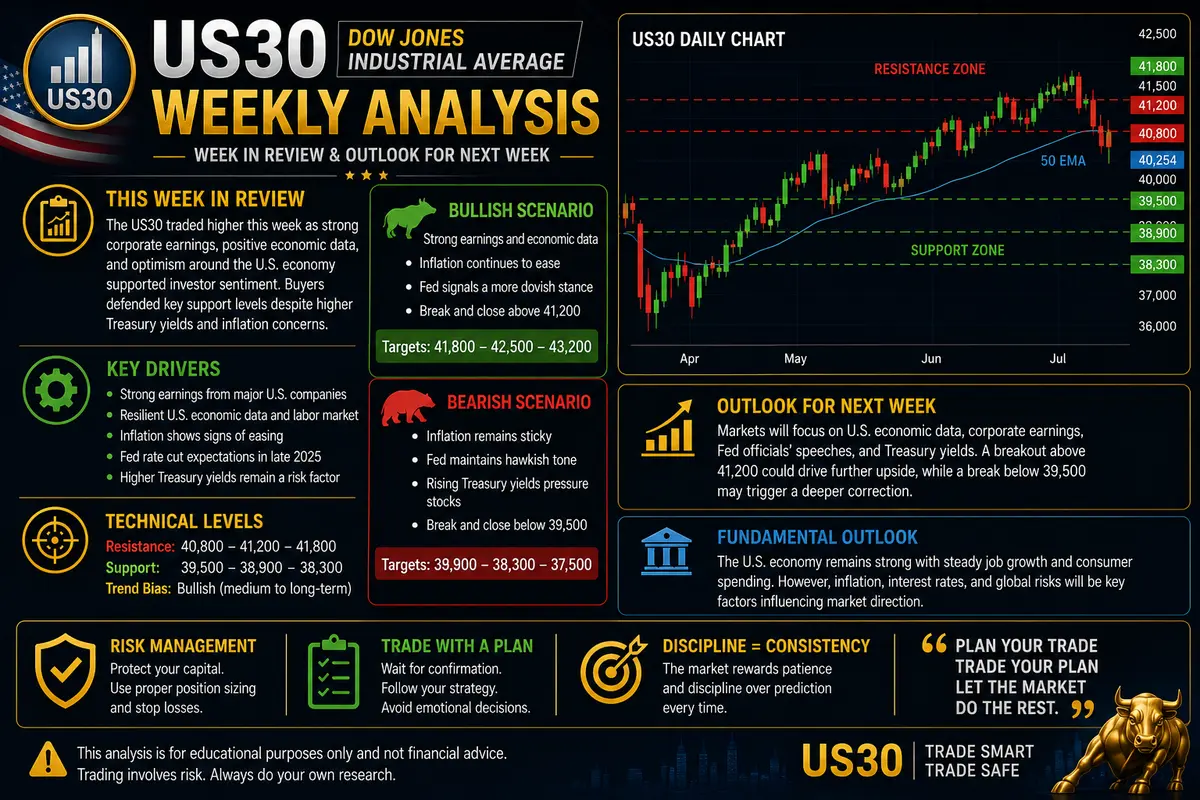
US30 has spent the last several weeks rewarding traders who stayed patient. Every meaningful pullback has eventually attracted buyers, and every fresh push higher has reminded the market that confidence in U.S. equities hasn’t disappeared. Looking at the bigger picture, it’s difficult to argue that the trend has turned bearish. The structure is still pointing higher, and buyers continue defending important support zones whenever the index begins to lose momentum.
That being said, the market is no longer trading in the easy part of the trend.
The higher an index climbs, the more difficult it becomes to convince investors to keep paying higher prices. Early buyers are already sitting on comfortable profits, while traders who missed the move are beginning to wonder whether they’re arriving too late. That combination often creates slower price action, even when the overall direction remains positive.
When I opened the chart today, the first thing that caught my attention wasn’t the trend itself. It was the way price has started behaving around the current resistance area. Instead of seeing aggressive buying similar to what we witnessed earlier in the rally, the candles have become smaller. The market is still holding near its highs, but it isn’t moving with the same confidence.
That doesn’t automatically make me bearish.
In fact, I think this kind of behaviour is quite normal after a sustained advance.
Markets need time to breathe. They don’t climb forever without stopping. Sometimes the strongest trends spend several sessions moving sideways before continuing. During those quiet periods, impatient traders often believe the rally is over, while experienced traders understand that consolidation can simply be the market preparing for its next move.
The important question is whether this consolidation is healthy or whether it’s the first sign that buyers are losing control.
At the moment, I think both possibilities remain open.
One thing working in favour of the bulls is location. Price has remained close to resistance instead of falling sharply away from it. That’s often a subtle but encouraging sign. If sellers were completely dominating, I would expect a much stronger rejection. Instead, buyers are still managing to keep the index near the highs, suggesting they haven’t stepped away from the market.
On the other hand, staying below resistance for too long also carries risk.
Every failed attempt to break higher gives sellers a little more confidence. Traders who believe the rally has gone too far begin opening short positions, while existing buyers start protecting profits. Eventually, that pressure can become strong enough to trigger a correction.
Whether that happens this week depends on how the market reacts once trading volume increases.
The opening hours of Wall Street are likely to provide the clearest signal. If institutions begin buying aggressively and the index produces strong hourly closes above resistance, I’d view that as evidence that the trend still has energy. If the market continues hesitating and every push higher is quickly rejected, I’d become more cautious about expecting immediate continuation.
There are also several fundamental reasons why investors remain optimistic about U.S. stocks.
Corporate earnings have generally been stronger than many analysts feared, and several large companies continue reporting healthy revenues despite a higher interest-rate environment. Investors also remain focused on the possibility that inflation will continue easing over time. If that expectation remains intact, confidence in equities could stay relatively strong.
However, optimism alone doesn’t move markets forever.
The Federal Reserve remains one of the biggest influences on sentiment. Every inflation report, employment figure and speech from policymakers has the potential to change expectations about future interest rates. Strong economic data is often positive for company earnings, but it can also encourage expectations that interest rates will remain elevated. That’s why markets sometimes react in ways that appear contradictory.
Bond yields deserve attention as well.
Whenever Treasury yields rise sharply, some investors move money away from stocks and into fixed-income assets. When yields fall or remain stable, equities often become more attractive again. Watching the relationship between US30 and the bond market frequently provides useful clues before large moves develop.
Another detail I find interesting is market psychology.
After several weeks of higher prices, many traders now expect every dip to be bought. That’s understandable because the market has repeatedly rewarded that approach. But history reminds us that trends eventually change when confidence becomes one-sided. I’m not saying that moment has arrived. I’m simply saying it’s worth staying alert rather than assuming the next breakout is guaranteed.
The current consolidation also tells us something about institutional behaviour.
Large investment funds rarely chase price after a strong rally. Instead, they often wait for periods of slower trading to decide whether valuations still justify additional buying. That’s one reason consolidation near resistance isn’t necessarily a warning sign. Sometimes it’s simply professional money deciding whether to commit more capital.
From a technical standpoint, I’d also keep an eye on the recent swing lows.
As long as those levels remain intact, I believe buyers still have a reasonable argument. Higher lows are one of the clearest signs that demand remains healthy. If those lows begin breaking consistently, then the conversation changes because the market structure itself starts weakening.
My View
If I had to choose a direction based on the current evidence, I’d still lean slightly bullish, but only slightly.
The broader trend hasn’t been broken, and buyers continue defending important areas whenever the market pulls back. That’s enough for me to avoid becoming aggressively bearish.
At the same time, I don’t think this is the type of market where traders should buy simply because the trend has been strong. Resistance is doing its job by slowing momentum, and the next move should be allowed to develop naturally rather than being forced through prediction.
If buyers manage to push above resistance with convincing price action and healthy participation, I believe US30 has a realistic chance of extending its upward trend during the week.
If the index continues struggling beneath resistance while lower highs begin forming, I’d expect a deeper pullback before any fresh attempt to move higher.
So, my outlook remains constructive, but cautious. The trend still belongs to the buyers, yet the current resistance is asking them an important question: Do they have enough conviction to keep driving the market higher, or is it finally time for the market to take a breather?
The answer probably won’t come from a prediction. It will come from how price reacts over the next few sessions. That’s where I’ll be looking for confirmation before becoming more confident in either direction.

Comments
No comments yet. Be the first to share your thoughts!
Authentication Required
You must be logged in to post a comment.