
US30 Weekly Outlook: What Smart Money Could Be Planning Before Wall Street Opens
US30 Weekly Outlook: What Smart Money Could Be Planning Before Wall Street Opens
As Wall Street prepares for Monday’s opening bell, traders are approaching the US30 (Dow Jones Industrial Average)with a mixture of confidence and caution. While the index has continued demonstrating resilience over recent weeks, experienced investors understand that every new trading week presents a fresh set of challenges. Rather than focusing solely on whether prices will rise or fall, institutional traders are asking a more important question: Where is capital most likely to flow, and what will motivate those decisions? Understanding this dynamic may prove far more valuable than attempting to predict every short-term movement.
Unlike technology-heavy indices that often react aggressively to developments surrounding artificial intelligence or software companies, the US30 reflects the performance of thirty of America’s most established corporations across industries including finance, healthcare, industrial manufacturing, energy, consumer products, and transportation. This diversification often allows the index to remain relatively stable during periods when individual sectors experience heightened volatility. As a result, traders should pay close attention not only to price action but also to the sectors leading or lagging during Monday’s session.
One of the most important themes likely to influence the market is investor confidence in the U.S. economy. Over recent months, economic reports have painted a mixed but encouraging picture. Inflation has gradually eased from previous highs, unemployment has remained relatively low, and consumer spending continues supporting overall economic activity. Although concerns surrounding borrowing costs have not disappeared completely, many investors now believe that the economy has a realistic chance of achieving slower inflation without entering a significant recession. This growing confidence has encouraged long-term investors to maintain exposure to high-quality American companies despite occasional periods of market volatility.
Corporate earnings expectations will also remain firmly under the spotlight. Investors no longer reward companies simply because they belong to well-known sectors. Instead, they are demanding measurable growth, healthy cash flow, disciplined cost management, and realistic guidance for future performance. Many of the companies represented within the Dow Jones have consistently demonstrated these qualities over many years, which explains why institutional funds often increase their holdings during temporary market corrections rather than reducing exposure. This behaviour reflects long-term conviction instead of short-term speculation.
Interest rates remain another critical piece of the puzzle. Equity markets generally perform best when investors have confidence that borrowing costs are becoming more predictable. If market participants continue believing that inflation is gradually moving under control, pressure on interest rates may ease further. Such an environment typically benefits established companies because financing becomes more manageable while consumer and business confidence improve. However, any unexpected inflation surprise capable of pushing bond yields higher could temporarily reduce enthusiasm for equities, particularly among more conservative investors.
The bond market deserves careful monitoring throughout Monday. Professional portfolio managers frequently observe Treasury yields before making significant equity decisions because changes in yields directly influence investment strategy. Lower yields often encourage investors to move additional capital into stocks in search of higher long-term returns. Rising yields, on the other hand, can attract money back into fixed-income investments, reducing demand for equities. Understanding this relationship can help traders interpret why the index moves beyond simply reacting to chart patterns.
Another important element involves institutional positioning. Large investment firms rarely react emotionally to overnight headlines or social media speculation. Instead, they evaluate whether long-term economic conditions continue supporting corporate profitability. If fund managers believe earnings growth remains sustainable, temporary pullbacks are often viewed as opportunities to accumulate additional shares. This patient approach explains why the US30 has repeatedly recovered after periods of market uncertainty. Institutional investors typically think in months and years rather than hours and days.
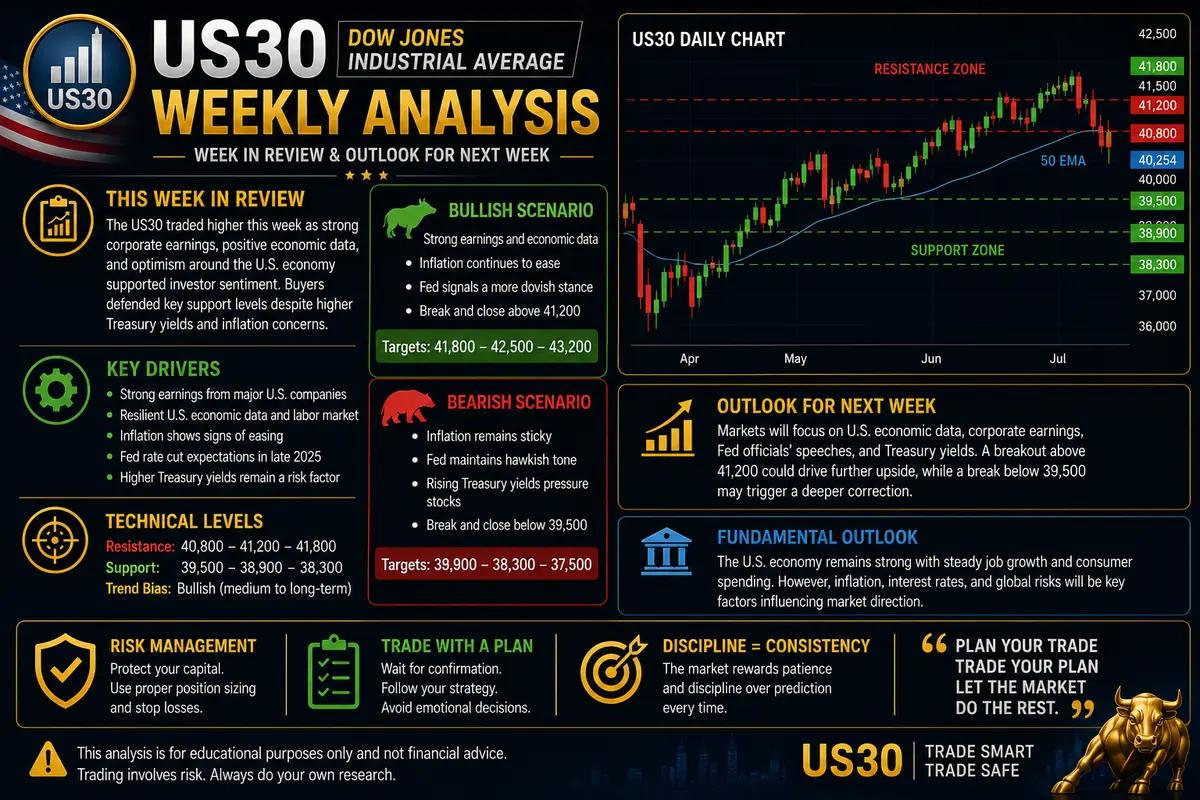
Technical analysis currently suggests that the broader market structure remains constructive. Recent pullbacks have been relatively shallow compared with previous advances, indicating that buyers continue defending important support zones. This pattern generally reflects confidence among larger market participants who remain willing to enter the market during periods of weakness. Nevertheless, resistance levels overhead continue attracting profit-taking, reminding traders that every trend requires fresh buying interest to continue developing.
Volume will become especially important during Monday’s session. A move higher supported by increasing trading activity would indicate that institutional money is participating in the rally rather than leaving the advance to short-term traders. Conversely, if prices rise while trading volume remains unusually light, experienced investors may question the sustainability of that movement. Strong trends are usually supported by broad participation rather than isolated buying activity.
Market psychology also appears healthier than during previous periods of excessive optimism. Instead of chasing every rally, investors have become increasingly selective, rewarding companies capable of delivering reliable earnings while avoiding businesses with weaker financial outlooks. This disciplined behaviour often contributes to more sustainable market trends because buying decisions are based on fundamentals rather than emotion. Healthy markets generally advance through confidence built gradually over time rather than explosive speculation.
Sector rotation may become another defining feature of Monday’s trading. Even if the overall index remains relatively stable, money could move between industrial companies, healthcare providers, financial institutions, and consumer businesses depending on economic expectations. Observing where capital flows within the index often provides valuable insight into the market’s true strength. Broad participation across multiple sectors is usually considered a stronger bullish signal than gains concentrated in only a handful of companies.
Global developments should not be ignored either. Although the US30 primarily reflects American businesses, international events continue influencing investor sentiment. Geopolitical tensions, changes in commodity prices, and developments in overseas economies all have the potential to influence risk appetite. If global conditions remain relatively calm, institutional investors may feel comfortable maintaining exposure to equities. Unexpected uncertainty, however, could encourage temporary defensive positioning before confidence returns.
Outlook for Monday
The overall outlook for US30 remains moderately bullish, supported by resilient corporate fundamentals, improving confidence in the U.S. economy, and continued institutional demand for high-quality blue-chip companies. However, traders should avoid assuming that every early rally will automatically develop into a sustained trend. Monday is more likely to reveal where professional investors are positioning themselves for the remainder of the week.
Rather than focusing exclusively on price, successful traders should monitor trading volume, bond yields, sector leadership, and institutional participation. These factors often reveal the market’s true direction before it becomes obvious on the chart. If buying pressure expands across multiple sectors and volume confirms the move, the US30 could continue building on its existing momentum. If participation remains weak or macroeconomic uncertainty increases, another period of consolidation should be viewed as a healthy pause rather than a sign that the longer-term outlook has changed. In markets driven by confidence, discipline will continue separating successful traders from impulsive ones.

Comments
No comments yet. Be the first to share your thoughts!
Authentication Required
You must be logged in to post a comment.