

When a Partner Leaves: Norway’s StrongPoint Searches for New Support
Introduction: A Blow That Was Not Fatal
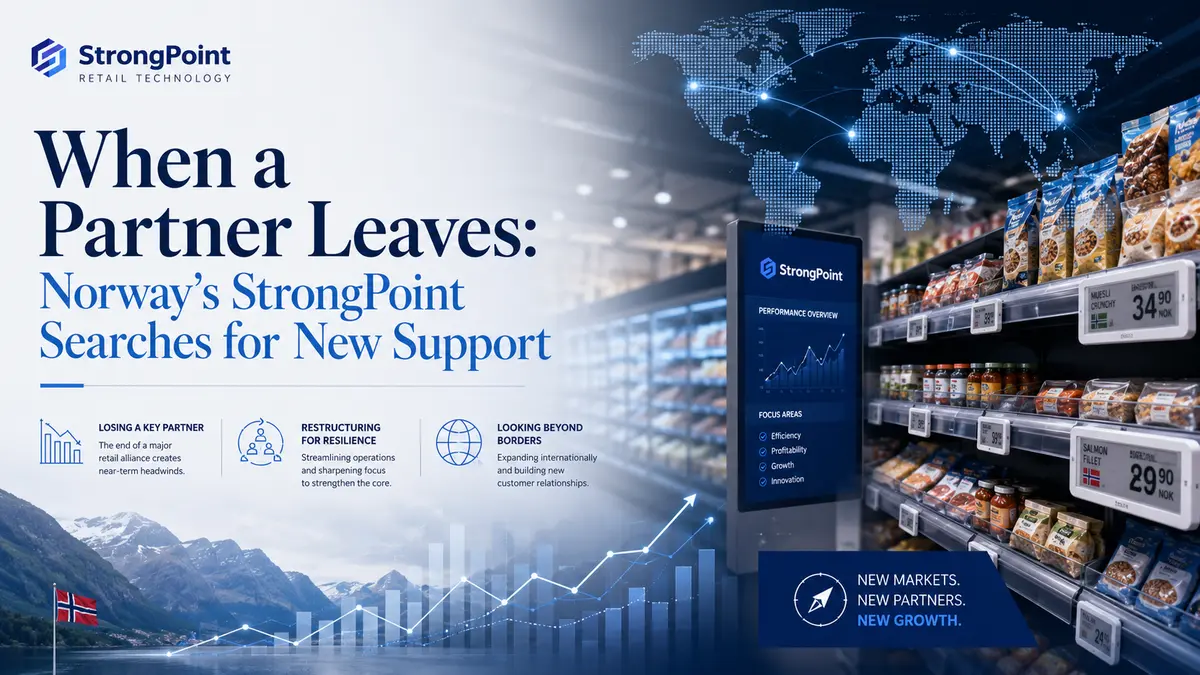
Norwegian technology company StrongPoint, which specializes in solutions for grocery retail, has published its second-quarter results, leaving investors with mixed feelings. Revenue declined by 2 percent year over year, reaching 342 million Norwegian kroner. At first glance, a two-percent decline is not a disaster. But behind this modest figure lies a story of a lost partnership, the need to restructure the business, and the search for new sources of growth.
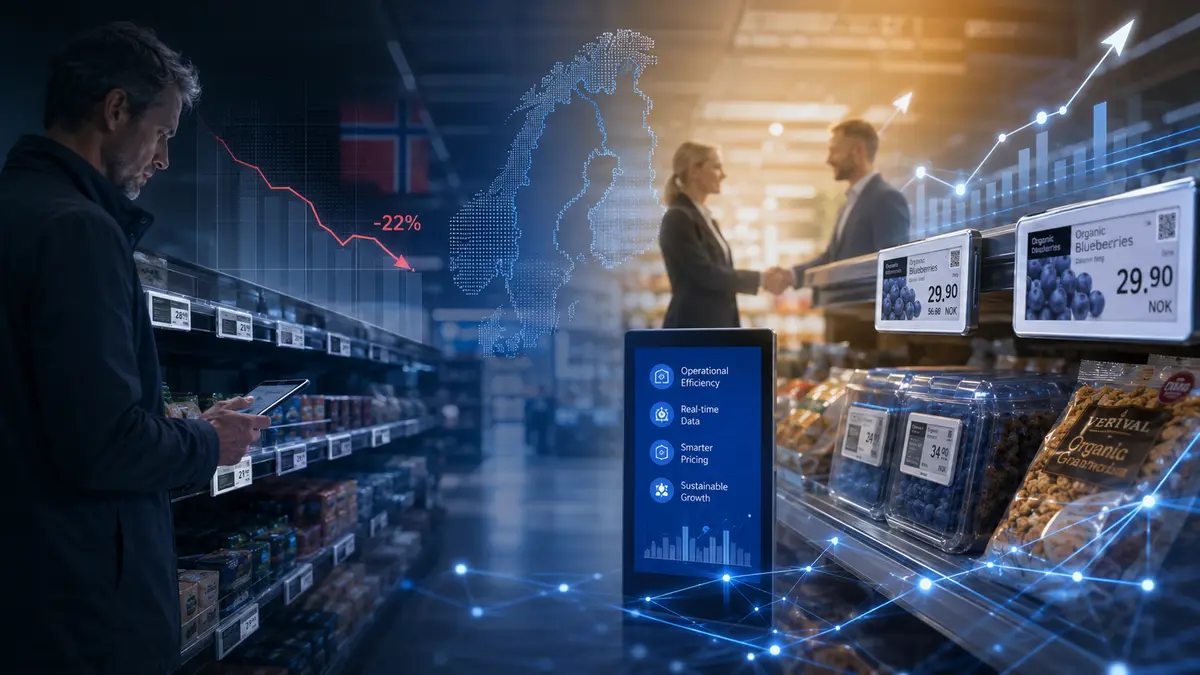
The former electronic shelf label partner, whose name the company does not disclose but who appears to have been a major player in the ESL market, has left. This departure left a deep wound in the Scandinavian segment of the business, where revenue fell by 22 percent. This is a serious decline, which was only partially offset by growth in international markets.
But StrongPoint’s story is not simply one of financial losses. It is a story about how a company deals with crisis, how it restructures its priorities, and where it sees new opportunities. EBITDA of NOK 5 million, an operating loss of NOK 6 million, and a net loss of NOK 8 million are figures that raise questions about the health of the business. At the same time, adjusted free cash flow reached NOK 49 million. And this gives reason for cautious optimism.
Electronic Shelf Labels: The Battlefield for the Market
What ESL Is and Why It Matters
For those unfamiliar with the inner workings of retail, it is worth explaining: electronic shelf labels are small displays placed on store shelves that automatically update information about prices and promotions. A technology that seemed futuristic just a few years ago is now becoming the standard for major retail chains.
The ESL market is growing rapidly. Supermarket chains around the world are switching from paper price tags to electronic ones because they save staff time, reduce the number of errors, and allow prices to be changed dynamically throughout the day. And in this growing market, intense competition has unfolded.
StrongPoint had long been one of the players in this field, maintaining a strategic partnership with a major solution provider. But the relationship deteriorated, the partner left, and the company was left with a gap in its Scandinavian segment.
The Loss of a Partner: How It Happened
The circumstances of the breakup remain behind the scenes, but the consequences are clear. The former partner was not just a supplier, but a key link in the value chain for customers. Its technologies, infrastructure, and reputation were all woven into StrongPoint’s business in the Scandinavian market.
When the partner left, customers faced uncertainty: would StrongPoint continue to service their price labels? Would it be able to find an alternative? In this situation, many customers apparently decided to leave together with the partner or simply freeze decisions about further cooperation.
A 22-percent decline in revenue in the Scandinavian markets is the price of that breakup. And it turned out to be high. The company did not simply lose part of its business — it lost momentum in its home market, where it had historically been strong.
Financial Performance: Numbers That Do Not Lie
Revenue: Almost at the Previous Level
Total revenue of NOK 342 million, with a decline of 2 percent, looks almost heroic when taking into account the scale of losses in the Scandinavian segment. This means that other areas of the business performed very well in order to compensate for the setback.
A 15-percent increase in international revenue became a lifeline. StrongPoint had clearly been betting on expansion beyond Norway and Scandinavia, and that bet paid off. While one market was being shaken, another was pulling the company upward.
EBITDA and Losses: The Cost of Restructuring
EBITDA of NOK 5 million, against the background of an operating loss of NOK 6 million and a net loss of NOK 8 million, may look concerning. But here it is important to look at the details: one-off costs of NOK 4 million distort the picture. Without them, EBITDA would have been almost twice as high.
These one-off costs are the price of restructuring the business after the breakup. Layoffs, contract terminations, and strategy revisions all cost money. But these are investments in the future that should pay off in the long run.
Free Cash Flow: The Hidden Trump Card
The figure that is truly encouraging is adjusted free cash flow of NOK 49 million. This is the money the company generated from its operating activities after all capital expenditures.
In a world where many technology companies burn cash faster than they can earn it, positive free cash flow amid falling revenue is a sign of a healthy business. StrongPoint knows how to manage working capital, control costs, and convert revenue into real cash. This skill will be critically important in the coming quarters.
The Scandinavian Market: Challenges and Solutions
Why a 22% Decline Hurts
The Scandinavian market has always been StrongPoint’s home base. Here, the company had strong positions, a recognizable brand, and loyal customers. Losing 22 percent of revenue in this segment is not just a financial blow, but also a psychological one.
Customers who had trusted StrongPoint for decades suddenly found themselves facing a choice. Some of them likely used the former partner’s ESL solutions, and the partner’s departure made those solutions non-operational or ineffective. Others wondered whether StrongPoint might leave the market altogether.
In such a situation, the company had to act quickly and decisively. And it did act, entering into a new partnership with Vusion. But as CEO Jacob Tveraabak notes, building a stable stream of recurring revenue with the new partner will take time.
A New Partnership as Hope
Vusion is not just a random supplier. The choice of a new ESL partner was a strategic decision that will determine the company’s future for the next several years. It had to be a reliable, technologically advanced player with a strong reputation and the ability to scale.
But any new partnership needs time. Time for technical integration, time for staff training, and time to convince customers of the reliability of the new solution. During this transition period, revenue will remain unstable.
StrongPoint’s main task now is to minimize this transition period and restore customer trust as quickly as possible. If the company manages to show that the new solution is at least no worse than the old one — and perhaps even better — the losses may not only be recovered, but exceeded.
International Markets: Light at the End of the Tunnel
Growth of 15%: What Lies Behind the Figure
International markets showed growth of 15 percent, partially offsetting the decline in the Scandinavian segment. This is a serious achievement, suggesting that StrongPoint’s products are in demand beyond its home region.
Where exactly did the company grow? Most likely in North America and possibly in some European countries. Grocery retail everywhere faces the same challenges: the need to improve efficiency, reduce costs, and enhance the customer experience. And StrongPoint’s solutions, it seems, are finding demand in different parts of the world.
Prospects in the United States: A Major Prize
The company’s statement that it expects profitable growth in the U.S. market after a recent breakthrough is particularly interesting. The United States is the dream of any technology business. It is the world’s largest economy, a huge retail market, and a country with a high level of technological development.
If StrongPoint has truly managed to break through in the United States, this could change the company’s trajectory. Success in America would not only bring revenue, but also strengthen the brand’s status, attract new customers in other regions, and create an opportunity to scale its solutions.
But a breakthrough is only the first step. The next, more difficult one is to establish a firm position in the American market, build sustainable customer relationships, and create a recurring revenue stream that grows steadily year after year.
Company Strategy: How to Emerge from the Crisis
Improving Efficiency and Optimizing Costs
CEO Jacob Tveraabak speaks of internal measures to improve efficiency and optimize the cost structure. This is an inevitable stage for a company undergoing structural changes.
What does this mean in practice? Most likely, it involves reviewing operational processes, eliminating duplicate functions, potentially reducing staff in areas where demand has fallen, and reinvesting in growth areas.
Importantly, these measures are already producing results: the decline in EBITDA was softened by an improved cost structure. This means the company is not simply cutting costs, but doing so intelligently while preserving its ability to invest in growth.
Recurring Revenue: A Focus on Stability
StrongPoint notes that recurring revenue declined due to the loss of the contribution from the former partner. This is a troubling signal, because for a technology company with a subscription-based business model, a stable stream of recurring revenue is the foundation of financial health.
Therefore, the strategy for the future will include restoring and growing this metric. The new partnership with Vusion should, over time, begin generating stable revenue. And the sooner this happens, the better for the company.
But other sources of recurring revenue should not be forgotten either. StrongPoint may develop additional services and subscriptions to diversify revenue and reduce dependence on a single business segment.
What Comes Next: Development Scenarios
Recovery in the Scandinavian Market
The most obvious scenario is a gradual recovery of revenue in Scandinavia as the new partnership with Vusion gains momentum. If the company succeeds in convincing former customers of the reliability of the new solution, they may return.
The speed of this recovery will depend on several factors: how quickly the technical integration is completed, how customers respond to the new solution, and how aggressive competition will be during this transition period.
Growth in the United States
The second scenario is accelerated growth in the U.S. market. If the breakthrough the company is talking about proves sustainable, the American market could become the main growth driver in the coming years.
At the same time, it is important to remember that entering a new market requires resources. Investments in marketing, sales, and technical support are necessary. And if the company invests too aggressively in the United States, this could create pressure on profits in the short term.
Diversification
The third scenario is diversification of the product portfolio. StrongPoint is known for its retail solutions, but the company may also see opportunities in other adjacent areas.
For example, inventory management solutions, consumer behavior analytics, and store automation systems are all areas where StrongPoint’s expertise could be applied.
Conclusion: A Test of Resilience
The second quarter of 2026 was a time of trials for StrongPoint. The loss of the old partner caused serious damage to the Scandinavian business, but it did not break the company. International markets grew, free cash flow remained strong, and management demonstrated its ability to adapt quickly to changing conditions.
The company is at a crossroads. On one side is the need to recover in its home market, where revenue has fallen. On the other is the enormous growth potential in the United States and other international markets. And all of this must be balanced with strict cost discipline and investment in development.
It is telling that the company is not making loud statements about a rapid recovery. On the contrary, it honestly acknowledges that building a stable stream of recurring revenue with the new partner will take time. This is a mature, balanced approach that inspires respect.
StrongPoint’s story is a reminder that growth in business is never a straight line. There are crises, losses, and painful breakups. But companies that can maintain cost discipline, invest in the future, and avoid panic in difficult situations ultimately emerge stronger.
StrongPoint has every chance of coming out of the current situation as a stronger and more diversified company. The key is not to lose focus, to continue working on efficiency, and to believe in its product. Because grocery retail is not going anywhere, and technology in this sector will only continue to develop.

Comments
No comments yet. Be the first to share your thoughts!
Authentication Required
You must be logged in to post a comment.