

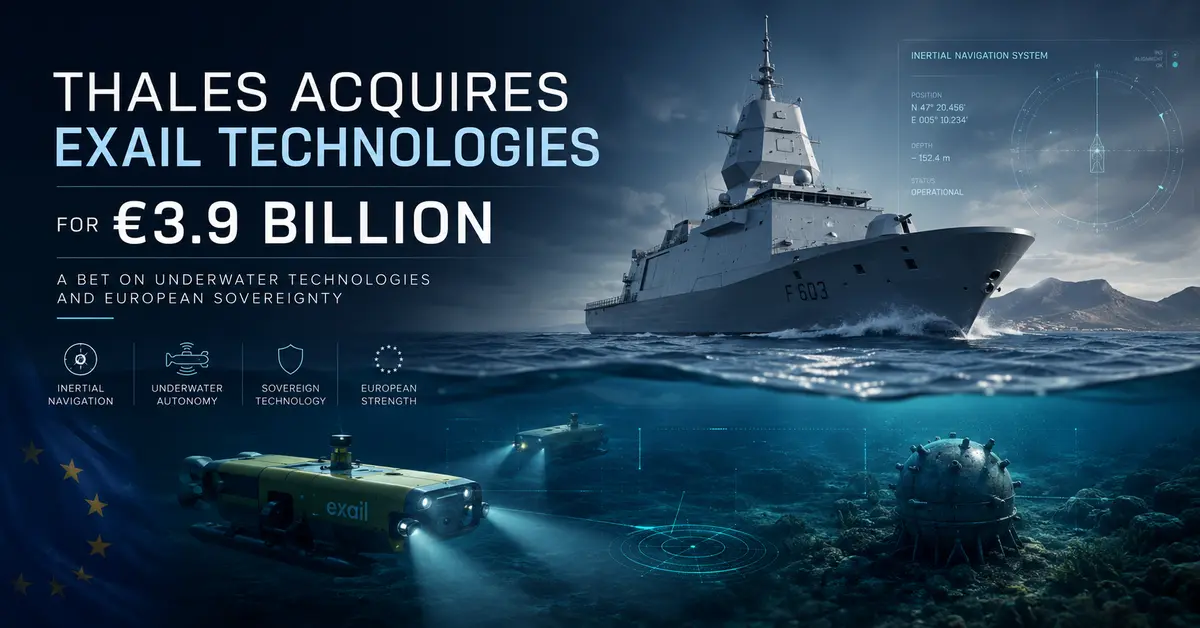
Thales Acquires Exail Technologies for €3.9 Billion: A Bet on Underwater Technologies and European Sovereignty
Introduction: The Monday That Changed Europe’s Defense Landscape
Monday morning. Paris, Thales headquarters. Chairman and CEO Patrice Caine holds a press conference that will become one of the most significant moments in the history of the French defense industry. Thales, a giant with €22.10 billion in revenue and 85,000 employees worldwide, announces the acquisition of a controlling stake in Exail Technologies. The deal is valued at €3.9 billion. The price per share is €134, which is 44% above the closing price before the news emerged.
Exail is not just a high-tech group. It is a European leader in robotic systems for naval mine countermeasures and the world’s second-largest player in shipborne inertial navigation systems. The company operates in nearly 80 countries, and its technologies have dual-use applications — both defense and civilian. Now it is becoming part of the Thales empire.
Behind this announcement lies something more than just an M&A deal. It is a strategic move that will strengthen Europe’s high-tech industrial base and reinforce its technological sovereignty. In a world where geopolitical uncertainty is becoming the new normal, Thales is betting on underwater warfare and inertial navigation — two areas that will be critically important in the coming decades.
Let’s examine what really stands behind this deal, what assets Thales is gaining, and why this acquisition could change the balance of power in the global defense market.
Exail Technologies: An Asset Worth Paying a Premium For
Who Exail Is and Why It Is So Valuable
Exail Technologies is not just a company with €479 million in revenue and 2,200 employees. It is a technological gem that has long remained in the shadow of larger players. But those who understand its capabilities know that Exail has unique competencies that cannot be replicated quickly.
Exail’s main specialization is underwater robotic systems for mine countermeasures. These are not just military gadgets. They are highly complex technological systems capable of operating in extreme conditions, detecting and neutralizing sea mines, and protecting shipping routes and naval vessels.
The second key area is shipborne inertial navigation systems. Without them, accurate positioning of submarines, surface ships, and even some civilian vessels is impossible. Exail ranks second globally in this field, behind only American giants.
It is important to note that Exail operates as a group free from ITAR restrictions — the International Traffic in Arms Regulations. This means its technologies can be transferred outside the United States without the same restrictions that apply to American counterparts. For Thales, which operates in 65 countries, this is a major advantage.
Deal Structure: Why the Gorgé Family Accepted a 44% Premium
The Gorgé family, which owns 35.51% of Exail, agreed to sell its stake for €134 per share. This is 44% above the closing price on June 25 — the day when the first reports appeared about third-party interest in the asset.
Such a premium is not simply generosity on Thales’s part. It is recognition that Exail is a strategic asset worth competing for. The Gorgé family understood that they had a rare opportunity to sell their business at a high price, and they took advantage of it.
The initial transaction will be followed by a mandatory tender offer to acquire 100% of Exail’s shares and bonds at the same price of €134 per share. This means that all Exail shareholders will be able to sell their stakes at this price if they choose to do so.
The deal requires approvals from antitrust and regulatory authorities, which will take time. Completion of the initial transaction is expected in the third quarter of 2027, while the mandatory tender offer is planned to close in early 2028. This is not fast, but for transactions of this scale, it is normal.
Strategic Rationale: Why Thales Is Buying Exail
Strengthening Europe’s Technological Sovereignty
Patrice Caine stated that the acquisition of Exail will strengthen Europe’s high-tech industrial base and reinforce its technological sovereignty. These are not just words — they reflect the real geopolitical situation.
For several years now, Europe has been realizing that its defense industry is too dependent on the United States and other external suppliers. The crises of recent years have shown that this dependence can be dangerous. Thales, as one of the leaders of European defense, is actively working to create an independent technological base.
Exail, with its expertise in underwater systems and inertial navigation, fits perfectly into this strategy. The acquisition allows Thales to gain access to technologies that were previously beyond its reach and integrate them into its own products.
Underwater Warfare: A New Front
One of the main reasons for the deal is Thales’s desire to expand its capabilities in underwater warfare. In recent years, the underwater domain has become increasingly important for military strategies.
Conflicts at sea, threats to subsea cables, and the protection of shipping routes all require advanced technologies. Exail, with its mine countermeasure systems, gives Thales the tools to operate in this segment.
In addition, Exail has expertise in autonomous underwater vehicles, or AUVs, which are used for reconnaissance, surveillance, and even combat missions. This is a market that will grow in the coming years, and Thales wants to be at the forefront of it.
Inertial Navigation: The Heart of Autonomous Systems
Inertial navigation is a technology that makes it possible to determine an object’s position without using external signals such as GPS. This is critically important for submarines, naval vessels, and certain civilian applications.
Exail ranks second in the world in this field. The acquisition gives Thales access to this expertise and allows it to integrate navigation systems into its own products.
It also creates synergies with other Thales businesses, especially its aerospace and defense divisions. Inertial navigation is used in missiles, aircraft, and ground systems, meaning the impact of the deal will be felt across the entire company.
Financial Aspects: Is This a Good Deal for Thales?
Multiples and Synergies
The deal implies a 2027 EV/EBIT multiple of approximately 24x including cost synergies, and around 20x including both cost and revenue synergies. This is a high multiple, but it corresponds to the complexity and strategic importance of Exail.
Thales expects total synergy impact on adjusted EBIT to exceed €90 million by 2032. Commercial synergies are expected to generate €500 million in additional revenue over 10 years, while operational efficiency should deliver more than €60 million in additional adjusted EBIT by 2030.
This means Thales plans to actively integrate Exail into its business and use its technologies to increase revenue and profit. Synergies will be achieved through cross-selling, production optimization, and cost reduction.
Impact on Financial Performance
Thales expects adjusted earnings per share to increase in the first year after the deal closes, excluding integration costs and purchase price allocation. This is a positive signal for investors.
The return on investment from the transaction is expected to exceed the weighted average cost of capital by the fifth year. This means the deal should create value for shareholders in the medium term.
Thales also stated that its projected net financial debt-to-EBITDA ratio for 2027 on a proportional basis will be around 0.7x, allowing it to maintain an investment-grade credit rating. The company’s dividend policy will remain unchanged as a result of the transaction.
These are important promises for investors, who often worry that large deals may lead to higher debt and lower dividends. Thales is providing assurances that the company’s financial stability will be preserved.
Integration and the Future of Exail
What Will Change for Employees and Customers
Exail will continue to operate as a division of Thales, preserving its expertise and culture. For employees, this means stability and access to the resources of a larger company.
Exail’s customers will also benefit from the deal. They will gain access to a broader portfolio of products and services, as well as stronger support from Thales. This is especially important for defense customers looking for comprehensive solutions.
At the same time, integration may be complex. Combining two major companies always requires time and effort. But Thales has experience with successful acquisitions, and it is likely to manage the integration without serious problems.
Europe’s Technological Sovereignty: What Comes Next
The acquisition of Exail is an important step for Europe, but it will not be the last. Thales will continue to look for opportunities to strengthen its technological position and reduce dependence on external suppliers.
Europe’s defense industry is undergoing a transformation. Countries are increasing defense spending, and companies capable of offering advanced technologies will be in high demand.
Thales, with its financial strength and strategic vision, is well positioned to benefit from this trend. The acquisition of Exail is only one step along this path.
Conclusion: A Deal That Changes the Balance of Power
Thales is acquiring Exail Technologies for €3.9 billion. This is not just a merger of two companies; it is a strategic move that strengthens Europe’s technological sovereignty and expands Thales’s capabilities in underwater warfare and inertial navigation.
Exail is a unique asset with €479 million in revenue and 2,200 employees. Its technologies have dual-use applications and operate in nearly 80 countries. The acquisition gives Thales access to mine countermeasure systems and navigation solutions that will be critically important in the coming decades.
The financial aspects of the deal look attractive: Thales expects earnings per share to increase in the first year and to maintain its investment-grade credit rating. Synergies from the deal are expected to exceed €90 million by 2032.
The Gorgé family, which owned Exail, received a 44% premium, confirming the strategic importance of the asset. The initial transaction will be followed by a mandatory tender offer to acquire 100% of the shares.
Thales, with €22.10 billion in revenue and 85,000 employees, continues to strengthen its position in the global defense industry. The acquisition of Exail is not just a deal — it is a statement of intent. Europe wants to be technologically independent, and Thales will be one of the main instruments of that independence.

Comments
No comments yet. Be the first to share your thoughts!
Authentication Required
You must be logged in to post a comment.