

Retail Sales in Italy Rose by 0.2% in May: Numbers That Say Nothing About Consumer Sentiment
Introduction: Italian Shopping That Neither Delights nor Alarms
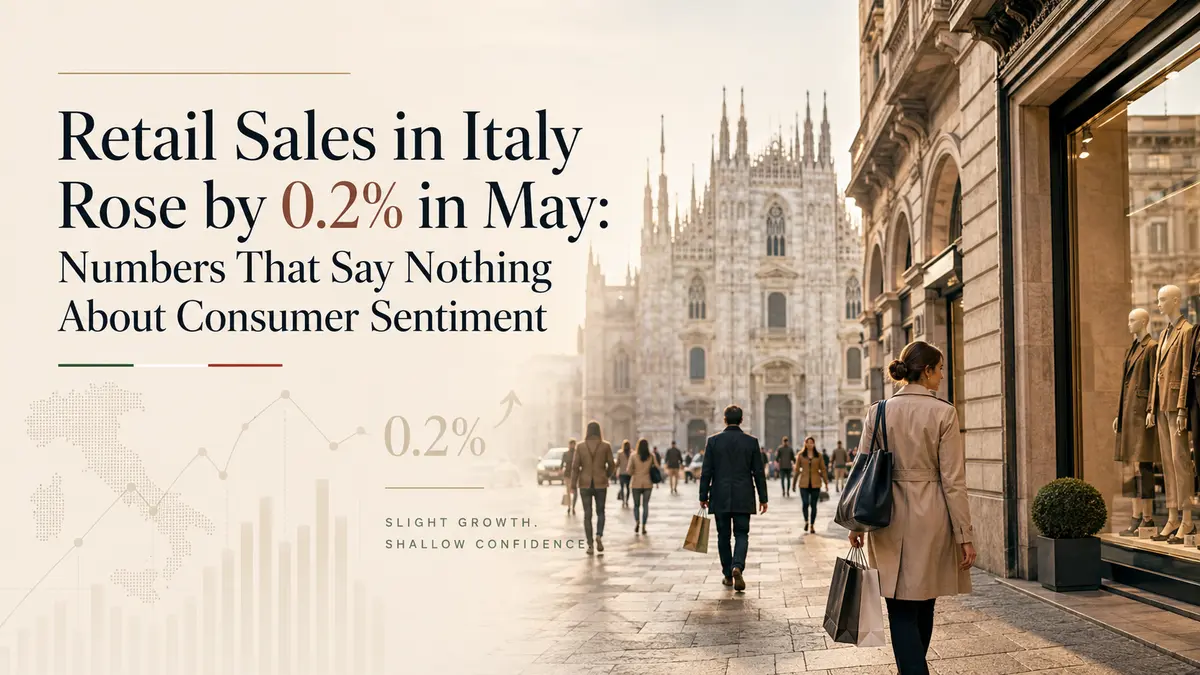
Friday. Rome, Milan, Naples — Italians are opening their wallets slightly wider than in previous months. The National Institute of Statistics, ISTAT, has published retail sales data for May, and the figures look… rather dull. Sales rose by 0.2% compared with April, when the indicator did not change at all. In annual terms, growth was 2.2%, slightly better than the revised April increase of 1.7%.
For the eurozone’s third-largest economy, this is neither a victory nor a defeat. It is more of a confirmation that the Italian consumer continues to spend, but without enthusiasm, without excitement, and without the confidence that drove markets in pre-COVID times.
Sales of food products increased by 0.2% month-on-month. Non-food goods also rose by 0.2%. Everything is even, everything is predictable, everything is within the margin of statistical error. Inflation in Italy, measured by the Harmonised Index of Consumer Prices, stands at 3.2% year-on-year. In other words, real sales growth, if inflation is deducted, is almost zero.
But let’s not rush to conclusions. Behind these dry figures lie many nuances: seasonal factors, regional differences, and consumer behavior patterns. And most importantly, the question of what these numbers say about the overall state of the Italian economy. Because retail sales are not just statistics — they are a mirror of consumer confidence, and consumer confidence is the engine of economic growth.
Let’s dig deeper. What really stands behind the 0.2% increase? Why is Italy, a country that has survived more than one crisis, now showing such sluggish momentum? And what does this mean for the future of the eurozone economy as a whole?
Figures and Context: What ISTAT Says
May vs. April: Stability Without Momentum
Let’s start with the most obvious point. Retail sales in Italy rose by 0.2% in May compared with April. In the previous month, it should be recalled, the indicator remained unchanged. So what we are seeing is not a trend reversal, but only a slight improvement after zero growth.
0.2% is a figure that falls within the margin of statistical error. In most developed economies, such a result would be considered “unchanged.” If ISTAT had announced that sales had not changed, no one would have been surprised. A 0.2% increase is more a sign that Italian consumers are not panicking, but they are not rushing to open their wallets either.
In annual terms, the picture is slightly more optimistic. Growth of 2.2% compared with May 2025 is better than April’s 1.7% increase, which was revised upward. The acceleration in annual dynamics suggests that, compared with last year, Italians have started spending a little more. But again, 2.2% is not the kind of pace that can restart the economy.
Especially when inflation is taken into account. Italy’s Harmonised Index of Consumer Prices stands at 3.2% year-on-year. This means that nominal sales growth of 2.2% actually indicates that the real volume of sales, measured in physical units, has declined. Italians are paying more for the same goods rather than buying more goods.
This is an important nuance that is often overlooked. ISTAT retail sales are expressed in value terms and do not account for changes in consumer prices. Therefore, when we see growth of 2.2%, we need to subtract inflation of 3.2% to understand how many goods were actually sold. And the real volume is negative.
Food and Non-Food Goods: The Same 0.2%
Interestingly, the structure of growth is even. Sales of food products increased by 0.2% month-on-month, and non-food goods also rose by 0.2%. This suggests that Italians are not changing the structure of their spending. They are not switching from food to clothing or vice versa. They are simply spending slightly more across all categories, but without clear preferences.
This is classic consumer behavior in times of uncertainty. When people lack confidence in tomorrow, they do not make sudden moves. They do not sharply reduce spending, but they do not begin making large purchases either. They simply continue spending roughly the same amount as before, with a slight adjustment for inflation.
The even growth in both food and non-food segments also suggests that Italians are not saving at the expense of consumption, but they are not increasing consumption at the expense of savings either. This is a middle ground, pointing to stable but non-growing prosperity.
Inflation: The Main Enemy of Retail Sales
Italian Inflation Is Above the Eurozone Average
Inflation in Italy stands at 3.2% according to the Harmonised Index of Consumer Prices. This is higher than the eurozone average, where inflation in May was around 2.8%. Italian consumers are facing faster price growth than their neighbors in Germany or France.
This can be explained by several factors. First, Italy is heavily dependent on energy imports, and although oil prices have declined, the effect of previous increases is still reflected in prices. Second, services inflation in Italy remains high due to rising wages and rental costs. Third, structural problems in the Italian economy — low labor productivity and high public debt — also contribute to price growth.
For retail sales, this means one thing: even when nominal sales growth exists, the real volume of sales declines. Italians are buying fewer goods but paying more for them. This is a classic inflationary trap that reduces household purchasing power and slows economic growth.
If inflation continues to remain at 3% or higher, retail sales may begin to decline in real terms. And that would no longer be mere stagnation, but a recession in the consumer sector.
Impact on Savings and Lending
High inflation also puts pressure on Italians’ savings. When prices rise faster than incomes, the real value of savings falls. Italians are forced either to spend more from their current income or to take out loans in order to maintain their usual level of consumption.
The Bank of Italy notes that growth in household lending has slowed in recent months. Italians have become more cautious about debt, especially against the backdrop of high interest rates. This limits the growth potential of retail sales, because consumers can no longer finance purchases through borrowed funds as they did during the years of low rates.
As a result, we see a vicious circle. Inflation reduces purchasing power, high rates restrict lending, and declining real incomes force people to economize. In this context, a 0.2% increase in retail sales even looks like a small victory.
What Lies Behind the Figures: Consumer Psychology
Consumer Confidence in Italy
To understand where retail sales are heading, we need to look inside the mind of the Italian consumer. And there, if surveys are to be believed, things are not so rosy. The consumer confidence index published by ISTAT has fluctuated in recent months but has not shown sustained growth.
Italians are concerned about political uncertainty, high taxes, the state of the economy, and, of course, inflation. The older generation in particular, which remembers past crises, prefers to save rather than spend.
On the other hand, young people and residents of northern regions, where the economy is more dynamic, tend to be more optimistic. But their share of total consumption is still not enough to reverse the overall trend.
Retail sales growth of 0.2% is precisely a reflection of this divide. Some people are saving, others are spending, but in the end the overall result is close to zero. And until something happens to change consumer psychology — for example, lower inflation or lower taxes — this sluggish dynamic will persist.
The Seasonal Factor
Seasonality is also important, although it is often ignored. May is a transitional month between spring and summer. Italians begin preparing for vacations, buying light clothing and food for picnics. But it is not the season when major purchases are usually made.
In June and July, when sales and holidays begin, retail sales may rise slightly. But this will be a seasonal fluctuation rather than a structural improvement. October, November, and December will again bring the peak before Christmas. So the 0.2% increase in May is more like a “breath” before the summer season than a signal of a turnaround.
Comparison with Neighbors: Italy vs. Europe
Italy in the Eurozone Context
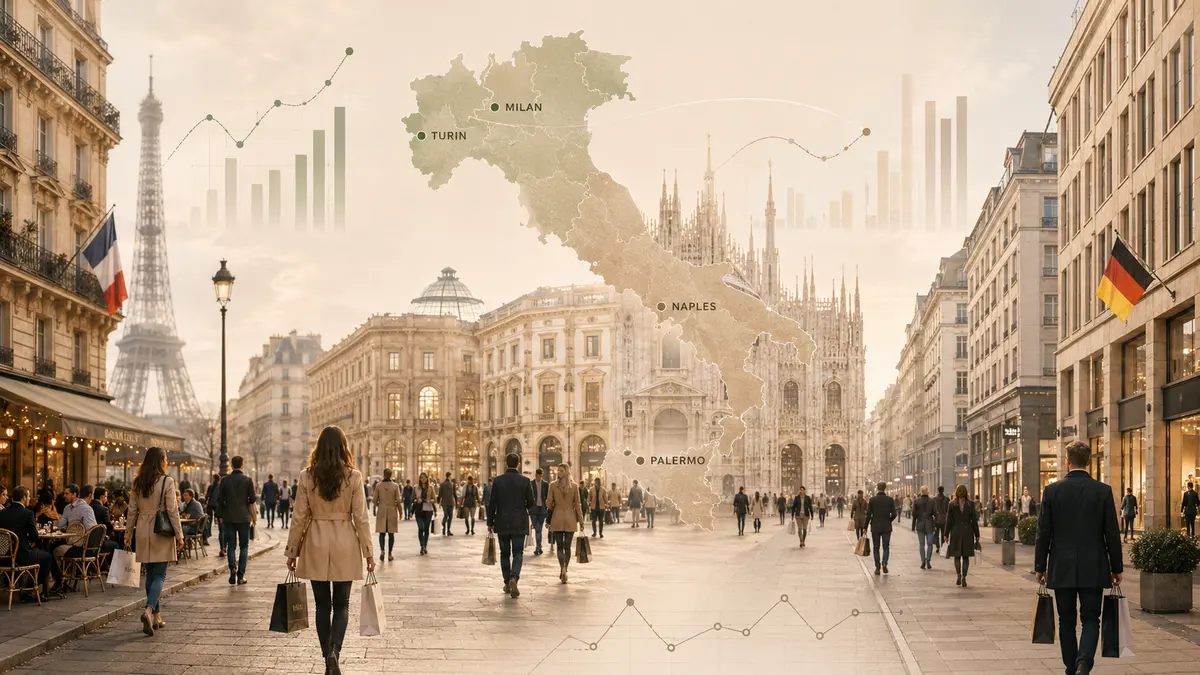
How does Italy look compared with other eurozone countries? In Germany, retail sales in May also showed weak momentum, but given lower inflation, real growth in Germany turned out to be slightly higher. In France, sales grew more strongly thanks to a tourism boom and pre-election spending.
Italy, as usual, finds itself somewhere in the middle. Not the worst, but not the best either. The Italian economy is an economy of “slow movement.” It grows slowly, reacts to changes slowly, and recovers slowly. But there is also an advantage to this: Italy rarely experiences sharp collapses because its consumers are used to saving and do not make abrupt moves.
On the other hand, Italy suffers from high public debt and political instability, which restrain investment and limit economic growth. Until these structural problems are resolved, retail sales are unlikely to show sustainable growth.
Geographical Differences Within the Country
It is important to note that Italy is not monolithic. The north, with its industrial centers such as Milan and Turin, demonstrates higher consumer activity than the south, where unemployment is higher and incomes are lower.
Retail sales in the north are growing faster than in the south. This is due to higher employment, higher wages, and a more diversified economy. In the south, consumers are more cautious, more dependent on government transfers, and more sensitive to inflation.
In ISTAT data, these regional differences are usually averaged out. Therefore, the overall growth of 0.2% may conceal stronger growth in the north and a decline in the south. To understand the real picture, one needs to look at regional data, but it is published with a delay.
What Awaits Italy in the Second Half of the Year
Forecasts and Scenarios
The second half of 2026 may bring both pleasant and unpleasant surprises for Italian consumers. On the one hand, inflation is expected to continue declining, which would increase real purchasing power. On the other hand, uncertainty in the global economy, especially in China and the United States, may affect Italian exports and, consequently, household incomes.
The ECB, as expected, may begin cutting rates in the second half of the year, which would ease access to credit and support consumer spending. But this easing will be gradual, and its effect will not appear immediately.
The Italian government may also take steps to support consumption, such as lowering taxes or increasing social payments. But budget constraints linked to high public debt narrow the room for maneuver.
Long-Term Trends
In the long term, retail sales in Italy will depend on two factors: demographics and structural reforms. An aging population means a shrinking number of consumers, especially in the durable goods segment. Young people are moving abroad, and this reduces domestic demand.
Structural reforms aimed at increasing labor productivity, lowering taxes, and improving the business climate could reverse this trend. But such reforms require political will, which Italy does not always have enough of.
For now, the Italian consumer remains cautious, and the May data only confirms this long-term trend. Sluggish growth of 0.2% is not an accident, but a pattern for an economy balancing between stagnation and slow recovery.
Conclusion: 0.2% Is Neither a Victory nor a Defeat
Retail sales in Italy rose by 0.2% in May. This is not the kind of figure that sparks strong emotions. It is not a decline that frightens investors, and it is not a surge that inspires optimism. It is simply a reflection of reality: the Italian consumer spends exactly as much as needed to survive, and a little more to feel human.
In annual terms, growth of 2.2% sounds better, but inflation of 3.2% wipes out that increase. In reality, Italians are buying roughly as much as they did a year ago, perhaps even slightly less. And this is happening at a time when the eurozone economy as a whole is showing signs of recovery.
What does this mean for the future? For now, nothing catastrophic. Italy is not in recession, its consumers are not panicking, and the economy is not collapsing. But it is not growing either. It is simply existing, waiting out uncertainty and hoping for better times.
Those better times may come if inflation continues to fall, the ECB begins to ease policy, and the Italian government implements the necessary reforms. But until that happens, Italians will continue spending exactly 0.2% more each month — no more and no less.
And this, perhaps, is the main lesson of the Italian economy: it does not know sharp rises or falls; it knows only a slow, measured, and predictable step forward. Sometimes this step is slightly longer, sometimes slightly shorter, but it never turns into a run. And perhaps that is not so bad after all.

Comments
No comments yet. Be the first to share your thoughts!
Authentication Required
You must be logged in to post a comment.