

Starmer Is Out. Germany’s PMI Just Missed Badly. And EUR/USD Is Pinned Below 1.4100 With the ECB Having Just Hiked Into a Contraction
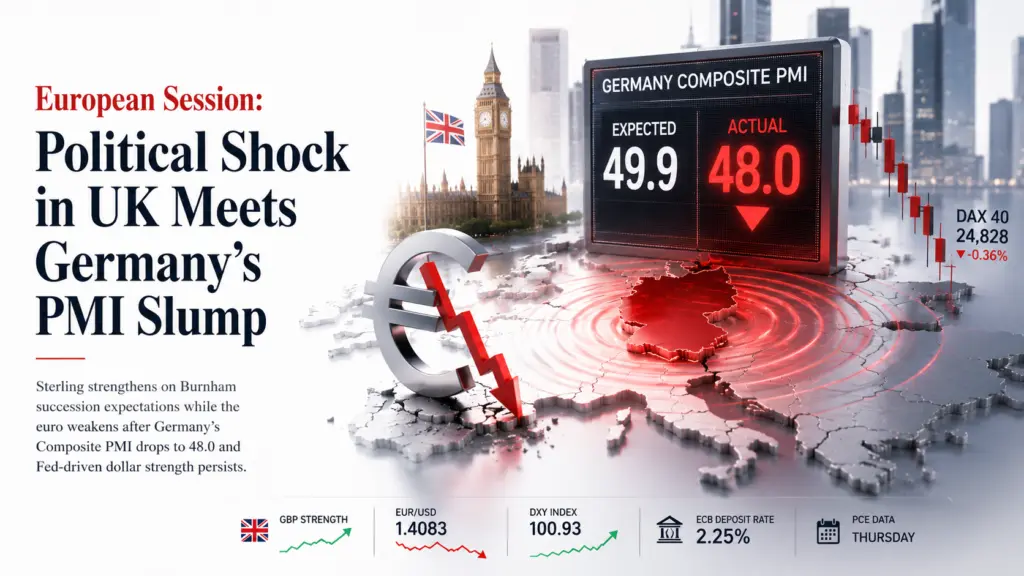
Two events landing simultaneously: UK Prime Minister Keir Starmer resigns and Andy Burnham is frontrunner for No. 10. Germany’s June Composite PMI slumps to 48.0 against 49.9 expected, with services collapsing to 46.8. EUR/USD at 1.4083 is stalling below 1.4100 resistance. Sterling is outperforming on political clarity. And the ECB has just hiked into a private sector contracting for the third month running.
There are sessions where the macro and the political arrive simultaneously and create a genuinely complex picture — and Tuesday’s European session is exactly that. UK Prime Minister Keir Starmer has confirmed his resignation, becoming the seventh British leader in a decade. Andy Burnham, the former Mayor of Greater Manchester, is the frontrunner to succeed him, with Wes Streeting’s endorsement carrying significant weight in the Labour party’s internal succession. Sterling is bid on the news — not because Burnham is inherently bullish for GBP, but because political uncertainty is worse for a currency than an orderly succession, and the market is pricing the orderly version.
At the same moment, Germany’s June flash Composite PMI landed at 48.0 — a reading below 50 signals contraction — against a 49.9 consensus and a prior reading of 48.8. The services component was the real shock: 46.8 versus 48.7 expected. This is the third consecutive month of private-sector contraction in Germany, and it lands in a week when the ECB — which just raised rates to 2.25% on June 11 for the first time since 2023 — is being watched closely for signals about whether a July follow-up is still credible. The PMI answers that question with uncomfortable clarity: the economy is not withstanding higher rates as smoothly as Philip Lane suggested.
Germany’s PMI at 48.0 is the third consecutive month of contraction. The ECB hiked two weeks ago. These two facts are in direct tension — and EUR/USD at 1.4083 reflects the market’s difficulty in reconciling them.
Starmer Resigns: What It Means for GBP
Keir Starmer’s resignation confirms what sterling traders had been pricing with increasing conviction over the past three weeks: the combination of local election losses, internal Labour dissent, and a government that had been struggling to articulate a coherent economic message had made his position untenable. Andy Burnham as frontrunner is the market’s preferred outcome — not because Burnham’s economic programme is dramatically different from Starmer’s, but because he represents a clean break with a government that had been creating policy uncertainty rather than resolving it.
EUR/GBP at 0.8630 falling on the news is the key tell. EUR/GBP declining means sterling is outperforming the euro, which makes sense: the ECB’s PMI headwind is a EUR-negative, and the Starmer resignation is a GBP-positive in relative terms because it removes a source of uncertainty. GBP/USD’s direction from here depends on whether Andy Burnham moves quickly to articulate a coherent fiscal framework and whether the BoE — currently on hold at 4.25% — interprets the political transition as a reason to wait longer before signalling cuts. A Burnham government that signals infrastructure spending and growth focus would be modestly GBP-supportive over weeks; the near-term uncertainty of the transition itself is the short-term headwind.
GBP/USD Direction: Cautiously bullish on political clarity; BoE 4.25% unchanged; Burnham succession orderly
EUR/GBP: Declining on Starmer departure; ECB PMI headwind vs GBP political relief
Key Watch: Speed of Burnham succession + first fiscal signals from new leadership
Germany PMI 48.0: The ECB’s Policy Error Question
Germany’s June Composite PMI at 48.0, with services at 46.8, is the hardest single data point the ECB has received since its June 11 hike. The central bank hiked to 2.25% citing persistent energy-driven inflation. The argument was credible — Eurozone CPI was at 3.0% for 2026 in ECB forecasts, and Pierre Wunsch was flagging a possible July follow-up. What the PMI says is that the transmission mechanism is working faster than expected: higher rates are already compressing services activity in the Eurozone’s largest economy.
The Eurozone Composite PMI came in at 49.5 — a modest recovery from prior months, and still below 50 — which confirms that Germany’s weakness is the dominant force in the regional picture. EUR/USD at 1.4083 stalling below the 1.4100 resistance reflects this. The 200-period SMA is the ceiling; MACD is in negative territory; RSI is at approximately 38. The technical picture is saying the same thing as the fundamental: the euro cannot rally convincingly when the ECB is trying to fight inflation in an economy that is contracting.
The path for EUR/USD depends on Wednesday’s ECB speaker slate. If Lagarde or Wunsch explicitly signal that the PMI data changes the calculus for July — either by softening the hike probability or by reiterating it despite the contraction — EUR/USD responds immediately. A July hike signal maintained despite 48.0 PMI = ECB credibility over growth, EUR modestly supported. A walk-back of July guidance = ECB capitulating to data, EUR weakens below 1.4000.
EUR/USD: 1.4083 — capped below 1.4100; 200-period SMA resistance; RSI 38
Direction: Neutral to bearish; PMI miss challenges ECB July hike narrative
Entry (Long): 1.3950–1.4000 — buy the PMI-driven dip if ECB speakers hold July signal
Stop Loss: 1.3880 — below structural support; ECB walks back July guidance
Take Profit: 1.4200 — resistance zone; July hike confirmed
DAX at 24,828: When Good Global News Meets Bad German Data
The DAX at 24,828 is down 0.36% in a session where the global backdrop is constructive — Iran-US talks progressing, oil stable, Nikkei firm — but the domestic data is uncomfortably weak. Germany’s 48.0 PMI is directly relevant to DAX earnings: the industrial and export-oriented names that dominate the index are the same names that are being squeezed by both higher ECB rates and softening domestic demand. The index is caught between a global tailwind (peace process, lower energy, AI cycle) and a domestic headwind (PMI contraction, ECB tightening).
The session’s DAX level of 24,828 is approximately 2.6% below January’s record high of 25,508. The record-high retest thesis is not broken by today’s PMI — but it is delayed. The 24,500 to 24,600 support zone is where the structured long entry sits for any trader who wants exposure to the global tailwinds without chasing the current level. The stop at 23,900 is below the structural floor that has held across June. The 10,800 FTSE target analogy: DAX’s equivalent is the 25,400 to 25,500 zone as a week-end target if the global picture holds.
DAX Direction: Neutral-Cautious; buy dips to 24,500–24,600 while global tailwinds hold
Support: 24,500–24,600 — structured long entry
Stop: 23,900 — below June structural floor
Target: 25,400–25,500 — approach to January record high
Silver at $62.40: Past the Entry Point
Silver at $62.40 per ounce has reached the accumulation zone that CSFX identified weeks ago as the industrial demand floor. The $63 to $65 range was the level where solar photovoltaic contacts, EV battery components, and AI data centre power infrastructure create a structural bid that is indifferent to the Fed’s dot plot. Silver is now trading inside that zone, which means the conditional long entry at $63 has been triggered. The question now is whether $62.40 is the floor or whether the hawkish Fed and strong dollar push through $61.50 toward $59.50, which would be the next structural support.
CSFX’s read: $62.40 is within the accumulation zone, not a breakdown. The stop at $59.50 — below the $61.50 structural support — remains the risk definition. The target at $70.73 remains the prior pivot zone. Thursday’s PCE is the macro gate: a hot print extends the dollar and pushes silver toward $61.50 before the industrial floor absorbs it; a soft print triggers a sharp silver recovery above $65. At $62.40, the risk-reward on the long is 1:2.2 from current price to the stop and target respectively.
Silver Direction: Accumulate at current $62.40; conditional long entry triggered
Entry: $62.40–$63.00 — within the industrial demand floor zone
Stop Loss: $59.50 — below $61.50 structural support
Take Profit: $70.73 — prior pivot zone; 1:2.2 risk-reward from entry
Week Gate: PCE Thursday — hot = $61.50 tested first; soft = recovery above $65
NatWest at £5.34: Political Risk and a 60% Annual Run
NatWest Group at £5.34 is 60% above its 52-week low and has been one of the FTSE’s strongest performers in 2026. That run has been driven by the same tailwinds that lifted the entire UK banking sector: a BoE that stayed hawkish longer than expected, keeping net interest margins elevated; a consumer that proved more resilient than feared; and the removal of the government’s shareholding overhang as the privatisation completed. The Starmer resignation introduces a near-term uncertainty variable that the market is pricing modestly into the stock — not because Burnham is inherently hostile to the sector, but because any change in government creates uncertainty about financial regulation priorities.
The structured trade: the stock is not a short on the Starmer resignation, but it is not a chase at current levels either. The 500p to 510p support zone — the prior consolidation range from April — is the add level if the political transition creates a brief dip. The BoE holding at 4.25% maintains the net interest margin support that has been the fundamental anchor for the sector.
Ethereum at $1,648 and BNB at $572: Crypto’s Risk-Off Session
Ethereum at $1,648.50 and BNB at $572.16 are both softer in Tuesday’s session as the hawkish Fed repricing and dollar strength create a risk-off tone across crypto assets. The ETH exchange supply sitting at record lows and the institutional accumulation thesis — BitMine’s 126,000 ETH purchase at year lows being the clearest signal — remains intact as a medium-term floor. Ethlabs pushing institutional ETH adoption as a corporate treasury asset is the structural story that the PMI or the Starmer resignation does not change.
BNB at $572 with BNB Chain TVL stable above $5 billion is a similar picture: the on-chain fundamentals are holding while the macro risk-off creates the price discount. The $1,650 to $1,750 ETH accumulation band that CSFX identified remains the framework. Thursday’s PCE is the macro gate for both assets: soft print = crypto risk-on recovery, hot print = both assets test their lower supports.
EU 30-Year Bund at 3.489%: The Long End Is Pricing Something
The EU 30-year Bund yield at 3.489% is notable because it is rising even as the PMI data argues for a softer ECB path. That divergence — long yields rising while growth data misses — is the classic stagflation signal in sovereign bond markets. The ECB hiked into a contraction. The market is now pricing both the near-term inflation persistence (hence higher yields) and the medium-term growth risk (hence the ECB policy error narrative). This is the Bund yield trading like Italian BTPs — not just pricing the ECB rate path, but also pricing a risk premium on whether the ECB has made a mistake.
For EUR/USD traders, the EU 30-year yield at 3.489% is an additional complicating factor: higher yields are nominally EUR-supportive, but if they reflect stagflation risk rather than hawkish ECB credibility, the support is hollow. The week’s decisive read on which interpretation is correct: ECB speakers Wednesday and PCE Thursday. Those two events will tell you whether the EUR/USD long from 1.3950 is a trade with an ECB credibility floor or a trade that needs to be reassessed at 1.3880.
─
Read Full Report: capitalstreetfx.com/market-analysis/daily-market-analysis/

Comments
No comments yet. Be the first to share your thoughts!
Authentication Required
You must be logged in to post a comment.