

Elixiron vs. Alzheimer’s: A Taiwanese Hope Based on a Tiny Sample of Seven Patients
A Quiet Revolution in Cambridge and Taipei
In a world where headlines are dominated by missile strikes, falling cryptocurrencies, and corporate scandals, some stories pass almost unnoticed. They do not flood social media feeds, cause traders to panic, or provoke angry political commentary. Yet these are often the stories that truly change the world—stories about science, medicine, and victories over diseases that once seemed like an unavoidable sentence.
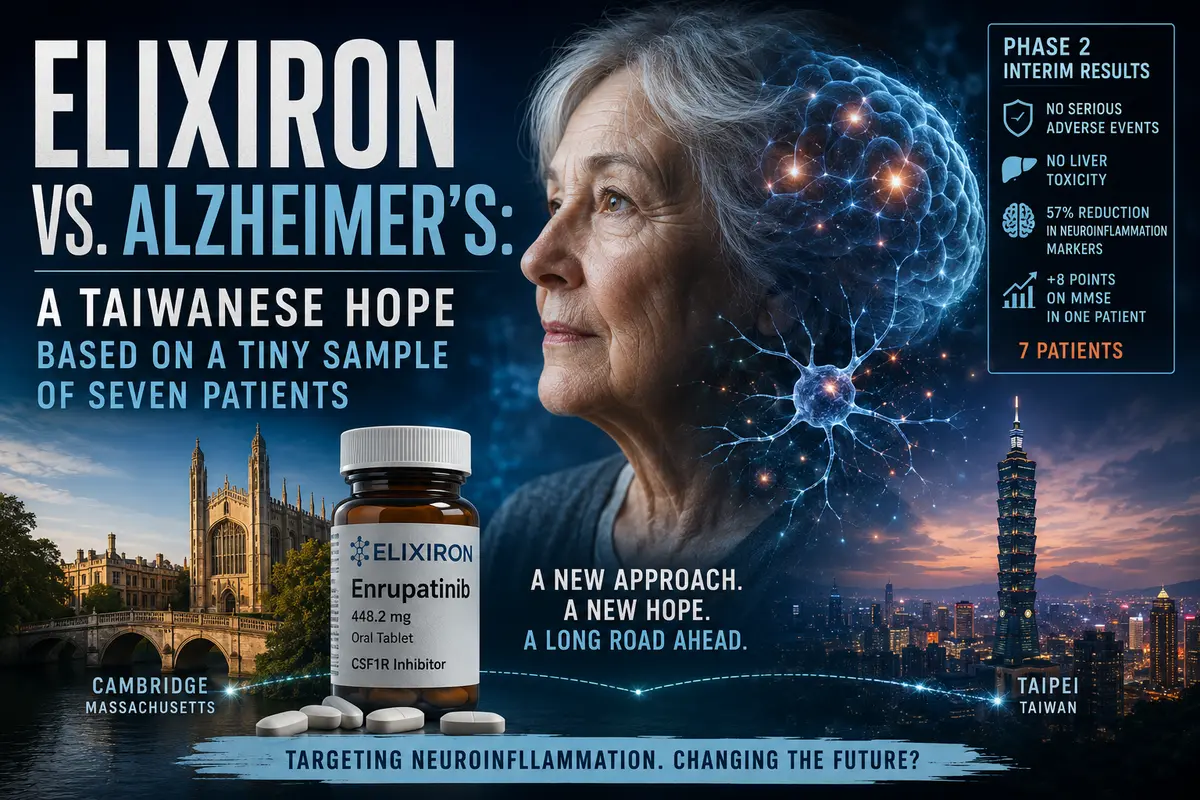
One such story has emerged from Cambridge, Massachusetts, and Taipei. Elixiron Immunotherapeutics, a company listed on the Taiwan Stock Exchange (ticker: 7871), has announced interim results from a Phase 2 clinical trial of its drug, enrupatinib, for the treatment of Alzheimer’s disease.
Alzheimer’s is a devastating illness that slowly extinguishes patients’ lives while turning their loved ones into helpless witnesses.
For now, these are only interim data. The evaluable group consists of just seven participants. The study is open-label, with no placebo group and no blinding. The scientific community—hardened by thousands of failed Alzheimer’s trials—approaches such announcements with caution bordering on cynicism. How many “breakthroughs” have collapsed under the weight of larger, more rigorous studies? Far too many.
Yet there is something in Elixiron’s data that has made even skeptics take notice: the absence of serious adverse events, the absence of hepatotoxicity (liver toxicity) that doomed many previous drugs in the same class, a reduction in neuroinflammation markers in 57% of participants, and one patient who improved by 8 points on the MMSE (Mini-Mental State Examination).
Eight points.
For those unfamiliar with the MMSE, it is a widely used cognitive assessment scored out of 30 points. A decline of 2–4 points per year is considered typical progression for Alzheimer’s disease. An improvement of 8 points could represent a shift from moderate dementia to mild impairment—or even a return toward normal cognitive function.
Of course, this is a single case. But it offers hope.
Let’s examine what enrupatinib is, how it works, why these interim data matter, and what risks remain.
What Is Alzheimer’s Disease and Why Is It So Difficult to Treat?
Alzheimer’s disease is far more than simple memory loss. It is a neurodegenerative disorder in which brain cells (neurons) gradually die.
It often begins with forgetfulness, then progresses to disorientation, inability to recognize loved ones, loss of speech, difficulty swallowing, respiratory decline, and ultimately death. From the first symptoms to the end, the disease typically unfolds over 8–10 years. During that time, both patients and families endure an immense burden.
The causes remain incompletely understood.
For decades, the dominant explanation was the amyloid hypothesis, which proposes that plaques made of amyloid protein accumulate in the brain and kill neurons. Based on this theory, pharmaceutical companies invested billions of dollars in clinical trials.
The outcome? Most failed.
Amyloid-targeting drugs, such as Biogen’s aducanumab, demonstrated limited effectiveness while raising significant safety concerns. Their approvals were met with substantial controversy.
Today, many researchers increasingly suspect that amyloid may be a consequence rather than the sole cause of the disease.
Attention has shifted toward microglia, the brain’s immune cells. Under normal circumstances, microglia protect the brain from infection and clear away cellular debris. In Alzheimer’s disease, however, they may become chronically activated, releasing inflammatory molecules and damaging healthy neurons.
In effect, the brain begins attacking itself.
This is the theory behind Elixiron’s approach.
Enrupatinib is a CSF1R inhibitor. CSF1R is a receptor found on microglial cells. By blocking this receptor, enrupatinib is designed to calm overactive microglia, reduce neuroinflammation, and potentially slow—or even reverse—neuronal damage.
This is not an amyloid-centered strategy.
It is an immunological strategy.
And it is gaining scientific credibility.
Phase 2 Results: What Seven Patients Revealed
The trial announced by Elixiron is currently in Phase 2, the stage where a drug is first tested in patients with the target disease rather than healthy volunteers.
The goals of Phase 2 studies are to assess:
-
Safety
-
Tolerability
-
Preliminary efficacy
-
Optimal dosing
In this study, patients with mild to moderate Alzheimer’s disease received 448.2 mg of oral enrupatinib twice daily for 28 days.
That is a relatively high dose, making the favorable tolerability profile particularly noteworthy.
Key Findings
Safety
No serious treatment-related adverse events were reported.
Importantly, researchers observed no clinically significant liver toxicity, a major issue that has hindered development of several earlier CSF1R inhibitors.
Reduction in Neuroinflammation
Among a biomarker-selected subgroup of seven participants with confirmed neuroinflammation:
-
80% demonstrated more than a 30% reduction in TSPO-PET imaging signals across multiple brain regions.
TSPO is a protein associated with activated microglia. Lower TSPO signals suggest reduced inflammation.
In the posterior cingulate cortex and precuneus—regions critically involved in memory—the reduction reached statistical significance.
In a broader group of participants with evaluable PET scans, regardless of biomarker selection:
-
57% showed reductions in neuroinflammation relative to baseline.
In other words, more than half of the patients exhibited a measurable biological response.
Cognitive Effects
The study was not designed to evaluate cognitive efficacy. Proper assessment would require:
-
Larger sample sizes
-
Placebo controls
-
Longer follow-up periods
Nevertheless, Elixiron reported one participant who showed both a TSPO-PET response and an 8-point increase in MMSE score.
An 8-point gain is substantial.
If not attributable to chance, measurement artifacts, or practice effects from repeated testing, it could indicate a clinically meaningful improvement.
A Potential Predictive Biomarker
The company also announced that preliminary analyses identified a biomarker capable of predicting which patients are likely to respond to treatment.
The biomarker has not yet been disclosed.
However, its potential significance is considerable.
Alzheimer’s disease is highly heterogeneous, with different biological mechanisms driving disease in different patients. If researchers can identify likely responders in advance, treatment effectiveness within the target population could improve dramatically.
Elixiron plans to use this biomarker in future participant selection.
The Limitations: Seven Patients and an Open-Label Design
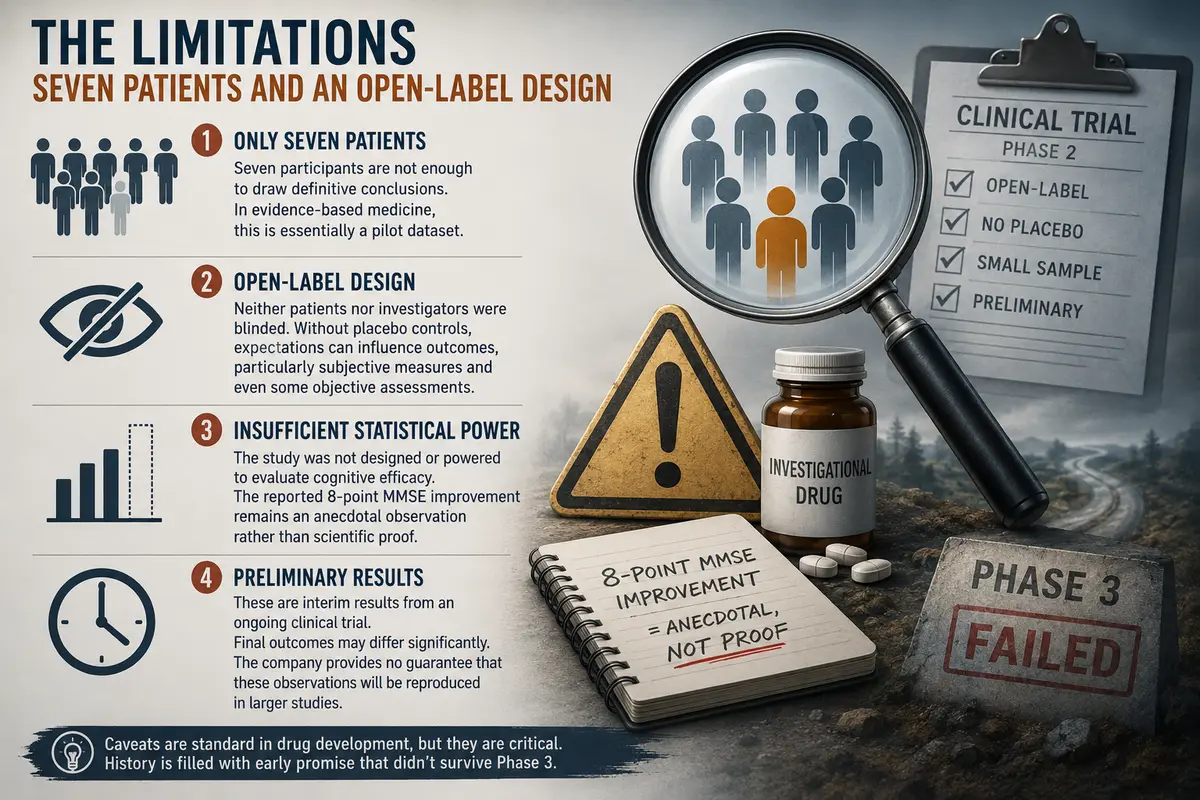
The company openly acknowledges several major limitations that are often overlooked in media coverage.
1. Only Seven Patients
Seven participants are not enough to draw definitive conclusions.
In evidence-based medicine, this is essentially a pilot dataset.
2. Open-Label Design
Neither patients nor investigators were blinded.
Without placebo controls, expectations can influence outcomes, particularly subjective measures and even some objective assessments.
3. Insufficient Statistical Power
Elixiron explicitly states that the study was not designed or powered to evaluate cognitive efficacy.
The reported 8-point MMSE improvement remains an anecdotal observation rather than scientific proof.
4. Preliminary Results
These findings are interim results from an ongoing clinical trial.
Final outcomes may differ significantly.
The company provides no guarantee that these observations will be reproduced in larger studies.
Such caveats are standard in pharmaceutical development, but they are critical.
History is filled with promising early-stage Alzheimer’s therapies that ultimately failed in Phase 3.
Support from the Alzheimer’s Association
One factor that distinguishes this study is support from the Alzheimer’s Association through its Part the Cloud program.
Part the Cloud was created specifically to fund innovative, high-risk Alzheimer’s research that might struggle to attract commercial investment.
Elixiron’s project was selected from numerous applicants.
That selection carries weight: experts in Alzheimer’s research judged the company’s approach worthy of serious investigation.
The program frequently supports unconventional ideas, and its backing suggests that the neuroinflammation-CSF1R hypothesis is being taken seriously within the scientific community.
What Comes Next?
Elixiron has announced plans to launch a placebo-controlled study using the newly identified biomarker to select participants.
This next stage will likely involve:
-
Larger patient populations
-
Multiple research centers
-
Randomization
-
Blinding
Such a trial should provide a far more definitive answer regarding whether enrupatinib works.
If successful, the company could pursue regulatory approval in:
-
The United States
-
Europe
-
Japan
-
Other global markets
That process would still take years.
If unsuccessful, enrupatinib will join the long list of experimental Alzheimer’s drugs that failed despite early promise.
What This Means for Patients and Families
For millions living with Alzheimer’s disease—and for those who care for them—any news of a potential therapy matters.
Even if it involves only seven patients.
Even if the findings are preliminary.
Because hope remains essential.
Alzheimer’s is not merely the loss of memory.
It is the loss of identity.
A person you have known your entire life may gradually stop recognizing you. They may become confused, fearful, aggressive, or withdrawn. Eventually they may lose the ability to speak, eat, and breathe independently.
And throughout that decline, families often have little they can do.
Current treatments primarily address symptoms. None reliably halt disease progression.
That is why therapies targeting underlying disease mechanisms attract so much attention.
Enrupatinib is one among many experimental candidates, but it has several potential advantages:
-
Oral administration (tablets rather than injections)
-
Favorable tolerability so far
-
A mechanism targeting microglia and neuroinflammation rather than amyloid
If neuroinflammation proves central to Alzheimer’s pathology, this strategy could ultimately prove more effective than previous approaches.
What Are Experts Saying?
Independent experts have responded with cautious optimism.
One neurologist from the University of California, speaking anonymously to a medical publication, summarized the sentiment:
“We need replication. We need larger studies. But for the first time in a long while, I’m seeing data that make me think we may be moving in the right direction.”
Another specialist in neuroimaging highlighted the TSPO-PET findings:
“A 30% reduction in signal is biologically meaningful. The question is whether that reduction translates into clinical improvement. We’ll likely know the answer in a few years.”
Critics note that Elixiron has not yet released complete patient-level data for all seven participants.
One patient improved by 8 MMSE points—but what happened to the other six?
Did they improve?
Remain stable?
Decline?
Those details remain unavailable.
The company has stated that more comprehensive data will be presented at scientific conferences.
For now, what we have is a press release, seven patients, and a measure of hope.
Conclusion: A Small Step for Science, a Significant Step for Hope
Elixiron Immunotherapeutics has done what every responsible biotechnology company should do: publish interim clinical findings.
The results are encouraging—but no more than that.
Approval, if it ever comes, remains years away.
Patient access would take even longer.
Yet in a field marked by decades of disappointment, every positive signal matters.
Enrupatinib could become one of the first drugs in a new generation of therapies targeting neuroinflammation.
Or it could share the fate of many promising predecessors.
Either way, the research continues.
A placebo-controlled trial is being planned.
The Alzheimer’s Association continues funding high-risk, high-reward projects.
Millions of patients and families continue waiting.
And while they wait, news from seven participants in Cambridge and Taipei offers a small but meaningful ray of light—a reminder that even in one of medicine’s most difficult battles, progress remains possible.

Comments
No comments yet. Be the first to share your thoughts!
Comments only for logged-in users.