

A Quiet Hunt for Its Own Shares: Why Futu Is Buying Back $300 Million Worth of Stock
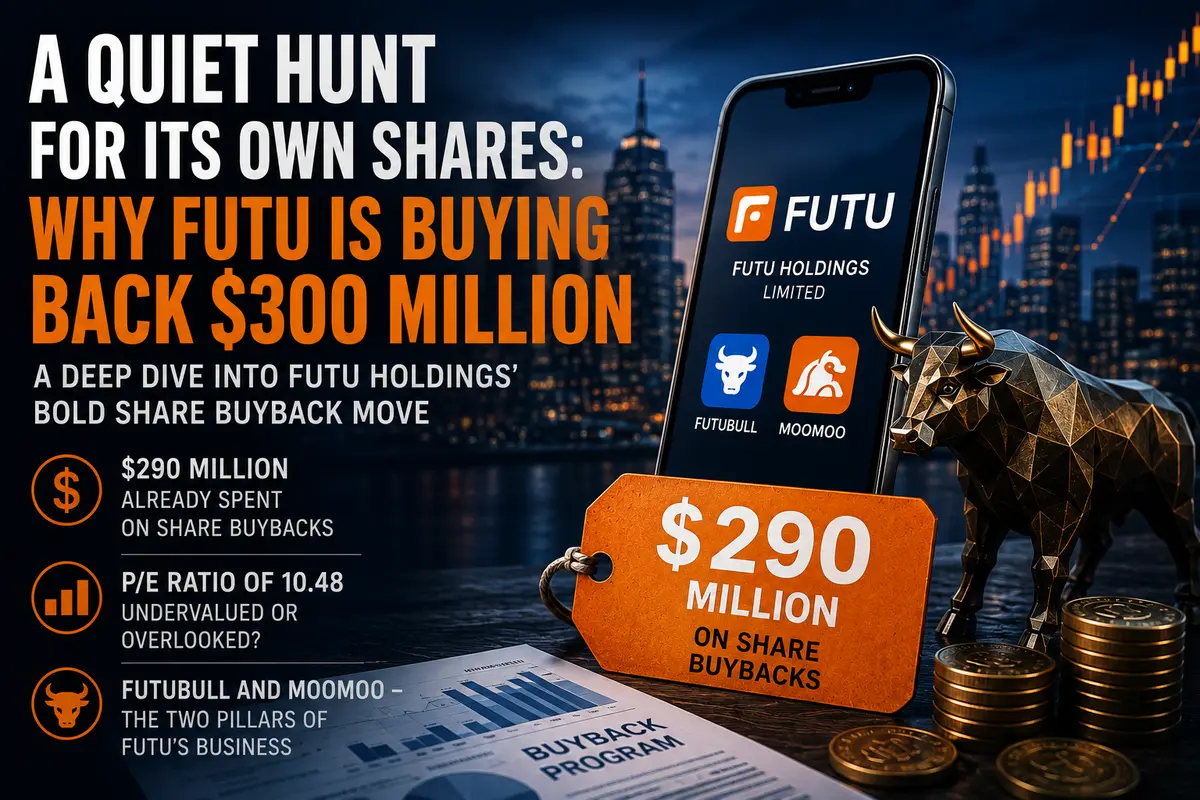
There is a gesture in corporate finance that says more about management sentiment than any press release ever could. That gesture is a share buyback. When a company spends real cash to repurchase its own stock, it is not merely returning capital to shareholders. It is telling the market: we believe our shares are undervalued. And when a company like Futu Holdings puts $290 million on the table, it deserves attention.
$290 Million as a Statement of Intent
The figure is impressive, though not record-breaking. $290 million represents roughly 2% of Futu’s current market capitalization, which stands at more than $15 billion. At first glance, 2% may not sound like much. But in the context of the buyback program announced last November, it is already a substantial tranche. The total authorization amounts to $800 million through the end of 2027. Futu has already used more than one-third of that allocation in the first year alone. The pace signals determination.
Management is not merely making declarations. It is acting. The company’s press release is dry and restrained, yet between the lines one can sense confidence: the company “may continue repurchases depending on market conditions.” No promises, no guarantees. But the mere fact that the company has already spent nearly $300 million speaks louder than words. Internally, management’s valuation of its own stock is clearly higher than the market’s.
A P/E Ratio of 10.48: Undervalued or Hiding Problems?
Futu trades at a price-to-earnings ratio of 10.48. For a technology-driven financial services company, that is a modest valuation. By comparison, American brokerage platforms such as Charles Schwab or Interactive Brokers often trade at multiples in the high teens or above twenty. Chinese technology companies have historically traded at P/E ratios of thirty or even forty. Yet here we have a multiple of barely ten and a half. Either the market sees risks that are not immediately obvious, or Futu is genuinely undervalued.
Their fair value model suggests that Futu shares are trading below intrinsic value. That is not a guarantee of future appreciation, but it is a signal that management clearly takes seriously. When you have an active buyback program and the market values your company below what you believe it is worth, you buy. That is not charity. It is rational capital allocation.
Still, there is a darker side to the story. The recent decline in the stock price mentioned in the company’s statement did not happen without reason. The market may be worried about regulatory risks in China, which have repeatedly hammered technology stocks in recent years. Investors may also be uneasy about the broader Chinese economy — the property crisis, weak consumer demand, and uncertainty surrounding trade tensions. Others may fear that capital outflows from emerging markets, fueled by the Iran conflict and high U.S. interest rates, could hurt Futu’s client base. There are plenty of reasons for caution. But management, judging by its actions, appears to view these risks as temporary.
Futubull and Moomoo: The Two Pillars of Futu’s Business
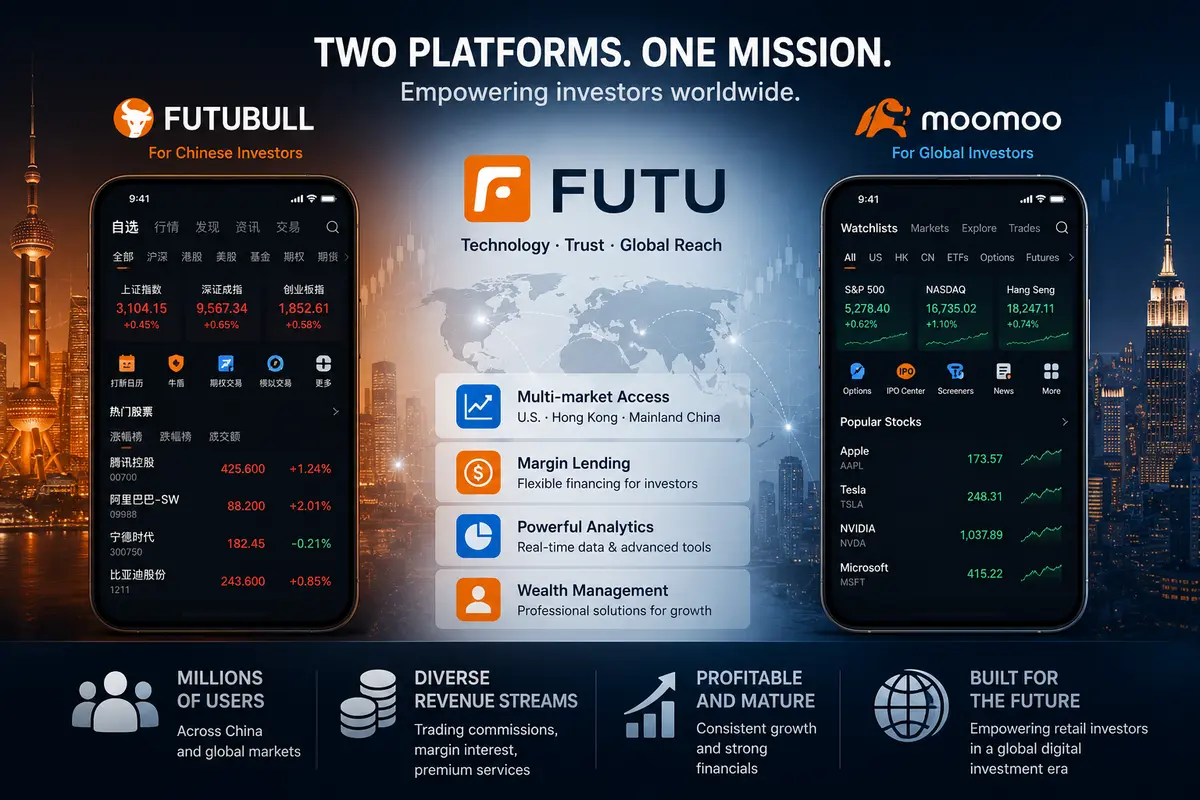
To understand what exactly Futu is buying with its $290 million, one must look at the business itself. The company operates two core platforms: Futubull, aimed primarily at the Chinese market, and Moomoo, which targets an international audience. Both platforms offer essentially the same services: order execution on U.S., Hong Kong, and mainland Chinese exchanges, margin lending, analytics, and wealth management tools.
This is not a startup searching for a viable business model. It is a mature, profitable business with millions of users and stable revenue streams. Futu earns money from trading commissions, interest on margin loans, and premium services for active traders. In an era when retail investors around the world are opening brokerage accounts and entering financial markets, this kind of business should thrive. And it does thrive — though the market seems oddly indifferent to that fact.
Buybacks in Theory and in Practice
The theory behind share buybacks is simple. A company reduces the number of shares outstanding. Earnings per share automatically increase, even if total profit remains unchanged. This supports the stock price and rewards remaining shareholders. In addition, buybacks send a signal: management is confident in the company’s future and believes the current share price is attractive.
In practice, however, buybacks are more complicated. Not all repurchase programs are beneficial. Some companies borrow heavily to buy back stock, increasing debt and financial risk. Others use buybacks to offset shareholder dilution caused by executive stock option programs. Still others simply misjudge fair value and repurchase shares at inflated prices, ultimately destroying shareholder value.
Futu, based on available information, does not appear to fall into any of these categories. The company is repurchasing shares with its own cash rather than borrowed money. The buyback program has clear limits and a defined timeline. A P/E ratio near ten and a half genuinely looks low for a technology-focused brokerage platform. And if management’s assessment is correct, shareholders who remain invested after the program is completed could benefit substantially.
What Comes Next
From the original $800 million authorization, $510 million remains available through the end of 2027. The pace of spending during the first year suggests that management has little interest in dragging the process out. If market conditions remain favorable for repurchases, the program could be completed ahead of schedule.
But there is also an alternative scenario. If markets rally, Futu’s shares appreciate, and the P/E multiple no longer looks especially attractive, management may slow down the pace of repurchases or suspend them altogether. After all, the company explicitly reserves the right to act “depending on market conditions.” A buyback is not an obligation — it is an option. And that option will be exercised only when management believes it is most beneficial for the company and its shareholders.
For now, however, $290 million is already on the table. That is a meaningful sum and a meaningful signal. Futu is not loudly proclaiming that its shares are undervalued in flashy headlines. It is simply and methodically buying back its own stock. And perhaps that is the most eloquent statement a company can make to the market.

Comments
No comments yet. Be the first to share your thoughts!
Authentication Required
You must be logged in to post a comment.