

Understanding Liquidity — Why Order Book Depth and Bid-Ask Spreads Matter
Understanding Liquidity — Why Order Book Depth and Bid-Ask Spreads Matter
If you ask a retail trader why market prices move, you will almost certainly hear that it happens because there were more buyers than sellers on a given chart candle. On its face, that explanation sounds reasonable enough, but it completely misses how modern electronic exchanges actually match transactions. On any centralized exchange or matching engine, every single executed trade requires an exact one-to-one pair: precisely one buyer for every seller. Volume is always perfectly balanced at the instant of execution.
What actually drives price discovery and causes asset valuations to shift is not the raw head-count of market participants, but the structural availability and distribution of liquidity. Specifically, price changes occur when aggressive market orders consume passive limit orders sitting in the exchange’s matching queue. Understanding this dynamic—how order book depth absorbs or fails to absorb incoming flow—is the single most important prerequisite for mastering trade execution, risk management, and order flow analysis.
The Matching Engine Architecture: Bids, Asks, and Order Types
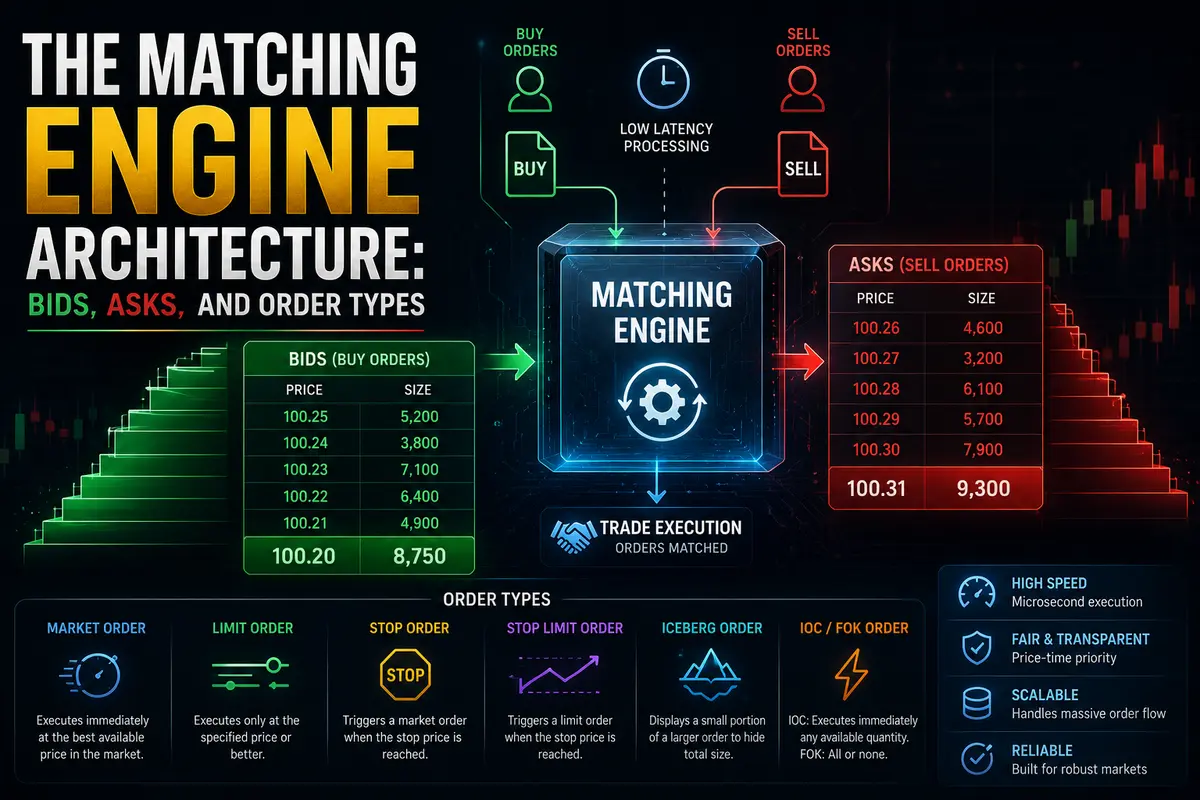
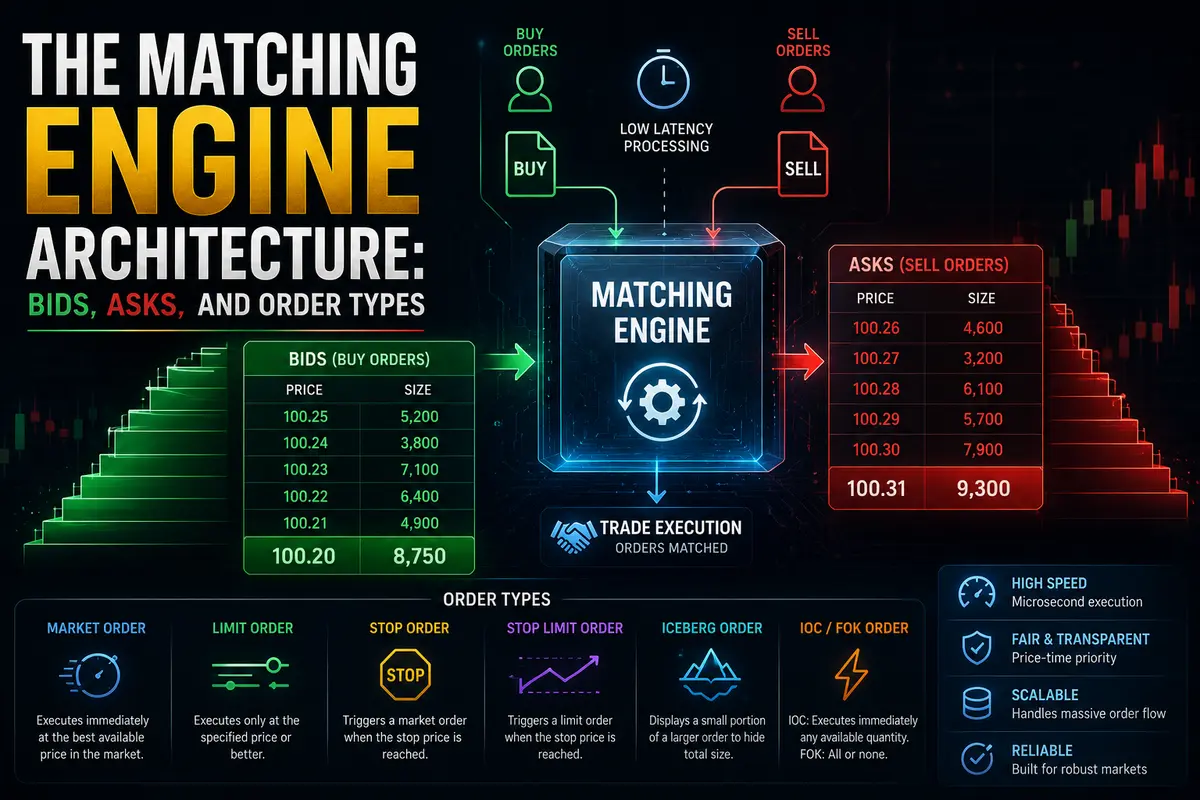
To understand why prices move, you have to peer beneath the surface of a standard price chart and examine the mechanics of a limit order book. At any given second, an exchange operates a centralized queue divided into two fundamental sides:
-
The Bid Side (Passive Buyers): This side consists of resting limit orders submitted by traders who wish to purchase an asset at a specific price equal to or below the current market valuation. These orders sit in line, ranked primarily by price priority and secondarily by time priority.
-
Passive Limit Orders: These orders supply liquidity to the market. They sit inside the order book queue, waiting for someone else to come along and take the other side of the trade. Limit order traders guarantee their execution price, but they accept the risk that their order might never be filled if market prices move away.
-
Aggressive Market Orders: These orders demand immediate execution. When a trader submits a market order, they tell the matching engine to execute their trade instantly against the best available limit orders sitting in the book. Market order traders guarantee immediate execution, but they sacrifice control over their exact fill price.
When a price chart moves up or down, it is the direct result of aggressive market orders eating through the resting passive limit orders stacked at current price levels.
The Bid-Ask Spread: A Real-Time Gauge of Volatility and Friction
The width of the bid-ask spread serves as a continuous barometer of market efficiency, inventory risk, and competitive liquidity provision.
In highly liquid, heavily traded instruments—such as mega-cap equities or benchmark index futures during core business hours—market makers compete aggressively for order flow. Because hundreds of market participants are competing to capture tiny fractions of a cent, the spread contracts to its minimum tick size. In these environments, round-trip transaction costs are negligible, and entering or exiting a position incurs minimal implicit friction.
Conversely, during periods of structural stress, economic news releases, off-peak trading sessions, or within illiquid exotic assets, the spread widens dramatically. Market makers are not obligated to stay in the book during times of heightened uncertainty. When news creates sudden event risk or directional imbalance, liquidity providers protect themselves by either pulling their limit orders out of the queue entirely or widening their quoted spreads to compensate for the elevated risk of adverse selection.
For active traders, a widening bid-ask spread carries immediate consequences:
-
Higher Entry Drag: The moment you enter a position using a market order in a wide-spread market, your trade starts at a significant unrealized loss equal to the full width of the spread.
-
Execution Slippage: Wide spreads often coincide with thin market depth, meaning market orders are forced to fill against liquidity sitting further away from the prevailing quote.
-
Triggered Stop Losses: In volatile, wide-spread environments, stop-loss orders—which typically convert into market orders upon activation—can fill at drastically worse prices than intended.
Order Book Depth and the Mechanics of Market Sweeps
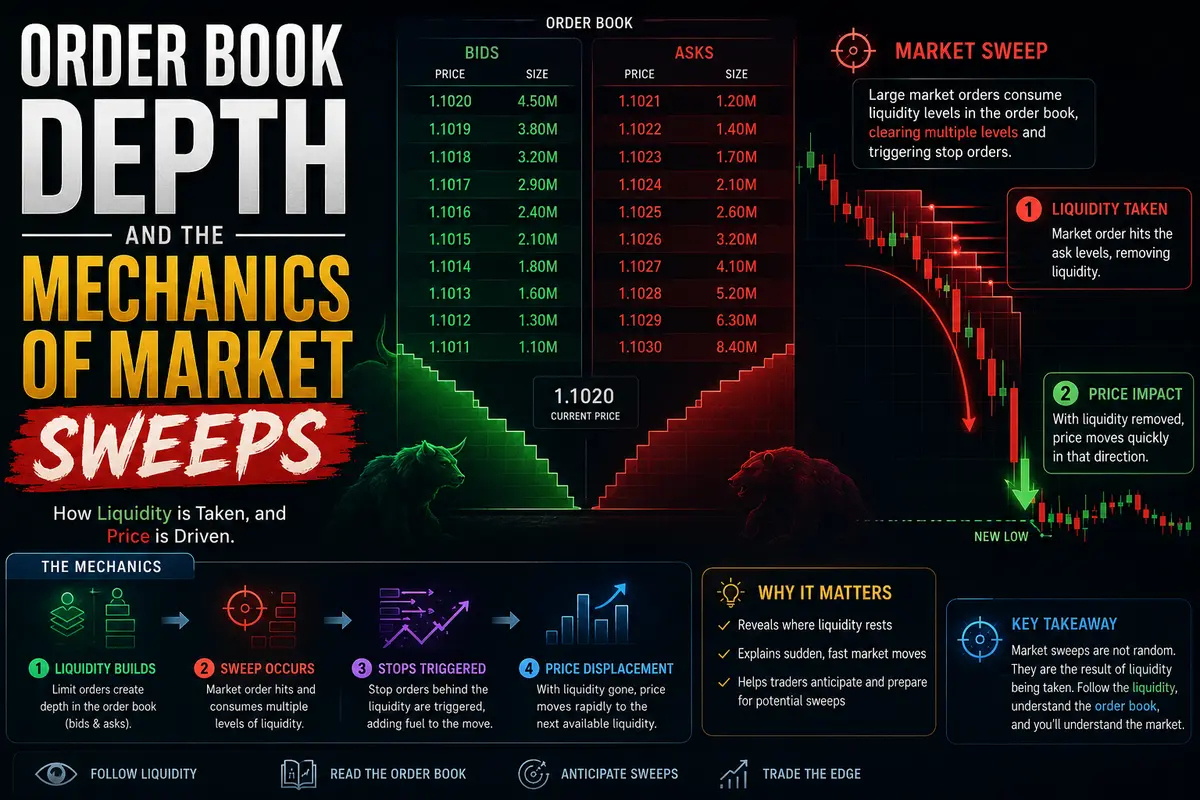
While the bid-ask spread reflects the immediate top-of-book prices, Market Depth (often referred to as Level 2 or Depth of Market) reveals the volume of passive limit orders stacked at price tiers above and below the prevailing quotes.
In a deep, healthy market, every price level features significant limit order volume. If an institutional trader submits an aggressive market order to buy 1,000 contracts, and there are 1,500 contracts offered at the best ask, the entire order is filled at that single price point. The market price does not change, because the top-of-book limit order volume absorbed the incoming buy pressure completely.
However, when market depth thins out—whether due to seasonal low-volume hours, macroeconomic uncertainty, or a sheer lack of market maker participation—the structural integrity of the order book weakens. If an aggressive buyer submits a market order for 1,000 contracts into a thin book where only 200 contracts are offered at the best ask, the matching engine must “sweep” the order book upward to fulfill the remaining balance:
-
The first 200 contracts execute at the initial best offer.
-
The next 300 contracts execute at the next higher price level.
-
The remaining 500 contracts execute at an even higher price level where sufficient selling interest finally exists.
This process results in immediate upward price movement across several ticks or points. The trader who placed the market order experiences severe negative slippage, and chart observers see a sudden green candle spike—not because millions of new buyers entered the market, but simply because a single sizable order swept a structurally hollow order book.
Practical Execution Strategies for Active Traders
Understanding the mechanics of liquidity shifts how experienced traders approach trade management and entry timing:
-
Prioritize Limit Orders in High-Spread Environments: When trading assets with variable or wide spreads, avoid relying on market orders. Utilizing limit or stop-limit orders allows you to dictate execution prices, preventing unexpected slippage drag from eroding your expected value.
-
Factor Spread Friction into Risk-to-Reward Ratios: Never evaluate a setup based on chart distances alone. If your profit target is 15 pips or ticks away, but the bid-ask spread is currently 3 ticks wide, 20% of your potential profit is consumed by execution friction before the position even starts working in your favor.
-
Monitor Depth Before Entering Breakout Trades: Classic technical chart breakouts frequently fail when there is insufficient order book depth to sustain momentum. If a technical resistance level breaks, but market makers immediately stack thick passive limit sell orders right above the level, the breakout will quickly stall and reverse into a liquidity trap.
-
Trade During Peak Liquidity Sessions: Align your execution windows with peak institutional trading hours. Higher volume ensures deeper order books, narrower spreads, and far more predictable order fulfillment.
Recognizing that prices are pushed and pulled by the interaction between aggressive market demand and passive liquidity reserves transforms technical chart reading from guesswork into a grounded analysis of structural market supply and demand.

Comments
No comments yet. Be the first to share your thoughts!
Authentication Required
You must be logged in to post a comment.