

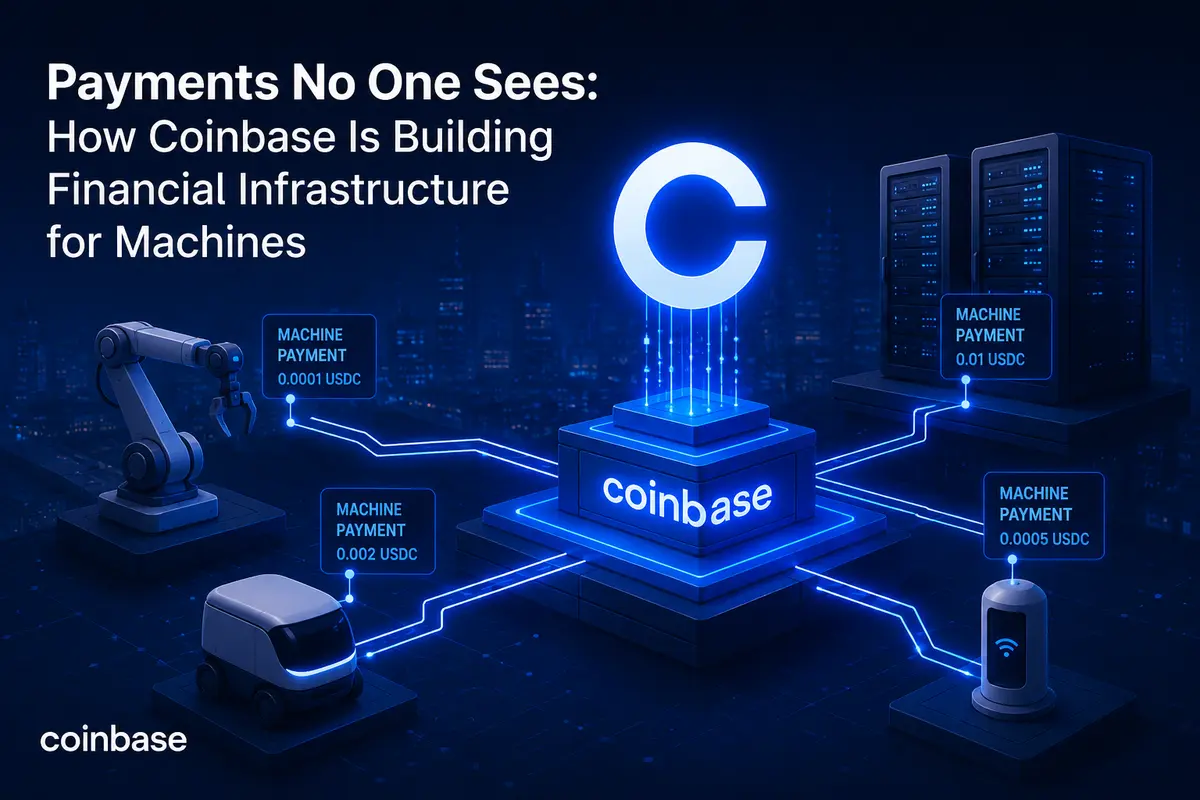
Payments No One Sees: How Coinbase Is Building Financial Infrastructure for Machines

Imagine a world where software pays software. Not people sending money to people, not a human buying a subscription to a service, but one line of code automatically settling with another line of code in a fraction of a second and for a fraction of a cent. It sounds like science fiction, but this is exactly the reality Coinbase is building right now through the x402 protocol. And the protocol’s latest upgrade — the introduction of batch settlements — brings that science fiction closer than ever to the everyday workflow of thousands of developers.
Why is this even necessary? The answer lies in the nature of artificial intelligence. Modern AI agents are resource-hungry creatures. They constantly need access to models, computing power, API calls to databases, and information from external sources. And all of that costs money. When there are hundreds or thousands of such operations per hour, and each one costs mere fractions of a cent, the traditional blockchain economy — with fees attached to every transaction — becomes pointless. Sending an on-chain transaction that costs a dollar just to pay one-tenth of a cent is absurd. That is exactly the absurdity this new solution eliminates.
Batch Settlements: Mathematics for the Microworld
The mechanism implemented by x402 is elegant in its simplicity. Instead of pushing every tiny transaction through the blockchain, the system bundles many small payments into a single package and settles the final balance with one transaction. It’s similar to how a restaurant doesn’t run to the bank after every cup of coffee sold but deposits the day’s revenue in one payment at the end of the day.
Technically, it works like this. The buyer — an AI agent or service that needs resources — first places ERC-20 tokens into an on-chain escrow. This acts as a deposit guaranteeing solvency. Then the interesting part begins: the agent can sign special off-chain vouchers, each confirming payment for an individual microscopic request. The seller receives the voucher, verifies its authenticity, performs the service — for example, delivering data or providing access to a model — and stores the voucher away. Once enough vouchers accumulate, the seller bundles them together and claims all owed funds in a single blockchain transaction from that escrow account.
The beauty of the scheme is that for the end user — the AI agent — there is virtually no delay. It sends a request, signs a voucher, receives a response. Everything happens within milliseconds. The accounting is reconciled later, in bulk, without unnecessary overhead or devastating transaction fees.
Less Than One-Tenth of a Cent: An Economy That Didn’t Exist Before
The latest x402 update enables payments smaller than one ten-thousandth of a dollar. This is an amount a human would never notice on a bank statement. It is smaller than currency conversion rounding. But for AI services, this is exactly the scale at which it makes sense to think.
Imagine an agent monitoring prices for thousands of products across hundreds of online stores. Every API request to each store costs a microscopic amount. If every request required a separate blockchain transaction with a fifty-cent fee, the business model would collapse within an hour of launch. But if thousands of requests are combined into a single final settlement, the economics suddenly work. That is precisely what Coinbase’s solution does — it transforms something that was previously economically irrational into a viable business model.
At the same time, it reduces the load on the blockchain itself. Instead of thousands of transactions clogging the network, only one goes through. For Ethereum and its scalability limits, this is not merely a pleasant bonus — it is a matter of infrastructure survival at scale.
Code 402: A Story Waiting for Its Time
Behind the x402 protocol lies a clever historical reference. In the HTTP specification — the protocol that powers the entire internet — there exists an error code numbered 402. It is called “Payment Required.” It was conceived in the early days of the web as a way to request payment for access to digital resources. But for decades, the code remained unused because there was no infrastructure capable of processing such payments automatically and without human involvement.
Now that old idea is finally getting a second life. x402 transforms HTTP 402 from a dead specification into a working protocol. An AI agent accesses a resource, receives a 402 response, automatically signs a payment voucher, and instantly gains access. No credit card forms, no redirects to payment gateways, no human pressing a “Pay” button. These are payments embedded directly into the fabric of the internet itself, operating at the same level as ordinary HTTP requests.
Coinbase’s Bigger Strategy: Betting on Autonomous Agents
The development of x402 is not an isolated experiment or a one-off initiative. It is part of a much broader and highly ambitious strategy Coinbase has been building for years. The company is increasingly focused on infrastructure for a world where autonomous agents act as independent economic entities — with their own wallets, their own funds, and the ability to spend them without human oversight.
A recent development confirms the seriousness of those ambitions. Amazon Web Services — the world’s largest cloud provider — integrated x402 and Coinbase wallet infrastructure for AI payments in USDC on the Base and Solana networks. This means agents operating in Amazon’s cloud can now conduct transactions without direct access to private keys — eliminating the risk that a compromised agent could drain an entire wallet. Security becomes paramount when an agent performs hundreds of microtransactions per hour and cannot be trusted with unrestricted control over significant funds.
Beyond Dollars: The Flexibility of ERC-20
An important detail that is easy to overlook: x402 works not only with stablecoins like USDC. The protocol supports any ERC-20 token. That means AI agents will be able to operate not only with digital dollars but with virtually any asset existing within the Ethereum ecosystem.
For developers, this opens enormous creative possibilities. One could build a service that accepts payment in platform-specific tokens. Different types of requests could be paid for with different assets. Tokenized loyalty points or specialized utility tokens could also be integrated. The protocol becomes not merely a dollar payment rail but a universal settlement layer for digital assets of all kinds.
At the moment, x402 is available for TypeScript and Go, while a Python version — critical for AI application development — is currently in preparation. This is especially important because without native Python support, the protocol risked remaining a niche tool for blockchain developers instead of becoming a standard across the broader AI ecosystem.
Competitors Are Not Sleeping: The Race for AI Payments
Coinbase is not operating in a vacuum. The race to become the primary payment layer for AI agents has already begun, and several serious players are on the track.
Circle, the issuer of USDC, has introduced its own AI payment tools. Their solution allows agents to use wallets, discover services, and conduct programmable stablecoin payments. This is a direct competitor to x402, and Circle clearly has no intention of surrendering this market without a fight.
Meanwhile, Aptos Foundation and Aptos Labs have committed $50 million toward AI infrastructure development. Their focus includes on-chain applications, trading systems, and data storage designed specifically for autonomous agents. The funding is substantial, the ambitions are equally large, and it is yet another sign that the industry genuinely believes machine-to-machine payments are the next major market.
What This Means for the Market and the Future
Batch settlements in x402 solve a problem that long seemed impossible: how to make blockchain economically viable for microtransactions without fees consuming the entire model. It is a foundational technological building block without which it is impossible to create a world where AI agents independently purchase data, pay for computation, and trade with one another.
If the technology gains widespread adoption, we may witness a fundamental shift in what blockchains are actually used for. Today, they are primarily associated with large transfers, trading, and asset storage. Tomorrow, they could become an invisible settlement layer through which millions of machine-to-machine microtransactions flow every second — transactions humans may never even notice.
For Coinbase, this is an opportunity to secure a dominant position in a new infrastructure segment before competitors flood in. The AI-agent economy is only beginning to form, and the payment layer is one of the critical battlegrounds where the standards of the next internet economy will be decided.
The next stage is real adoption inside working AI services. And here, Python support and ease of integration will become decisive factors. Right now, this is still early infrastructure — but history shows that it is often exactly these kinds of quiet foundational technologies that eventually become the invisible backbone upon which giants are built.

Comments
No comments yet. Be the first to share your thoughts!
Comments only for logged-in users.