

Half a Billion in the Red: A Number That Cannot Be Hidden
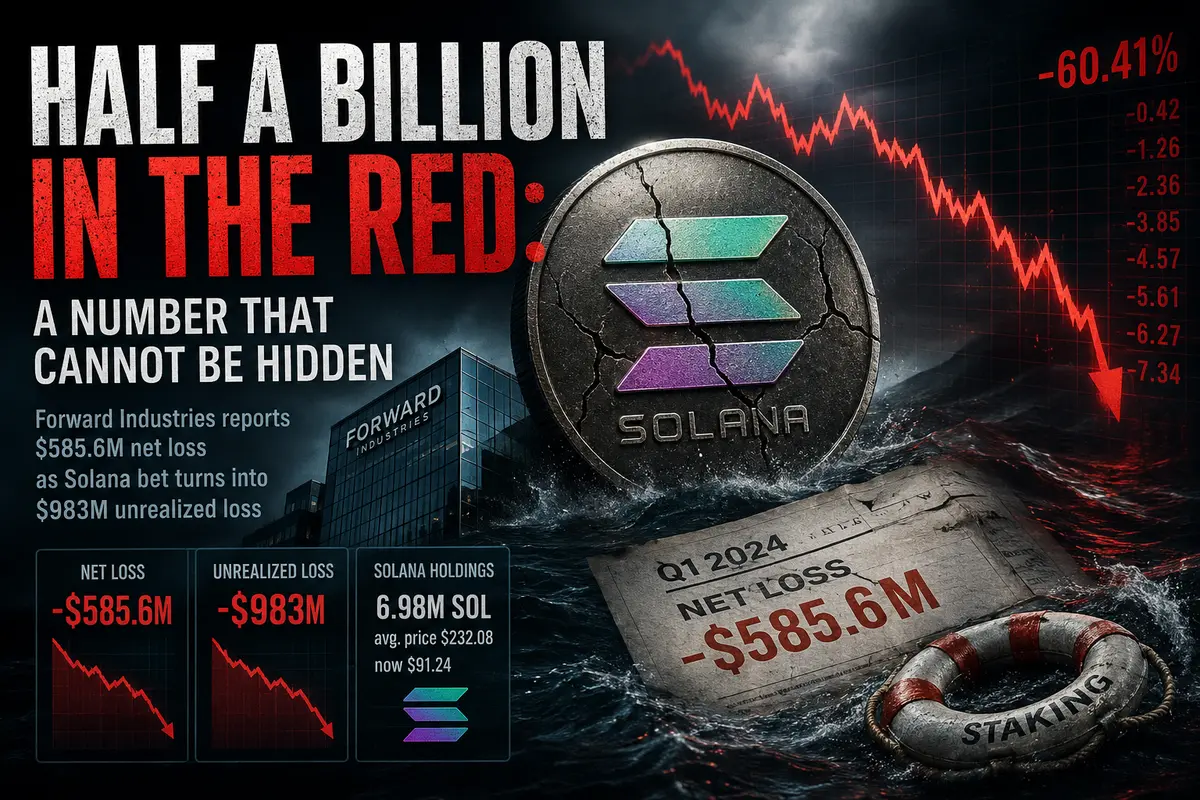
The first quarter ended for Forward Industries in a way no shareholder would wish to see. The company, proudly calling itself the world’s largest corporate holder of Solana, reported a net loss of $585.6 million. Nearly six hundred million dollars. This is not an accounting abstraction or a paper entry — it is real blood draining from the balance sheet, impossible to disguise with optimistic press releases about a brighter future.
And the bad news does not stop there. The loss recorded in the financial statements reflects only part of the picture. There is also what accountants call an unrealized loss — paper-based, perhaps, but no less painful because of it. And here the numbers become outright catastrophic. Today, the gap between what Forward paid for its tokens and what they are worth now has reached almost one billion dollars. $983 million — just shy of a round and terrifying figure, but the essence remains unchanged. The company is sitting on losses the size of a small nation’s budget, while the market watches with the cold curiosity of an anatomist.
Let’s break down the arithmetic, because it is brutally simple. At the beginning of the year, Forward held nearly seven million Solana tokens — precisely 6.98 million. The company bought them at an average price of $232.08 each. Today, the market price hovers around $91.24. A simple multiplication reveals the outcome: the position’s total valuation has shrunk to $636.9 million. They bought high, now they hold and hope for a miracle — and so far, the miracle has not arrived.
Solana at $91: How the Bet Collapsed
To understand the scale of the disaster, one must step away from accounting figures for a moment and look at the asset itself. Solana has been one of the brightest blockchain projects of recent years — fast, technologically advanced, backed by an army of loyal supporters. But like almost every cryptocurrency outside of Bitcoin, it has gone through extreme volatility. Falling from the levels at which Forward entered its position down to the current $91 is not a correction — it is a collapse of more than 60%.
For a leveraged trader, such a decline means liquidation and an exit from the game. For a company that publicly declared cryptocurrency as its primary treasury reserve asset, it means looking shareholders in the eye and explaining how $1.5 billion in raised capital turned into barely over $600 million in market value. And those explanations, judging by the reporting, sound something like this: we believe in the long-term outlook, we are not selling, we are staking.
Staking as a Lifeline
And here we arrive at the one bright spot Forward can present to skeptics. Quarterly revenue increased more than fourfold, reaching $21.4 million. For a business that not long ago operated in entirely different sectors, this is an impressive jump. The primary source of that income is staking.
Almost all of the Solana tokens owned by the company are staked — meaning they are actively generating yield by helping validate transactions on the network. The report discloses a specific figure: approximately 6.73% annual yield before fees. This is not a fantasy-level return, but in a world where bank deposit rates are measured in low single digits and government bonds yield only slightly more, nearly seven percent annually on large capital appears quite respectable.
The problem is that staking income, even at its most stable, cannot offset the collapse in the asset’s underlying value. $21 million in quarterly revenue versus nearly $1 billion in unrealized losses is like trying to bail water out of a sinking ship with a bucket. Staking generates pennies while the core position loses dollars. And until Solana begins recovering lost ground, the mathematics will continue working against Forward.
A Transformation That Missed the Target
The story of Forward Industries is a classic tale of a dramatic business transformation that initially looked brilliant, only to become a massive headache later. Just last year, this was an entirely different company. Then management decided the old business was no longer enough, that the future belonged to cryptocurrencies, and that they would enter that future in spectacular fashion.
The model — or more accurately, the object of imitation — was Strategy, the world’s largest corporate holder of Bitcoin. The logic was straightforward: if Strategy managed to turn Bitcoin accumulation into the foundation of its business model and raised billions around it, why not repeat the same trick with Solana? Forward joined dozens of organizations adopting this approach and began aggressively buying tokens.
To execute these Napoleonic ambitions, enormous sums were raised. Heavyweights of the crypto industry such as Galaxy Digital, Jump Crypto, and Multicoin Capital provided backing. Altogether, the company succeeded in raising $1.65 billion. The transaction moved quickly: within the very first week after closing, Forward purchased 6.82 million Solana tokens. The next plan was even more ambitious — mobilizing an additional $4 billion for continued accumulation. But those plans remained only plans. The market turned before the company could expand its position further.
A Roller Coaster for Shareholders
For those who bought Forward shares during the hype wave, what followed became a brutal test of nerves. After the company announced its new strategy and initial Solana purchases, the stock price surged roughly eightfold. The company became a darling of crypto enthusiasts, a symbol of how traditional businesses could ride the blockchain wave. But the rise was followed by an equally spectacular fall.
From its peak, the stock collapsed by nearly 90%. This was not a correction — it was almost total destruction of shareholder value. Those who bought near the top lost nearly everything. Those still holding the shares are either deeply committed believers in the company’s strategy or simply unable to sell at such devastating losses while hoping for a miracle. The ticker FWDI has become a symbol of how quickly crypto-fueled euphoria can turn into financial catastrophe.
Strategy Under Pressure Too: Similarities and Differences
Interestingly, almost simultaneously with Forward, the very company that inspired all this imitation — Strategy — also reported major problems. The largest publicly traded corporate holder of Bitcoin finished the first quarter with a loss of $12.5 billion. Twelve and a half billion dollars — a figure that makes Forward’s half-billion loss look almost modest by comparison.
But there is a critical difference. Strategy holds Bitcoin, an asset that throughout its history has endured multiple crashes and repeatedly recovered to new highs. Bitcoin has achieved the status of digital gold; institutional investors believe in it, exchange-traded funds have been built around it, and regulators recognize it. Solana, despite all its technological strengths, remains a far more volatile and less predictable asset.
Moreover, Strategy has at least acknowledged the possibility of selling part of its Bitcoin reserves if circumstances demand it. Forward, meanwhile, remains silent about sales, preferring instead to stake and wait. But how long such patience can survive under the pressure of nearly a billion dollars in unrealized losses remains an open question.
Lessons for Everyone Watching Crypto Treasury Strategies
The story of Forward Industries is a vivid, almost textbook case of the risks involved in corporate cryptocurrency treasury strategies. When markets rise, adding tokens to a corporate balance sheet looks like a stroke of genius. Shares soar, investors applaud, executives give interviews about the digital future. But when the market turns, all of it transforms into hundreds of millions in losses, furious shareholders, and a balance sheet resembling a minefield.
Can Forward recover from this dive? Theoretically, yes — if Solana rebounds, if staking revenues continue growing, if the broader market turns bullish again. But that is three separate “ifs,” none of which depend on the company itself. Forward made a bet that, so far, has not paid off. And now the entire market is watching to see whether the company has enough patience and financial endurance to survive until a reversal comes — or whether the story of the world’s largest corporate Solana holder will enter financial textbooks as a case study in how not to manage treasury reserves.

Comments
No comments yet. Be the first to share your thoughts!
Authentication Required
You must be logged in to post a comment.