

ASIAN SESSION · WEDNESDAY 17 JUNE 2026 The Nikkei Just Broke 70,000. The Iran War Is Over. And Everyone Is Waiting for Warsh
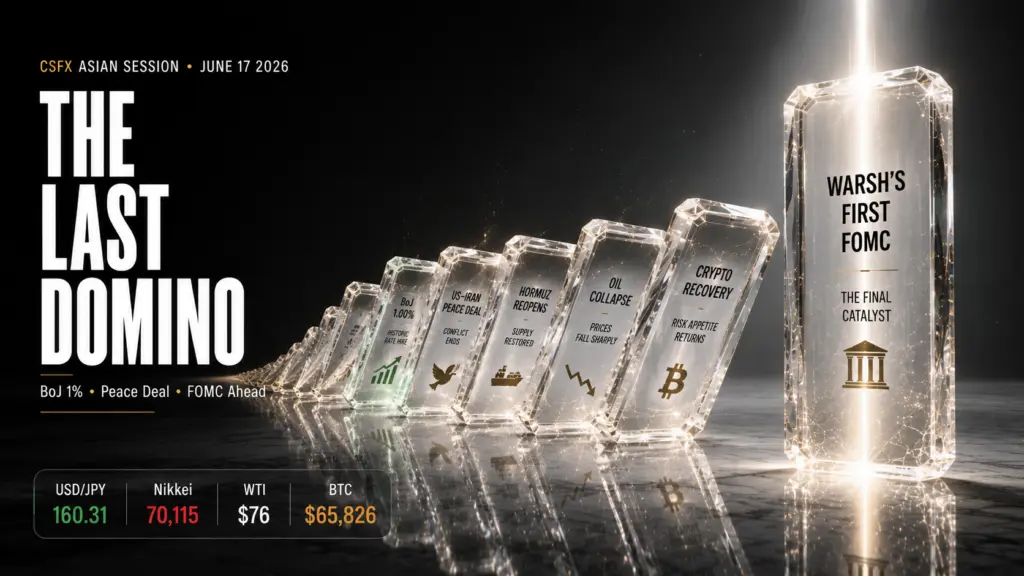
Japan hiked to 1% for the first time since 1995. The US-Iran peace deal is signed. Crude is at a three-month low. The yen is still weak. And Asia is riding all of it into the most consequential Fed meeting of the year — all in a single Wednesday morning.
There are sessions you look back on months later as the moment everything changed, and sessions that just feel like they should be that moment but are actually the pause before the real move. Wednesday’s Asian session is genuinely the former. Two events that had been holding the region in suspense for weeks have both resolved in the market’s favour overnight. The Bank of Japan hiked to 1.00% — the first time at that level since 1995 — and the US-Iran peace deal has ended the three-month conflict, reopened the Strait of Hormuz, and sent WTI crude crashing toward a three-month low near $76. And yet the story of this session is not those two events. It is the Nikkei 225 breaking 70,000 for the first time in history.
The carry trade did not unwind. That is the most important thing to say about the BoJ hike. Every trader who had been positioned for a violent yen strengthening on the hike — and there were many — is waking up to a world where USD/JPY is at 160.31, nearly unchanged, and AUD/JPY is holding firm near 113.21. The reason is sequencing: the Fed is still at 3.50 to 3.75% and tonight Kevin Warsh may lean hawkish. A 250 basis-point gap between the Fed funds rate and the BoJ policy rate is still enormous carry. You do not unwind that on a 25bp move by Tokyo — especially when the BoJ’s forward guidance was careful and the dissenting board member voted for a hold.
The carry trade survived a 1% BoJ rate. USD/JPY at 160.31 after Japan’s biggest rate move in decades is the market telling you the Fed still dominates.
The Nikkei Above 70,000: Why Japan Is the Session’s Dominant Story
Japan’s Nikkei 225 breaking above 70,000 for the first time in history is not an accident of the BoJ hike. It is actually partly because of the BoJ hike — and partly despite it. The mechanism that drives Japanese equities higher in a BoJ tightening cycle is counterintuitive: a credible move toward policy normalisation signals that Japan’s economy is strong enough to absorb higher rates, which is a fundamentally different narrative from the twenty years of ‘Japan is in permanent deflation’ that had suppressed multiples. Foreign institutional investors — who had been underweight Japan for years — are now reweighting. The Nikkei’s semiconductor and AI-linked names are the specific leaders, riding the same global AI infrastructure demand wave that has been driving US tech.
The Iran peace deal adds the commodity angle. Japan imports nearly 100% of its oil. Every $10 fall in Brent is a terms-of-trade improvement worth billions annually to Japanese manufacturers, airlines, and consumers. WTI near $76 today versus $95 three months ago is a structural margin improvement flowing through to corporate earnings projections for the rest of 2026. The Nikkei at 70,115 is pricing that improvement in real time.
USD/JPY at 160.31: The Intervention Zone Nobody Is Testing
USD/JPY at 160.31 is sitting exactly on the level that Japan’s Ministry of Finance has historically treated as its line in the sand. The pair has been here before — briefly in July 2024 and again in May 2026 — and both times intervention was either executed or verbally threatened. The market is treating it with the same respect today: not pushing through it aggressively, not retreating sharply from it either. Just sitting on the number.
The reason it has not broken lower after the BoJ hike is precisely the FOMC tonight. If Warsh is hawkish — if he foregrounds core services CPI and refuses to acknowledge the disinflationary impulse from the Iran deal — then the US-Japan rate differential stays wide and the yen has no structural reason to strengthen. The asymmetric trade remains: short USD/JPY from 160.50 with a tight stop at 161.20, targeting 157.50 to 158.00 on a confirmation that the BoJ normalisation cycle has more runway. But that confirmation comes from Tokyo, not Washington.
AUD/JPY at 113.21: The Carry Pair That Survived
AUD/JPY at 113.21 is the clean expression of what the carry trade looks like when a BoJ hike does not actually kill it. Australia’s RBA held at 4.35% yesterday — no change, hawkish bias retained — while Japan’s BoJ hiked to 1.00%. The spread compressed from 335 basis points to 335 basis points. That is not a typo: because both central banks moved in opposite directions — RBA held while BoJ hiked — the net carry differential is marginally unchanged. AUD/JPY near 113 is the result.
The risk to AUD/JPY is asymmetric. If Warsh is dovish tonight, risk assets extend their rally and AUD/JPY holds or advances — carry trades perform well in a dovish-Fed environment. If Warsh is hawkish, risk-off hits the AUD harder than the JPY, which is still finding support from carry flows, and AUD/JPY pulls back sharply. This is one of the few pairs where the FOMC directional impact is non-obvious and worth sizing carefully.
Oil at $76, Aluminium Sliding, Corn at Eight-Month Lows
The commodity complex is having one of its most significant sessions of the year. WTI at $76 is a three-month low driven by the Hormuz reopening removing the chokepoint risk that had been embedding a $15 to $20 war premium into crude since February. The signing ceremony is scheduled for 19 June. Until it happens, there is still a residual uncertainty premium — but the direction is clear. Each additional $5 of oil deflation that lands in the data over the next four to six weeks makes Warsh’s job progressively easier at every subsequent FOMC meeting.
Aluminium at $3,409 per tonne is sliding as Gulf supply chains normalise. The Middle East conflict had disrupted aluminium smelting operations and logistics across the region. With the conflict ending, that supply disruption premium is unwinding in the same way the oil premium is. Corn near $4.13 per bushel — its lowest since October 2025 — is the biofuel connection: when oil crashes, the economic incentive to divert corn into ethanol production weakens, increasing the perceived supply available for food and feed markets. Lower oil is corn bearish via the biofuel channel.
Bitcoin, Chainlink, and Dogecoin: Three Different Stories in the Same Session
Bitcoin at $65,826 is up more than 11% off its sub-$60,000 early-June lows — a recovery driven by the Iran peace deal’s risk-on wave and the easing of the ‘higher for longer’ rate narrative that oil’s collapse is facilitating. But spot ETF flows have only just turned from net negative to marginally positive, which means this recovery is geopolitical in origin rather than institutionally driven. The FOMC tonight is the next test: a dovish Warsh would convert the geopolitical recovery into an institutionally-driven accumulation phase; a hawkish hold would expose the fragility of a bounce built on peace-deal sentiment rather than genuine ETF inflows.
Chainlink at $8.34 is the session’s most interesting crypto story precisely because it has an independent catalyst: the FIFA World Cup oracle deal and record on-chain whale accumulation. These are real-world adoption signals that are indifferent to the FOMC’s rate decision. Dogecoin near $0.086 — still close to its 52-week low — is the cleaner read on how far the meme-coin complex has lagged the broader recovery. Its lack of a specific catalyst makes it pure beta: it will move with the FOMC outcome rather than against it.
Tonight Is Everything: The FOMC Decides at 14:00 ET
Kevin Warsh’s debut FOMC decision lands at 14:00 ET, with the press conference at 14:30. The hold is near-certain. The tone is everything. A dovish Warsh — one who explicitly acknowledges that the Iran peace deal’s disinflationary impulse has changed the near-term inflation calculus — would be the final catalyst that converts today’s Asia-driven risk rally into a global, institutionally-confirmed risk-on regime. The Nikkei would extend above 70,000, USD/JPY would finally test below 159, AUD/JPY would firm, BTC would accelerate toward $70K, and the Bund yield would pull back as global rate pressure eases.
A hawkish hold — Warsh foregrounding core services CPI and signalling that the Fed’s work is not done — reverses the tone but not the structure. The Nikkei record stands regardless; Japan’s corporate earnings story does not hinge on Warsh. The yen would benefit marginally from reduced carry demand. Crypto would pull back. Oil would be relatively unaffected — that move is the Iran deal, not the Fed. The divergence tonight is between assets whose rally has been geopolitically driven and those whose rally needs Fed validation. Know which bucket your positions are in before 14:00 ET.
─
Live trade levels and FOMC reaction analysis for USD/JPY, AUD/JPY, Nikkei, aluminium, corn, Bitcoin, Chainlink, and Dogecoin published at capitalstreetfx.com.
Read Full Report: capitalstreetfx.com/market-analysis/daily-market-analysis/

Comments
No comments yet. Be the first to share your thoughts!
Authentication Required
You must be logged in to post a comment.