

Hyundai Takes Full Control of Boston Dynamics: A Bet on Humanoid Robots and Welding the Future
A Morning in Seoul: The Deal Everyone Had Been Waiting For
On Thursday, South Korean automotive giant Hyundai Motor HYUD.L ... officially announced that it would acquire the remaining shares of Boston Dynamics from $ SOBKY ... Japan’s SoftBank Group. This is not merely another piece of corporate finance news—it is a declaration of Hyundai’s intention to gain full control over one of the most ambitious projects in the robotics industry. As is often the case with major deals, there is far more behind the dry wording of the press release than a simple transfer of shares.
To recap the background, Hyundai acquired a controlling stake in Boston Dynamics in 2021. At the time, the deal caused a sensation. The company, famous for its four-legged Spot robots and dancing humanoid Atlas robots, had always been viewed more as an icon of engineering excellence than as a commercially successful business. SoftBank, which had owned Boston Dynamics since 2017, retained a stake of approximately 9.65%. Now, however, the Japanese group has exercised its put option, and Hyundai is purchasing the remaining stake in full.
The value of the transaction has not been officially disclosed, but South Korean media estimate it at approximately 500 billion won, equivalent to around $325–335 million. For Hyundai, which paid roughly $880 million for an 80% stake in 2021, this is not an especially large amount, particularly when measured against the scale of the company’s ambitions.
Why Does Hyundai Want Full Control?
The main answer is strategy. Whenever a company has a minority shareholder—even one holding less than 10%—certain limitations remain. Like any investor, SoftBank had its own interests and expectations regarding the timeline for generating returns. Those restrictions will now disappear. Hyundai will be able to make long-term decisions without having to accommodate another shareholder’s expectations and can fully integrate Boston Dynamics into its manufacturing and innovation ecosystem.
Hyundai calls this its “Physical AI” strategy. The idea is to combine Boston Dynamics’ advanced robotics technology with Hyundai’s vast manufacturing expertise, mobility solutions, and global supply chain. Full ownership of Boston Dynamics will allow Hyundai to build a vertically integrated system covering everything from development and mass production to deployment at its own factories.
This is not simply the purchase of technology. It is the creation of a closed-loop ecosystem in which robots learn and improve directly on production lines, while data collected from those lines is immediately used to refine future models.
Atlas Is Heading to the Factory: No Longer Just a Show, but a Real Job
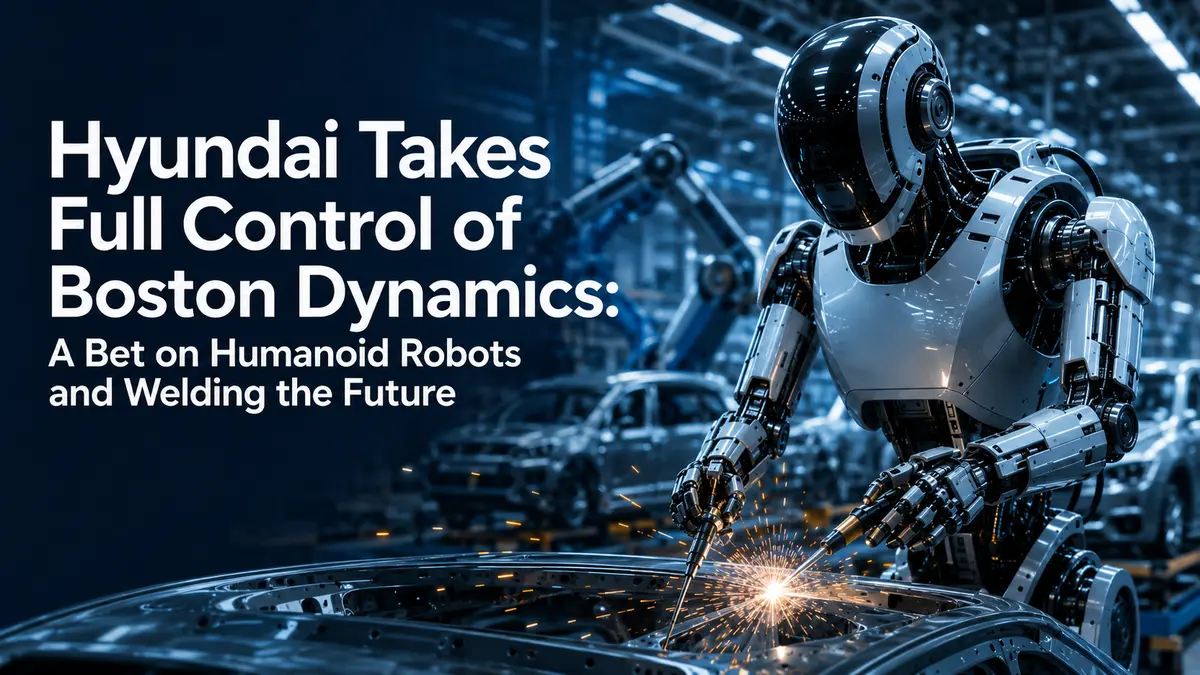
The central figure in this story is the humanoid robot Atlas. For decades, Boston Dynamics has amazed the world with videos of Atlas dancing, completing parkour courses, and performing backflips. Hyundai, however, does not see these demonstrations as entertainment. For the company, Atlas is a practical tool that must deliver measurable value on the production line.
The plan is both ambitious and highly detailed. Beginning in 2028, Hyundai will start deploying Atlas at its new electric vehicle manufacturing facility in Georgia, United States, known as HMGMA—the Hyundai Motor Group Metaplant America.
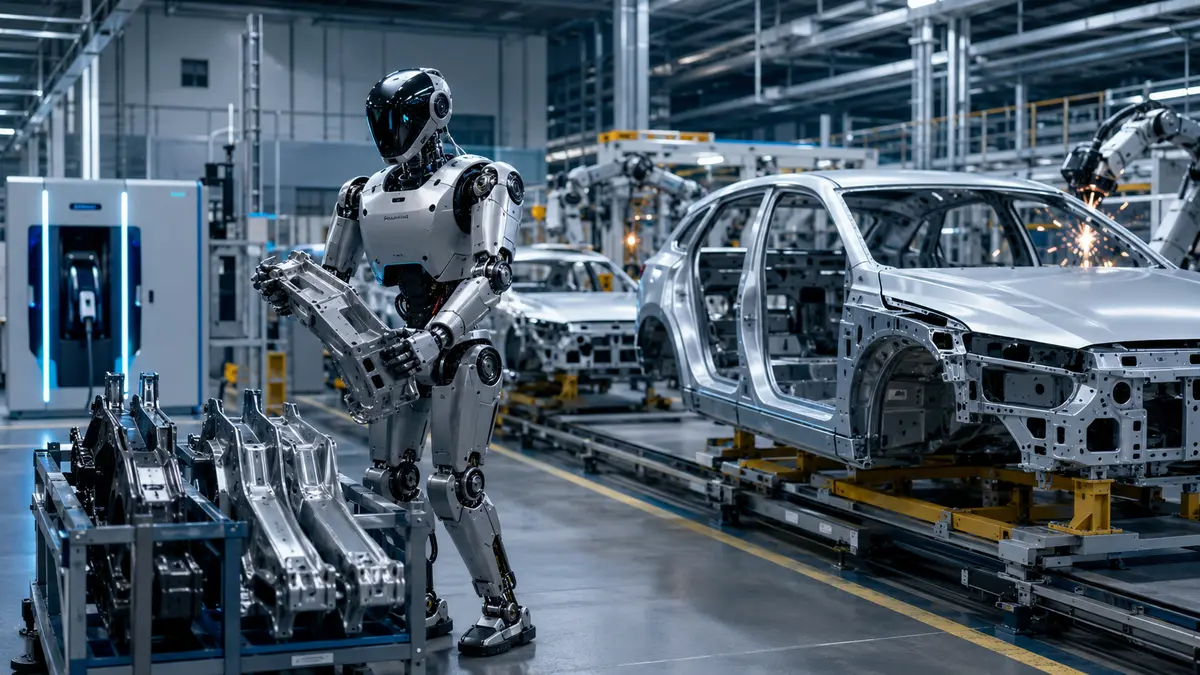
At the initial stage, the robots will perform “parts sequencing,” a process in which components are prepared and delivered for assembly in the correct order. It is not the most complex task, but it provides an ideal testing ground for evaluating the technology under real manufacturing conditions.
By 2030, Atlas robots are expected to move on to more complex operations, including component assembly and welding. The plan includes establishing production capacity for up to 30,000 robots per year. A significant proportion—approximately 25,000 units—will be deployed at Hyundai and Kia factories, while the remainder will be offered to external customers.
Atlas has several impressive characteristics that make it suitable for this type of work. It can rotate its torso through 360 degrees, giving it exceptional flexibility in confined spaces. It can lift loads weighing approximately 30–50 kilograms and has 56 degrees of freedom.
Perhaps most importantly, Atlas can independently approach a charging station and replace its own batteries, allowing it to operate with minimal interruption. According to the company, training the robot to perform a new task takes less than one day.
Hyundai is not simply releasing impressive demonstration videos. It is building an entire infrastructure for training and testing robots, including the Robot Metaplant Application Center, or RMAC, which is scheduled to open in 2026.
Market Reaction: Numbers and Concerns
Investors, however, reacted to the news without much enthusiasm. Hyundai Motor shares fell by 3.6% on the Seoul stock exchange. That decline appears relatively moderate when compared with the broader collapse of South Korea’s KOSPI index, which fell by almost 6% on the same day amid a widespread sell-off in the technology sector. SoftBank shares, meanwhile, remained almost unchanged.
This suggests that the market had already priced the transaction in, and the announcement that the deal was being finalized did not come as a surprise.
Some analysts also noted that investors might have reacted more positively if Hyundai had purchased the stake at a higher price, as this would have implied a higher valuation for Boston Dynamics. Instead, according to certain experts, the transaction removed the possibility of an imminent upward revaluation of the robotics company—an event that might otherwise have served as a catalyst for Hyundai’s shares.
The market is clearly waiting to see whether Hyundai can transform its bold plans into actual profits.
The Human Factor: Labor Unions Remain on Alert
Perhaps the most interesting and potentially explosive aspect of the deal lies not in technology or finance, but in its social consequences. Hyundai’s South Korean labor unions have long viewed automation with considerable suspicion, and their concerns are not entirely unfounded.
According to the union, approximately 2,000 of the plant’s 24,676 employees are expected to retire each year through 2032. Should the company decide not to hire replacements, union membership could decline by 10,000 people—around 40% of its current total.
Against the backdrop of Hyundai’s announced plans for the large-scale deployment of robots, this sounds like a direct threat to jobs.
The union has already held two-hour warning strikes and is planning longer industrial actions. In one statement, the union leader said directly that employees believe the company intends to replace human workers with new technologies. This represents a red line that Hyundai’s management will have to approach with extreme caution.
The company, for its part, continues to promote the concept of “human-centered automation,” under which robots take over heavy and dangerous tasks while people remain responsible for supervision, control, and management. Convincing the unions of this vision, however, will not be easy.
Looking Ahead: Betting on People Made of Metal
Hyundai is making an enormous bet—a bet that the future belongs to humanoid robots working alongside people and performing the dirtiest, most repetitive, and physically demanding tasks.
Full control of Boston Dynamics gives Hyundai all the tools required to pursue this vision. The company is not simply acquiring technology; it is building an ecosystem in which a world-class automotive manufacturer also becomes a global robotics powerhouse.
Hyundai is not alone in pursuing this objective. Tesla is aggressively promoting its Optimus robot, promising to begin production as early as August 2026 and eventually reach an annual output of one million units. Chinese manufacturer Xpeng is also advancing rapidly with its Iron robot.
Hyundai, however, has one important advantage: it already owns Boston Dynamics, with its 30 years of experience in mechanics, robotics, and motion control—not merely ambitious plans.
The question is whether Hyundai can overtake its competitors and turn humanoid robots into a mass-market product rather than an expensive technological toy. Another crucial question is whether it can achieve this while maintaining peace with its own workforce.
The year 2028 is not very far away. That is when Hyundai’s Georgia factory will begin testing the true value of this investment. Should Atlas prove capable of operating reliably and efficiently on a real production line, the technology could transform not only Hyundai but the entire manufacturing industry.
Should it fail, the project may become an extraordinarily expensive lesson.



Comments
No comments yet. Be the first to share your thoughts!
Authentication Required
You must be logged in to post a comment.