

The Global Cryptocurrency Market: A New Era of Finance

The cryptocurrency market represents a relatively new, entirely digital segment of the global financial ecosystem dedicated to the exchange of virtual assets. At their core, cryptocurrencies are digital assets that utilize advanced cryptography to guarantee transaction security, prevent double-spending, and manage the creation of new units on a decentralized ledger known as a blockchain. Over the past decade, this market has evolved from a niche cypherpunk experiment into a foundational pillar of the modern financial system, capturing the intense attention of retail investors, institutional funds, and technological innovators worldwide.
Unlike traditional financial markets like the New York Stock Exchange (NYSE) or the London Stock Exchange, the cryptocurrency market operates 24/7 without geographical limitations or opening and closing bells. This borderless nature allows users from any continent to trade digital assets seamlessly at any time of day or night. Trading primarily occurs on centralized and decentralized cryptocurrency exchanges (such as Binance, Coinbase, or Uniswap), providing global gateways where users can buy, sell, or swap thousands of different digital assets with high liquidity.
Major Cryptocurrencies Shaping the Industry
While there are currently tens of thousands of cryptocurrencies in existence, the market is largely anchored by a few foundational projects that command the majority of the global market capitalization. Some of the most recognized and widely utilized include:
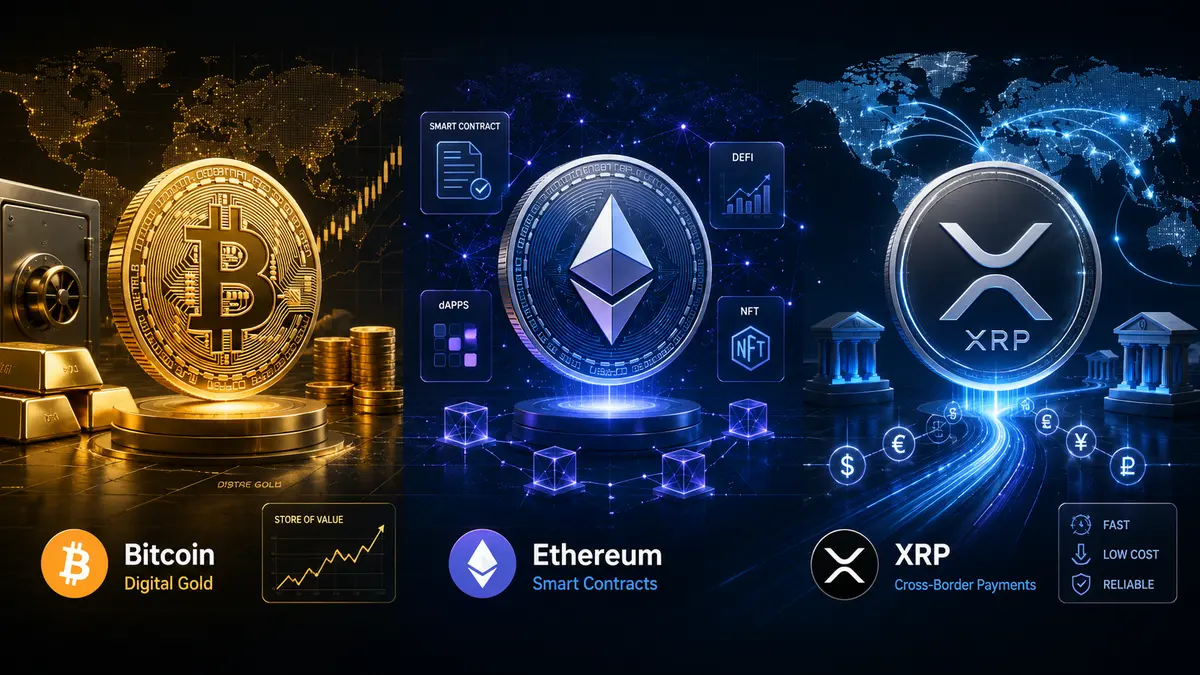
Bitcoin (BTC): The Digital Gold
As the very first cryptocurrency, Bitcoin paved the way for the entire digital asset revolution. Today, it is widely viewed not just as a medium of exchange, but as a global store of value — often referred to as “digital gold.” On the global stage, Bitcoin has seen massive institutional adoption, with publicly traded software companies like MicroStrategy holding billions in BTC, and even sovereign nations like El Salvador adopting it as legal tender. The recent approval of Bitcoin Spot ETFs by the US Securities and Exchange Commission (SEC) has further cemented its status in traditional Wall Street portfolios. BTCUSD ...
Ethereum (ETH): The Smart Contract Pioneer
Ethereum is the second most popular cryptocurrency by market capitalization, but its utility extends far beyond simple peer-to-peer payments. It introduced “smart contracts” — self-executing code that allows developers to build decentralized applications (dApps). This innovation birthed the global Decentralized Finance (DeFi) movement and the Non-Fungible Token (NFT) boom. Today, global enterprises use the Ethereum network to tokenize real-world assets, settle inter-bank transfers, and build Web3 infrastructure. ETHUSD ...
Ripple (XRP): Bridging Traditional Finance
Ripple was explicitly designed to act as a bridge between the burgeoning crypto industry and the traditional banking sector. It focuses on facilitating incredibly fast and cheap cross-border payments for financial institutions. By offering a modernized alternative to the aging SWIFT network, Ripple has partnered with major global banks and payment providers, such as Santander, to streamline international remittances across continents, proving that crypto can optimize legacy financial systems. XRPUSD ...
Primary Avenues for Earning in the Crypto Economy
Earning money in the cryptocurrency market presents a unique opportunity for both individual traders and large investment firms to generate profits within a rapidly evolving, high-potential environment. There are several primary methods for generating capital in this industry, each carrying its own distinct strategies and risk profiles.
Long-Term Investing (HODLing)
One of the most popular and historically successful ways to earn in the cryptocurrency market is through straightforward investment, colloquially known as “HODLing.” Investors purchase assets like Bitcoin or Ethereum with the expectation of long-term price appreciation. Many global investors employ a Dollar-Cost Averaging (DCA) strategy, buying a set amount of crypto every month regardless of the current price, which helps mitigate the extreme volatility inherent in digital assets.
Active Trading and Speculation
Trading on cryptocurrency exchanges involves actively buying and selling digital assets to profit from short-term price fluctuations. Global traders utilize a variety of complex strategies, including day trading, swing trading, algorithmic bots, and technical analysis (studying chart patterns and moving averages). Furthermore, international platforms now offer advanced derivatives, such as futures and options, allowing traders to bet on price movements without actually holding the underlying asset.
ICOs, STOs, and Modern Fundraising
Initial Coin Offerings (ICOs) and Security Token Offerings (STOs) represent innovative methods for blockchain startups to raise development funds. By purchasing tokens during an ICO or STO, early investors gain a stake in a new project, hoping to profit immensely if the project succeeds globally. While the ICO boom of 2017 saw startups worldwide raising billions, the market has since matured. Today, fundraising is more regulated, with global hubs like Singapore and Switzerland hosting compliant token offerings that attract venture capital from around the world.
Cryptocurrency Mining and Staking
Mining is the computational process used by Proof-of-Work networks (like Bitcoin) to validate transactions, secure the network, and create new blocks. Miners are rewarded with newly minted cryptocurrency for their efforts. However, mining on a global scale now requires massive industrial warehouses filled with specialized hardware (ASICs) and cheap, abundant electricity — often found in regions like Texas, USA, or Iceland (due to geothermal energy). Alternatively, many modern networks now use Proof-of-Stake (like Ethereum), where users “stake” their existing coins to secure the network and earn a passive yield, vastly reducing environmental impact while still offering a steady return.

Key Catalysts and Influencing Factors
The cryptocurrency market is arguably the most dynamic and sentiment-driven segment of the modern global economy. Its extreme volatility is driven by a complex web of interconnected factors, ranging from geopolitical shifts to cutting-edge technological breakthroughs.
1. Global Regulatory Decisions
Decisions made by governments and regulatory bodies have an immediate and profound impact on cryptocurrency prices. For instance, when China enacted a blanket ban on cryptocurrency trading and mining, the market experienced a severe short-term crash. Conversely, the implementation of clear, supportive frameworks — such as the Markets in Crypto-Assets (MiCA) regulation in the European Union — boosts institutional confidence and drives massive capital inflows into the market.
2. Technological Innovations
The underlying technology of blockchain is constantly evolving. Upgrades that solve major pain points naturally attract more users and investors. For example, the development of “Layer 2” scaling solutions (like the Lightning Network for Bitcoin or Arbitrum for Ethereum) allows networks to process millions of transactions per second globally for fractions of a cent. Improvements in cryptographic security and interoperability between different blockchains also play a massive role in shifting investor sentiment.
3. Macroeconomic Indicators
Cryptocurrencies do not exist in a vacuum; they are highly sensitive to traditional macroeconomic forces. When central banks, such as the US Federal Reserve, raise interest rates, risk-on assets like crypto often see price declines as investors move to safer government bonds. However, in regions suffering from hyperinflation — such as Argentina, Turkey, or Venezuela—citizens frequently turn to cryptocurrencies and stablecoins (like USDT) as a vital economic lifeline to preserve their wealth against collapsing fiat currencies.
4. Market Liquidity and Exchange Dynamics
The sheer volume of trading activity on global exchanges dictates the immediate price action of cryptocurrencies. Large holders of crypto, known as “whales,” can move the market significantly with a single large sell order. Furthermore, the overall health and transparency of major exchanges dictate market trust. The collapse of major global trading platforms has historically triggered severe market panics, reinforcing the industry’s mantra: “Not your keys, not your coins,” and pushing users toward decentralized, self-custody solutions.

Comments
No comments yet. Be the first to share your thoughts!
Authentication Required
You must be logged in to post a comment.