

The Swiss Giant Keeps Its Word
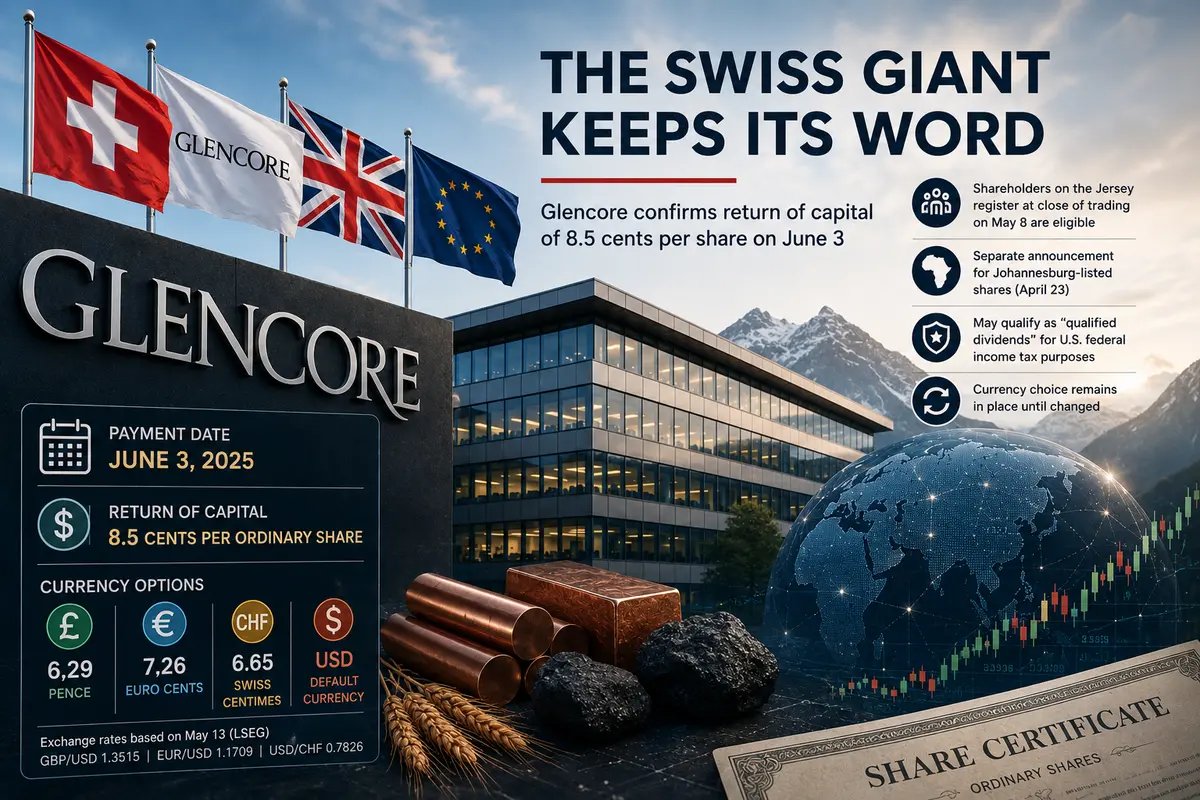
On Thursday, confirmation arrived from Baar, home to Glencore’s headquarters, of what the market had been expecting since the company released its annual report. Glencore announced that on June 3 shareholders will receive a return of capital of 8.5 cents per ordinary share.
On paper, the figure looks modest. But once multiplied by the billions of shares outstanding, it turns into hundreds of millions of dollars flowing into investor accounts — from London-based funds to South African pension managers.
Formally, the payment still requires shareholder approval at the annual general meeting. In Glencore’s case, though, that is largely procedural. The company typically aligns such decisions with its major shareholders in advance and rarely walks back announced distributions.
There is also an important technical detail: only investors on the Jersey shareholder register at the close of trading on May 8 will qualify for the payment. Jersey is not there by accident. The island has long been part of Glencore’s corporate structure, helping the company navigate different tax and legal regimes.
A Multi-Currency Setup
Glencore operates as a global machine, and its payout structure reflects that. Shareholders can receive the distribution not only in US dollars, but also in pounds sterling, euros, or Swiss francs. Investors who did not submit a currency election by May 11 will automatically receive the payment in dollars.
The company fixed the conversion rates using the average closing exchange rates published by London Stock Exchange Group on May 13. That translates into approximately:
-
6.29 pence per share;
-
7.26 euro cents;
-
6.65 Swiss centimes.
Glencore also disclosed the underlying exchange rates:
-
GBP/USD — 1.3515;
-
EUR/USD — 1.1709;
-
USD/CHF — 0.7826.
For retail investors, this may look like routine disclosure. For institutional holders, however, it is useful operational detail — a quick way to assess how favorable the conversion rates are relative to market pricing.
South Africa Has Its Own Role
For shares listed in Johannesburg, Glencore issued a separate announcement back on April 23. That reflects South Africa’s special place in the company’s history.
Glencore grew out of a commodities business deeply tied to the African continent and still maintains substantial operations there today. Payments in South African rand also require a separate currency and settlement framework, especially given that the rand remains one of the more volatile emerging-market currencies.
For local investors, exchange rates are not abstract mathematics. They directly affect the real purchasing power of the cash received.

A Tax Advantage for US Investors
Buried in the release is another detail that could matter for a specific group of shareholders. Glencore stated that distributions made in 2026 may qualify as “qualified dividends” for US federal income tax purposes.
That matters for American investors because qualified dividends are taxed at preferential long-term capital gains rates rather than ordinary income rates. For wealthier shareholders, the difference can be substantial.
There is, however, a standard condition attached: investors must satisfy minimum holding-period requirements. The US tax system uses those rules to separate long-term shareholders from short-term traders.
Choose a Currency Once — and Leave It There
Glencore also reminded shareholders that currency elections remain in place until changed.
At first glance, it sounds trivial. But for institutional investors, it matters. The system reduces operational risk and removes the need to reconfirm payment preferences every time a distribution is made.
These details rarely make headlines, but they shape how large funds view a company over the long term.
Why Glencore Calls It a Return of Capital
Glencore deliberately uses the term “return of capital” rather than “dividend.” That distinction matters.
Dividends are typically paid out of profits. A return of capital can come from different sources and may carry a different tax treatment. For a multinational company operating across dozens of jurisdictions, the structure of shareholder payouts is not just an accounting issue — it is part of broader financial efficiency.
Glencore has relied on this approach for years, and it appears to work for both management and investors.
What Stands Behind Those 8.5 Cents
The amount itself is not eye-catching. But Glencore has never been a company built around flashy payouts.
Its strength lies in scale and resilience. The group is one of the largest players in global commodities markets, spanning trading, mining, logistics, and the movement of metals and energy products around the world.
Glencore does not earn money solely from mines. It earns money from the flow of raw materials — from streams of copper, coal, zinc, and grain moving through global supply chains.
That is why, for long-term shareholders, the payout represents more than just a few cents per share. It is a stake in a vast system through which a significant share of the world’s commodity trade passes.
The announcement from Baar may look like a small piece of corporate news. But trust in markets is built on exactly these kinds of moments. As long as Glencore continues delivering predictable shareholder returns, investors know the machine is still running.

Comments
No comments yet. Be the first to share your thoughts!
Comments only for logged-in users.